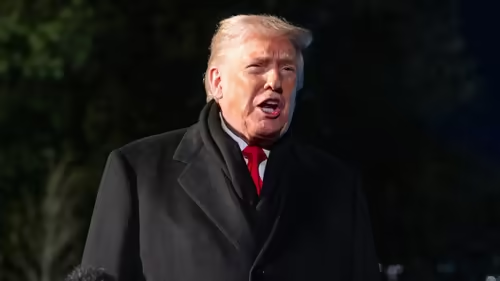
Donald Trump is once again at the center of a geopolitical firestorm—and this time, it’s over who he wants sitting at the table for world peace. In a recent statement that has baffled allies and alarmed critics, the former U.S. president defended his plan to invite Russian President Vladimir Putin to his proposed “Trump Board of Peace,” despite well-documented Russian threats regarding Greenland. The announcement comes amid growing intelligence reports that Moscow sees the Arctic island as a strategic prize, potentially destabilizing NATO’s northern flank. So why include a leader accused of undermining Western security in a forum meant to promote peace? Trump’s answer is as blunt as it is controversial: because he “gets the job done.”
Table of Contents
- The Controversial Invitation: Trump Defends Putin
- Russia’s Greenland Ambitions: A Real Strategic Threat?
- What Is the Trump Board of Peace?
- Why Putin? Analysts Weigh In on Trump’s Logic
- Impact on NATO and Transatlantic Unity
- Historical Context: Trump, Putin, and the Peace Rhetoric
- Conclusion: A Bold or Dangerous Gamble?
- Sources
The Controversial Invitation: Trump Defends Putin
When asked about the apparent contradiction—inviting a leader whose actions are seen as aggressive into a peace initiative—Trump didn’t flinch. “Look, I’m not inviting people because they’re popular with the press,” he said. “I’m inviting leaders who have influence, who get things done, even if they’re controversial.” He emphasized that the Trump Board of Peace would be a results-oriented forum, not a “diplomatic photo op.” This framing aligns with Trump’s long-standing transactional view of international relations, where power and leverage matter more than ideology .
Russia’s Greenland Ambitions: A Real Strategic Threat?
The timing of Trump’s comments is especially sensitive. Intelligence assessments from multiple NATO countries suggest that Russia has been actively exploring ways to increase its influence in Greenland, a self-governing territory of Denmark located strategically between North America and Europe . While Russia hasn’t made a formal territorial claim, its military buildup in the Arctic—including new icebreakers, air bases, and submarine patrols—has raised alarms in Washington and Copenhagen .
Analysts warn that a Russian foothold in Greenland could allow Moscow to monitor U.S. missile defenses, disrupt undersea communication cables, and project power deep into the North Atlantic. As one European security expert put it, “Greenland isn’t just ice—it’s the next front line in great-power competition” .
Key Concerns About Russian Activity Near Greenland
- Military Surveillance: Enhanced radar and signal intelligence capabilities targeting NORAD installations.
- Economic Leverage: Attempts to fund mining and infrastructure projects to gain political influence.
- Hybrid Warfare: Use of disinformation campaigns to stoke separatist sentiment or anti-Danish sentiment.
- NATO Vulnerability: Exploiting perceived gaps in alliance cohesion, especially among Nordic members.
What Is the Trump Board of Peace?
Though details remain sparse, Trump has described the Board of Peace as a high-level advisory group composed of the world’s most powerful leaders—regardless of their human rights records or geopolitical alignments. The goal, he claims, is to cut through bureaucratic red tape and broker real deals on issues like nuclear disarmament, counterterrorism, and trade . Critics argue it’s a vanity project that legitimizes authoritarian regimes, while supporters see it as a pragmatic alternative to what Trump calls “ineffective” multilateral institutions like the United Nations.
Why Putin? Analysts Weigh In on Trump’s Logic
Foreign policy experts are divided on Trump’s rationale. Some suggest it’s a continuation of his long-held belief that he can personally manage Putin—a notion that has repeatedly failed to materialize. Others see it as a deliberate provocation aimed at reasserting his “America First” brand ahead of the 2026 political cycle .
“Trump doesn’t see Putin as an adversary; he sees him as a counterpart who respects strength,” explains Dr. Elena Martinez, a senior fellow at the Brookings Institution . “But this ignores the fact that Putin’s definition of ‘peace’ often includes the expansion of Russian influence at the West’s expense.”
Impact on NATO and Transatlantic Unity
Perhaps the most significant consequence of this proposal is its potential to fracture NATO. The alliance has worked hard since 2014 to present a united front against Russian aggression. Trump’s willingness to elevate Putin in a peace forum—even a symbolic one—could be interpreted by Moscow as a sign of Western division, which analysts say is exactly what the Kremlin wants .
As one NATO diplomat anonymously told Reuters, “Every time a major Western figure treats Putin as a legitimate peacemaker while he’s threatening sovereign territory, it weakens our collective deterrence.” This dynamic plays directly into Russia’s strategy of weakening transatlantic bonds through political and informational warfare . [INTERNAL_LINK:us-russia-relations] [INTERNAL_LINK:nato-security-updates]
Historical Context: Trump, Putin, and the Peace Rhetoric
This isn’t the first time Trump has praised Putin or downplayed Russian aggression. From his infamous 2018 Helsinki summit to his repeated refusal to condemn Russian election interference, Trump has consistently framed Putin as a strong leader worthy of respect . His latest comments fit neatly into this pattern—but with higher stakes, given the current volatility in the Arctic and Eastern Europe.
Conclusion: A Bold or Dangerous Gamble?
The idea of a Trump Board of Peace may sound visionary to some, but in practice, it risks normalizing authoritarianism and undermining decades of diplomatic consensus. Inviting Putin—amid credible threats to Greenland and ongoing wars in Ukraine—doesn’t just blur moral lines; it could embolden adversaries and confuse allies. True peace, many argue, requires accountability, not just access. Whether this proposal remains a campaign talking point or evolves into a serious initiative, it has already succeeded in one thing: forcing the world to confront the uncomfortable question of who gets to define peace in the 21st century.
Sources
- Times of India. “Trump defends inviting Putin to Board of Peace despite Greenland ‘threat’…”
- CNN. “Trump pitches ‘Board of Peace’ with world leaders including Putin and Xi.”
- The Guardian. “Russia’s Arctic ambitions raise alarm in NATO over Greenland strategy.”
- BBC News. “Why is Russia so interested in the Arctic—and what does it mean for global security?”
- Foreign Policy. “Greenland Is the New Flashpoint in U.S.-Russia Rivalry.”
- Politico. “Trump’s Putin praise returns as 2026 speculation heats up.”
- Brookings Institution. “Understanding Trump’s enduring view of Vladimir Putin.”
- Reuters. “NATO diplomats express concern over Trump’s outreach to Putin.”
- RAND Corporation. “Russian Strategy to Undermine NATO Cohesion: An Assessment.”
- The New York Times. “A History of Trump’s Praise for Putin, From Helsinki to Now.”