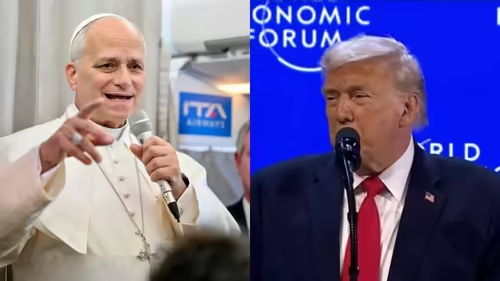
When Donald Trump announced his vision for a “Board of Peace”—a global council of world leaders, religious figures, and influencers aimed at resolving international conflicts—he didn’t just send out diplomatic notes. He went straight to the highest moral authority on Earth: Pope Francis. Now, the Vatican finds itself at the center of a high-stakes dilemma: should it accept an invitation to join the Trump Board of Peace, or risk appearing to endorse a deeply polarizing political project?
The Holy See has not said yes. It hasn’t said no, either. In a carefully worded statement, Cardinal Pietro Parolin, the Vatican’s Secretary of State, confirmed that the invitation is under serious review. “We are considering what to do,” he told reporters, adding that such a decision “requires time” . This cautious pause speaks volumes in a world where silence can be as loud as a declaration.
Table of Contents
- What Is Trump’s ‘Board of Peace’?
- The Pope’s Dilemma: Moral Authority vs. Political Risk
- Trump Board of Peace: Global Reactions and UN Concerns
- Historical Context: Popes and Political Initiatives
- Why Trump Wants the Pope on His Board
- Possible Outcomes: What Could the Vatican Do?
- Conclusion: Faith, Diplomacy, or Political Theater?
- Sources
What Is Trump’s ‘Board of Peace’?
Unveiled as part of Trump’s post-presidency global engagement strategy, the Trump Board of Peace is pitched as a non-governmental, high-level forum to mediate conflicts, promote dialogue, and “bring real peace to the world.” While details remain sparse, the initiative appears to position itself as an alternative—or perhaps a supplement—to traditional multilateral institutions like the United Nations.
Trump has claimed that several world leaders have already accepted invitations, though he has not named them publicly. The inclusion of religious leaders, especially Pope Francis, is clearly central to the board’s projected legitimacy. By associating with a figure revered by over a billion Catholics worldwide, the initiative seeks instant moral credibility.
The Pope’s Dilemma: Moral Authority vs. Political Risk
Pope Francis has consistently championed peace—from his historic mediation in the US-Cuba thaw to his vocal opposition to war in Ukraine and Gaza. His moral voice carries immense weight. But aligning with a Trump-led initiative is fraught with peril.
Trump’s tenure was marked by policies that often clashed with Catholic social teaching: family separations at the border, withdrawal from climate accords, and inflammatory rhetoric on immigration. For the Vatican to join his board could be seen as whitewashing those legacies. On the other hand, refusing might close a potential channel for genuine peacemaking. As Cardinal Parolin’s measured response shows, the Holy See is walking a tightrope [[INTERNAL_LINK:vatican-diplomacy-in-modern-conflicts]].
Trump Board of Peace: Global Reactions and UN Concerns
The international community is divided. Some nations, particularly those aligned with Trump’s foreign policy, have reportedly welcomed the idea. Others, however, are deeply skeptical. Diplomats from European and Global South countries have privately expressed concern that the board could undermine the United Nations’ role as the primary forum for conflict resolution.
“Creating parallel structures outside the UN framework risks fragmenting global diplomacy,” said one senior UN official, speaking on condition of anonymity. The fear is that the Trump Board of Peace could become a vehicle for selective intervention—addressing conflicts that serve specific political agendas while ignoring others.
Historical Context: Popes and Political Initiatives
The Vatican has a long history of engaging with global peace efforts—but always on its own terms. Pope John Paul II played a key role in ending communism in Eastern Europe. Pope Benedict XVI warned against the “dictatorship of relativism.” Pope Francis brokered the 2014 US-Cuba rapprochement.
Crucially, these interventions were never tied to a single political leader’s brand. The Holy See acts as a neutral, spiritual mediator—not a member of a partisan council. That precedent makes Trump’s invitation uniquely problematic. It’s not just about peace; it’s about branding.
Why Trump Wants the Pope on His Board
The answer is simple: legitimacy. In a post-presidency landscape where Trump is rebuilding his global image ahead of a potential 2028 run, the endorsement of Pope Francis would be a geopolitical masterstroke. It would signal to conservative Catholics, evangelical Christians, and global moderates that his peace initiative is not just political—but divinely sanctioned.
For Trump, the Pope isn’t just another invitee. He’s the ultimate validator. And that’s precisely why the Vatican is hesitating.
Possible Outcomes: What Could the Vatican Do?
Several paths lie ahead:
- Accept with conditions: The Vatican could join but insist on structural changes, transparency, and alignment with UN principles.
- Decline politely: A quiet “no” citing existing commitments, avoiding public confrontation.
- Propose an alternative: Suggest integrating the board’s goals into existing Vatican-led peace dialogues.
- Delay indefinitely: Continue “considering” until the initiative fades—a classic diplomatic stall.
Conclusion: Faith, Diplomacy, or Political Theater?
The invitation to the Pope is more than a gesture—it’s a test. For Trump, it’s a chance to cloak his ambitions in sacred legitimacy. For Pope Francis, it’s a moment to reaffirm that true peace cannot be branded, marketed, or monopolized by any one leader. The Vatican’s eventual decision on the Trump Board of Peace will reveal not just its stance on this initiative, but its vision for the role of faith in an increasingly fractured world.