Table of Contents
- The Davos Debut of Trump’s Board of Peace
- Why Was India Missing From the Stage?
- Pakistan on the Global Stage with Shehbaz Sharif
- Who’s In? The Countries Joining the Initiative
- Geopolitical Implications and Global Reactions
- Conclusion: A New Era of US-Led Diplomacy?
- Sources
The Davos Debut of Trump’s Board of Peace
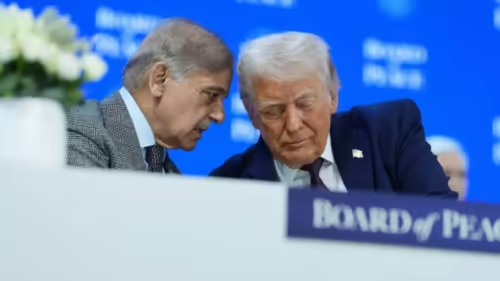
In a move that has sent ripples through the diplomatic world, former US President Donald Trump officially unveiled his much-anticipated Trump Board of Peace at the World Economic Forum in Davos on January 22, 2026 . The initiative, which comes with a hefty $1 billion price tag, is designed as a new international body to resolve global conflicts, with an initial focus on post-war Gaza . The signing ceremony, held amidst the snowy backdrop of the Swiss Alps, marked a significant moment in Trump’s second-term foreign policy agenda.
The Trump Board of Peace aims to be a coalition of nations working together to foster stability and reconstruction in conflict zones. While the concept has been met with both intrigue and skepticism, its launch was a high-profile event attended by several world leaders .
Why Was India Missing From the Stage?
One of the most striking aspects of the launch was the conspicuous absence of India, despite having received a formal invitation to join the initiative. According to multiple White House statements, India was among the dozens of countries invited to be a part of this US-led global body [[5], [8], [10]].
So, why wasn’t India on that stage in Davos? The answer appears to lie in a careful and cautious diplomatic calculus. Indian officials from the Ministry of External Affairs (MEA) have maintained a public silence, neither confirming acceptance nor outright rejection of the offer . Reports suggest that the Indian government is actively weighing its options, with any final decision requiring cabinet-level approval .
This strategic pause is likely driven by several factors. First, the initiative’s primary focus on Gaza presents a complex political landscape for India, which has historically balanced its relationships with both Israel and Palestine. Second, domestic political pressure, including from opposition parties who have urged the government not to join a board they believe doesn’t adequately respect Palestinian rights, adds another layer of complexity . For now, India seems to be opting for a wait-and-watch approach, a move that prioritizes its long-term strategic interests over immediate symbolic alignment .
Pakistan on the Global Stage with Shehbaz Sharif
In stark contrast to India’s absence, Pakistan’s Prime Minister Shehbaz Sharif was present in Davos and was notably featured on stage during the unveiling of the Trump Board of Peace. Sharif had arrived in Switzerland on January 21st to attend the WEF Annual Conference, which runs from January 19th to 23rd [[17], [18]]. His presence at such a high-profile US-led event is a significant diplomatic win for Pakistan, signaling a potential thaw or recalibration in its relationship with Washington.
Sharif’s participation included meetings with other global leaders, including the IMF’s Managing Director Kristalina Georgieva, underscoring Pakistan’s efforts to engage on both economic and political fronts at the forum . His prominent role in the Trump Board of Peace launch positions Pakistan as a key player in the new US diplomatic framework, a development that will undoubtedly be watched closely by its regional neighbors and rivals.
Who’s In? The Countries Joining the Initiative
The Trump Board of Peace has garnered a diverse, if somewhat controversial, coalition of nations. While around 60 countries were initially invited, approximately 35 have agreed to join so far . The list of confirmed members includes a mix of Middle Eastern, European, and Asian nations.
Here are some of the key countries that have publicly announced their participation:
- Saudi Arabia
- Turkey
- Egypt
- United Arab Emirates
- Israel
- Jordan
- Indonesia
- Hungary
- Canada
- Azerbaijan
- Kosovo
Notably, the inclusion of both traditional US allies and nations with more complex relationships with Washington, like Turkey and Belarus, highlights the broad and perhaps opportunistic nature of the coalition [[22], [24]]. This diverse membership is intended to lend the board a sense of global legitimacy, though it also raises questions about its internal cohesion and ability to reach consensus on contentious issues.
Geopolitical Implications and Global Reactions
The launch of the Trump Board of Peace is more than just a new diplomatic forum; it’s a clear signal of the United States’ intent to reassert its leadership in global conflict resolution under the Trump administration. By creating a parallel structure to existing international bodies like the UN, the US is effectively offering a new, American-centric model for peacekeeping and post-conflict reconstruction.
This move has already begun to divide the international community. Some nations see it as a pragmatic and well-funded alternative to often-stalled multilateral processes. Others, however, view it with suspicion, fearing it could undermine established international law and institutions. The fact that major powers like India are holding back their support only adds to the uncertainty surrounding the board’s long-term viability and influence.
For readers interested in the broader context of US foreign policy, our analysis on [INTERNAL_LINK:us-foreign-policy-under-trump-2026] provides deeper insights into this strategic shift.
Conclusion: A New Era of US-Led Diplomacy?
The unveiling of the Trump Board of Peace in Davos marks a bold, if untested, chapter in international diplomacy. The absence of India from the launch stage, despite its invitation, speaks volumes about the careful calculations sovereign nations must make when aligning with powerful but polarizing initiatives. Meanwhile, Pakistan’s visible participation, led by Shehbaz Sharif, signals a potential realignment in South Asian geopolitics. As more countries decide whether to formally join this new board, the world will be watching to see if this US-led vision for peace can translate into tangible results or if it will remain a symbolic gesture on the global stage.
Sources
- Times of India: Trump unveils ‘Board of Peace’: India absent from stage; Pak’s Shehbaz Sharif joins US Prez
- Sky News: What is Trump’s Board of Peace – and is it going to replace the UN?
- Reuters: Trump launches ‘Board of Peace’ with signing ceremony in Davos
- Dawn: PM arrives in Davos to attend World Economic Forum annual meeting
- Al Jazeera: Seven more countries agree to join Trump’s Board of Peace