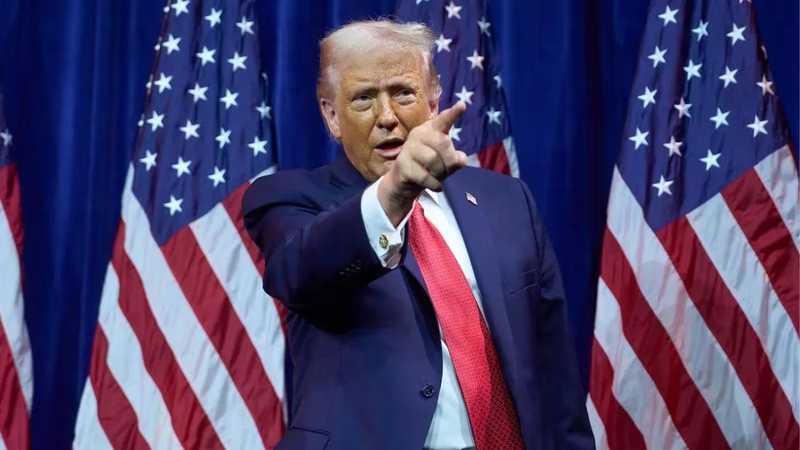
Donald Trump is back in the headlines with a characteristically bold and controversial foreign policy statement. In a recent declaration that has reignited debate across Washington and Europe, the former US president blasted NATO, claiming that its member nations only increased their defense spending after his direct intervention. He went even further, asserting that without America’s might, the alliance would be a paper tiger—insisting that “Russia and China only fear … the United States” . This isn’t just political rhetoric; it’s a sweeping re-interpretation of recent global security dynamics, one that positions Trump as the singular architect of Western military readiness.
Table of Contents
- Trump’s Bold Claims: A Breakdown
- What Trump Said: The Full Context
- NATO Spending: Truth or Exaggeration?
- Russia, China, and the US Military Deterrent
- Ukraine and Trump’s “Peace Through Strength” Narrative
- Global Reaction and Political Fallout
- Conclusion: Reshaping the Narrative of Global Power
- Sources
Trump’s Bold Claims: A Breakdown
Trump’s statement is a multi-pronged argument built on three key pillars:
- Financial Accountability: He claims he personally forced NATO allies to “pay their bills,” leading to a significant increase in their defense budgets.
- Strategic Deterrence: He argues that the US is the sole reason Russia and China respect NATO, implying the alliance is otherwise impotent.
- Global Peacemaker: He asserts that his actions “prevented Russia from taking all of Ukraine” and “ended numerous conflicts,” saving “millions of lives” .
These claims are designed to reinforce his long-standing “America First” foreign policy doctrine and position him as a uniquely effective global leader.
What Trump Said: The Full Context
Speaking with his typical bluntness, Trump stated, “They weren’t paying. I got them to pay… Billions and billions of dollars more.” He then directly linked this financial pressure to global power dynamics: “Russia and China, they only fear… the United States. They don’t fear NATO.” He framed his presidency as a period of unprecedented diplomatic success, where his tough stance supposedly averted large-scale wars . This narrative is central to his 2026 campaign messaging, painting his potential return to office as essential for global stability.
NATO Spending: Truth or Exaggeration?
While Trump’s claim about NATO spending has a kernel of truth, experts argue it’s a significant oversimplification. It’s accurate that many NATO members were not meeting the agreed-upon target of spending 2% of their GDP on defense before his presidency. During his term (2017-2021), there was a notable uptick in defense budgets across the alliance .
However, attributing this solely to Trump ignores other critical factors:
- The 2014 annexation of Crimea by Russia had already spurred European security concerns.
- The commitment to the 2% target was a collective NATO decision made in 2014, years before Trump took office.
- Many allies had already begun planning budget increases as part of their post-Crimea security reassessments .
So, while Trump’s public pressure may have accelerated the process, he was not the original catalyst.
Russia, China, and the US Military Deterrent
Trump’s assertion that “Russia and China only fear the United States” touches on a core truth of contemporary geopolitics: the US possesses the world’s most powerful military. Its nuclear arsenal, global network of bases, and advanced technological capabilities are unmatched. It is the primary security guarantor for its NATO allies and partners in the Indo-Pacific .
However, to dismiss NATO as irrelevant is a dangerous misreading. NATO is a force multiplier. The combined military, economic, and intelligence capabilities of its 32 member states create a formidable bloc that neither Russia nor China can easily challenge. The alliance provides a framework for joint operations, shared intelligence, and collective defense that amplifies American power rather than diminishing it .
Ukraine and Trump’s “Peace Through Strength” Narrative
Trump’s claim that his actions “prevented Russia from taking all of Ukraine” is perhaps his most historically dubious. During his presidency, Russia was already deeply entrenched in eastern Ukraine and had annexed Crimea. His administration did provide lethal aid to Ukraine, a policy continued and vastly expanded by the Biden administration after the full-scale invasion in 2022 .
His broader claim of having “ended numerous conflicts” and saving “millions of lives” is vague and unverifiable. While his administration brokered the Abraham Accords, which normalized relations between Israel and several Arab states, the claim of ending numerous conflicts and saving millions of lives is seen by many foreign policy experts as a significant exaggeration lacking concrete evidence .
Global Reaction and Political Fallout
Trump’s comments have been met with a mix of frustration and concern from traditional US allies in Europe. Many view his criticism of NATO as undermining a crucial pillar of the post-WWII international order that has kept the continent at peace for decades. It also raises questions about his commitment to the principle of collective defense, a cornerstone of the NATO treaty .
Domestically, the statement is a clear rallying cry for his base, reinforcing his image as a strong leader who puts America first. It sharpens the contrast with the current administration and sets the stage for a fierce foreign policy debate in the upcoming political cycle.
Conclusion: Reshaping the Narrative of Global Power
Donald Trump’s decision to blast NATO is more than just a criticism of an alliance; it’s a fundamental reframing of America’s role in the world. He is arguing for a transactional, America-centric view of global security, where alliances are judged solely on their immediate, measurable benefit to the US treasury. This stands in stark contrast to the traditional view of alliances as strategic, long-term investments in shared security and democratic values. Whether this narrative resonates with the American public in 2026 will have profound implications not just for US politics, but for the future of the entire Western security architecture. For a deeper dive into the evolving US role in global alliances, see our analysis on [INTERNAL_LINK:future-of-us-foreign-policy].
Sources
- Times of India: ‘Russia, China only fear …’: Trump blasts Nato; takes credit for pushing bloc to pay ‘bills’
- NATO Official Website: Defence Expenditure of NATO Countries (2023)
- Center for Strategic and International Studies (CSIS): NATO Defense Spending Analysis
- US Department of Defense: Global Force Posture
- Council on Foreign Relations (CFR): What is NATO?
- US Department of State: U.S. Relations With Ukraine
- Brookings Institution: Trump’s Foreign Policy Legacy
- Deutsche Welle (DW): Europe’s Response to Trump’s NATO Comments