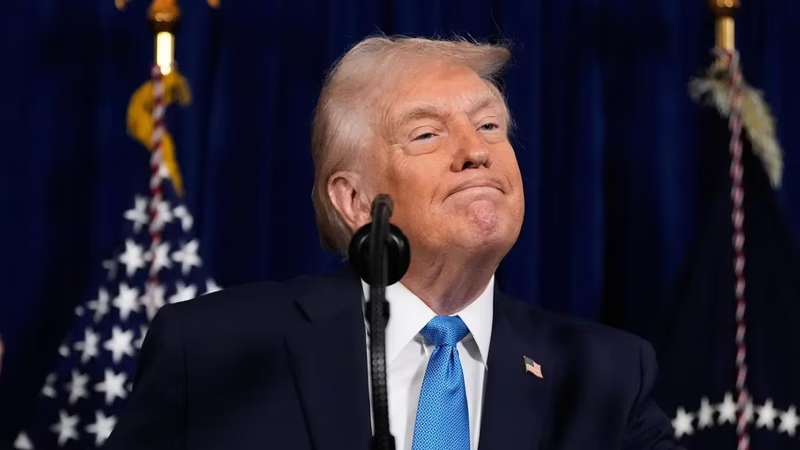
The American Dream of homeownership is slipping further out of reach for millions. As families struggle with record-high prices and interest rates, a familiar figure has returned with a dramatic solution: Donald Trump. His latest proposal? A sweeping ban on institutional investors from buying single-family homes. But is this a genuine fix for the US housing affordability crisis, or a politically charged oversimplification of a deeply complex problem?
Table of Contents
- Trump’s Bold Announcement: What Was Said?
- Who Are These Institutional Investors, Really?
- The Impact of Institutional Investors on the Housing Market
- Why Now? The Timing of Trump’s Policy Push
- The Feasibility and Potential Consequences
- Conclusion: Is This the Solution America Needs?
- Sources
Trump’s Bold Announcement: What Was Said?
In a move that sent shockwaves through the real estate and financial sectors, former President Donald Trump announced his intention to immediately ban large institutional investors from purchasing single-family homes. Framing his policy as a defense of the common citizen, Trump declared, “People live in homes, not corporations,” a line that has already begun to echo across social media and news cycles .
The announcement, made as he gears up for what is expected to be a fierce 2026 political climate, directly targets Wall Street firms and large private equity groups. He argues that these entities are not just participating in the market but are actively distorting it, using their vast capital to outbid hard-working families and convert potential owner-occupied homes into rental properties . This, he claims, is a primary driver behind the US housing affordability crisis that has left many Americans priced out of the market.
Who Are These Institutional Investors, Really?
The term “institutional investor” can sound monolithic, but the reality is more nuanced. It’s crucial to distinguish between a few major players and a broader, often misunderstood, segment of the market. Contrary to popular conspiracy theories, giant asset managers like BlackRock have publicly stated they are “not among the institutional investors buying single-family homes” for their core portfolios .
The real heavyweights in the single-family rental (SFR) space are specialized firms such as:
- Invitation Homes: The largest owner of single-family rental homes in the US.
- American Homes 4 Rent: A major REIT focused on acquiring and managing single-family properties.
- Pretium Partners: A private equity firm with a massive SFR portfolio through its Progress Residential brand.
While these firms are significant, their overall market share is often exaggerated. A study by the Joint Center for Housing Studies of Harvard University suggests their national footprint, while concentrated in certain Sun Belt markets, is far from dominant across the entire country .
The Impact of Institutional Investors on the Housing Market
So, what is the actual impact of corporate buyers on home prices? The research is mixed, painting a picture that’s far from black and white.
On one hand, a body of evidence suggests these large buyers can exert upward pressure on prices, particularly in the aftermath of a market shock like the 2008 financial crisis, where they bought up foreclosed properties en masse . Their ability to pay in cash and close deals quickly can indeed outcompete traditional buyers, especially first-timers .
On the other hand, other studies argue that the narrative is overblown. Some research indicates that institutional investment can actually increase the supply of rental housing and, in some cases, even lead to lower rents by adding liquidity to an otherwise under-supplied market . Their role, therefore, might be more of an amplifier of existing market trends rather than the sole creator of the affordability problem .
Why Now? The Timing of Trump’s Policy Push
The US housing market in 2026 remains a critical pain point for voters. Despite forecasts of a slight improvement, experts agree that affordability will be a major obstacle for most buyers, with home prices and mortgage rates staying stubbornly high . This creates a potent political issue.
Trump’s proposal is a masterclass in populist messaging. It identifies a clear villain (faceless corporations) and a simple, if drastic, solution (a ban). This approach resonates with a broad base of frustrated citizens who see their path to homeownership blocked. It’s a direct appeal to the economic anxieties that have defined much of his political career.
The Feasibility and Potential Consequences
While the idea is simple to state, its execution would be a legal and logistical nightmare. Defining what constitutes an “institutional investor” for the purposes of a ban would be fraught with challenges. Would it apply to a small LLC owned by a family? What about a real estate agent who owns a few rental properties? The potential for loopholes and unintended consequences is enormous.
Furthermore, such a ban could have significant negative repercussions:
- Reduced Rental Supply: A sudden exit of these large landlords could create a vacuum in the rental market, potentially leading to even higher rents for those who can’t or don’t want to buy .
- Market Instability: Forcing a major class of buyers out of the market could lead to a sharp, destabilizing correction in home prices in areas where they are most active.
- Legal Challenges: The policy would almost certainly face immediate and fierce legal challenges on the grounds of government overreach and potential violations of property rights.
Many housing economists argue that the real solution to the affordability crisis lies in addressing the fundamental issue of supply: a decades-long shortage of housing units. Policies that streamline zoning laws and incentivize new construction are often seen as more effective long-term strategies than simply banning a category of buyer [INTERNAL_LINK:us-housing-shortage-solutions].
Conclusion: Is This the Solution America Needs?
Trump’s proposal to ban institutional investors from the single-family home market is a powerful political statement that taps into a very real and widespread frustration. It’s a clear, easy-to-understand message in a complex world. However, as a practical policy solution, it appears to be a blunt instrument that fails to address the root causes of the housing crisis. While these corporate buyers may have played a role in inflating prices in specific markets, the primary driver remains a chronic shortage of homes. A comprehensive solution will require nuanced, multifaceted approaches that go far beyond a simple ban. For now, this proposal serves more as a campaign rallying cry than a viable blueprint for fixing the American housing market.
Sources
- Times of India: People live in homes, not corporations: Trump to ban large investors from buying single-family homes in US
- BlackRock: BlackRock and Housing: Setting the Record Straight
- Brookings Institution: Housing Affordability
- Joint Center for Housing Studies of Harvard University: Research on Institutional Investment
- US Department of Housing and Urban Development (HUD): Housing Choice Voucher Program