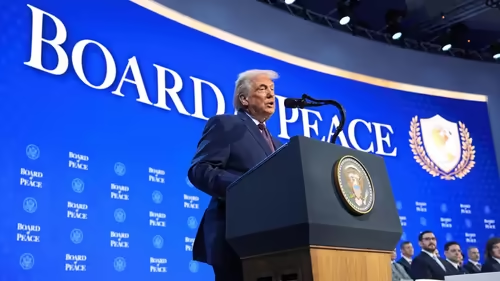
In a move that has sent shockwaves through international diplomatic circles, former U.S. President Donald Trump has officially withdrawn Canada’s invitation to his newly announced ‘Board of Peace.’ The decision comes on the heels of a powerful speech by Canadian Prime Minister Mark Carney, who publicly challenged the notion of unchecked American hegemony on the global stage . This isn’t just a snub; it’s a high-stakes geopolitical chess move with far-reaching implications for the future of Western alliances and the fragile peace process in Gaza.
Table of Contents
- The Davos Spark: Carney’s Challenge to US Hegemony
- What is Trump’s ‘Board of Peace’?
- The Diplomatic Rebuke: How Trump Responded
- Why This Diplomatic Spat Matters for Global Stability
- Conclusion: A New Era of Transactional Diplomacy?
- Sources
The Davos Spark: Carney’s Challenge to US Hegemony
The catalyst for this sudden diplomatic rift was Prime Minister Mark Carney’s address at the World Economic Forum in Davos. In a speech that was both measured and firm, Carney argued that the post-war international order cannot be sustained by a single nation’s dominance. He emphasized that true global stability and security are built on a foundation of mutual respect, multilateral cooperation, and a rules-based system—not on the unilateral dictates of a superpower . While he didn’t name the United States directly, the target of his message was unmistakable. His core argument was simple yet profound: Canada doesn’t live because of the US, but as an equal partner in a shared democratic project. This direct challenge to the concept of American exceptionalism appears to have been the final straw for the former president.
What is Trump’s ‘Board of Peace’?
Just days before the Davos summit, Donald Trump had unveiled his latest foreign policy initiative: the ‘Board of Peace.’ Positioned as a bold new framework to resolve the intractable conflict in Gaza, the board was touted as a vehicle for swift, decisive action, free from the bureaucratic inertia of traditional institutions like the United Nations . Trump, leveraging his self-proclaimed status as a master dealmaker, had personally invited a select group of world leaders, including PM Carney, to join this exclusive council. The Board of Peace was framed as a pragmatic, results-oriented alternative to decades of failed diplomacy. However, its sudden creation and the personal nature of the invitations raised questions about its legitimacy and long-term viability from the outset.
The Diplomatic Rebuke: How Trump Responded
Trump’s response to Carney’s speech was swift and public. In a characteristically blunt open letter posted on his Truth Social platform, he announced that the Board of Peace was “withdrawing its invitation” to the Canadian Prime Minister . The message was clear: participation in Trump’s initiatives is contingent on unwavering loyalty and public alignment with his worldview. There was no room for dissent or independent foreign policy, even from a close ally like Canada. This action transforms the Board of Peace from a proposed peace forum into a political litmus test, where membership is less about a commitment to peace and more about fealty to its founder. It’s a stark reminder of the transactional nature of diplomacy under Trump’s leadership.
Key Points of the Dispute
- The Trigger: PM Carney’s Davos speech criticizing the concept of a unipolar world dominated by one nation.
- The Action: Trump’s immediate and public revocation of Canada’s invitation to the Board of Peace .
- The Implication: A clear message that allies must offer public support or face exclusion from key initiatives.
Why This Diplomatic Spat Matters for Global Stability
This isn’t merely a personal feud between two leaders. The fallout has significant consequences for the broader international landscape.
First, it exposes a deep and growing fissure within the Western alliance. The traditional post-WWII consensus on liberal democracy and multilateralism is being actively challenged by a more nationalist, America-first ideology. Canada’s stance, under Carney, represents a defense of the old order, while Trump’s actions signal a definitive break from it.
Second, the credibility of the Gaza peace initiative itself is now in question. By making the Board of Peace a tool for political retribution, Trump undermines its potential as a neutral arbiter. If the board is seen as an extension of Trump’s personal agenda rather than a genuine peace effort, it will struggle to gain the trust of all parties involved in the conflict, particularly those who are already skeptical of U.S. motives.
Finally, this incident serves as a cautionary tale for other allied nations. It demonstrates that their relationship with a potential second-term Trump administration could be highly conditional, based on their willingness to publicly endorse his policies without reservation. This creates a climate of uncertainty that can paralyze collective action on critical global issues.
Conclusion: A New Era of Transactional Diplomacy?
The withdrawal of Canada’s invitation to the Board of Peace is a defining moment in modern diplomacy. It crystallizes the shift from a rules-based international system to one governed by personal relationships and political loyalty. While PM Carney stood on principle, defending a vision of a cooperative world order, Trump responded with a classic power play, using access to his pet project as a weapon. As we look ahead, the success of any future peace efforts, whether from Trump or others, will depend on their ability to transcend these personal dynamics and build genuine, inclusive coalitions. For now, the path to peace in Gaza appears to have just become a little more complicated. For more on the evolving dynamics of US foreign policy, see our analysis on [INTERNAL_LINK:us-foreign-policy-shifts].
Sources
- Times of India: After PM Carney says Canada doesn’t live because of US, Trump pulls Board of Peace invite
- Reuters: Trump disinvites Canada from Board of Peace after Carney’s Davos speech
- Council on Foreign Relations: Understanding the Rules-Based International Order