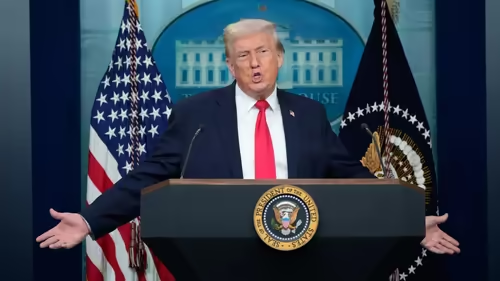
The world is holding its breath again. In a move that echoes the volatile rhetoric of his first term, President Donald Trump has declared that “another beautiful armada” is floating toward Iran. The statement, made at a rally in the midwestern United States, was both boastful and conciliatory: “I hope they make a deal,” he added [[5]]. This announcement has sent shockwaves through diplomatic channels and financial markets alike, as the already simmering **US-Iran tensions** threaten to boil over into a full-blown crisis.
But what does this “armada” actually consist of, and is Trump’s tough talk a genuine prelude to war or a high-stakes gambit to force Tehran back to the negotiating table? Let’s dive deep into the facts, the forces at play, and the potential fallout.
Table of Contents
- What Is Trump’s “Iran Armada”?
- Why Is the US Deploying Forces to Iran?
- Iran’s Response to US Military Threats
- Is Trump Bluffing or Is War Imminent?
- Conclusion: Navigating a Dangerous Standoff
- Sources
What Is Trump’s “Iran Armada”?
When Trump uses the term “beautiful armada,” he’s not just waxing poetic. He’s referring to a very real and potent show of American military might. According to defense reports, this deployment centers around the USS Abraham Lincoln carrier strike group [[9]]. This isn’t just a single ship; it’s a floating city of war, typically comprising:
- An aircraft carrier (the USS Abraham Lincoln)
- A guided-missile cruiser
- Several guided-missile destroyers
- A fast-attack submarine
- A supply ship
This strike group is a self-contained naval airbase capable of launching hundreds of sorties, providing a massive escalation in offensive and defensive capabilities in the region. It joins other recent US deployments, including Patriot and THAAD missile defense systems, which were announced just days before Trump’s statement [[8]]. This significant build-up transforms the Persian Gulf into one of the most heavily militarized zones on the planet.
Why Is the US Deploying Forces to Iran?
The official line from the White House is about “deterrence” and “protecting regional allies.” The administration points to a series of provocations from Iran and its proxies, including drone and missile attacks on shipping lanes and US bases in the region [[11]]. There’s also an underlying, unspoken goal: to create maximum pressure on Tehran.
By amassing such overwhelming force on Iran’s doorstep, the Trump administration is attempting to replicate the “maximum pressure” campaign of his first term. The logic is simple: make the cost of non-compliance so high that Iran has no choice but to negotiate a new, more comprehensive deal—one that addresses not just its nuclear program but also its ballistic missile development and regional activities. This strategy is a direct link to the secondary keyword, Trump Iran deal, as the military muscle is being used as leverage for diplomacy.
However, this approach is fraught with danger. [INTERNAL_LINK:history-of-us-iran-relations] shows that such overt displays of force have often led to miscalculation and escalation, not concession.
Iran’s Response to US Military Threats
Tehran is not backing down. In fact, its response has been swift and defiant. Iran’s Foreign Ministry has issued a stark warning, stating the country is “more prepared than ever” to deliver a “decisive response” to any attack [[17]]. They have explicitly stated that any US aggression would be treated as an “all-out war” [[18]].
This isn’t just empty rhetoric. Iran has spent years developing its own asymmetric warfare capabilities, designed specifically to counter a superior US naval force. Its arsenal includes:
- A vast fleet of fast-attack boats
- Thousands of short and medium-range ballistic missiles
- A sophisticated network of drones
- Naval mines to choke the Strait of Hormuz
Iran’s strategy is to make any potential conflict so costly and chaotic for the US and its allies that Washington would be deterred from initiating it in the first place. The message is clear: if you bring your armada, we will turn the Persian Gulf into a graveyard for your ships.
Is Trump Bluffing or Is War Imminent?
This is the multi-billion-dollar question. On one hand, Trump’s history suggests a preference for bluster over battle. His previous “armada” announcements often resulted in a de-escalation once the media cycle moved on. His repeated public statements that he “hopes” for a deal suggest that his primary goal is a diplomatic victory he can tout on the campaign trail [[3]].
On the other hand, the current military deployment is undeniably real and substantial. The arrival of the USS Abraham Lincoln strike group is a tangible escalation that goes beyond mere words [[13]]. The situation is further complicated by the fact that once these forces are in place, the risk of an accidental clash—a misidentified radar contact, a close-quarters naval encounter—increases exponentially. Such an incident could spiral out of control before either leader has a chance to pull back.
As the Institute for the Study of War notes, various members of Iran’s “Axis of Resistance” have also threatened retaliation, creating a complex web of actors where a single spark could ignite a regional conflagration [[11]]. The current standoff is arguably the most dangerous since the 2020 assassination of Qasem Soleimani.
Conclusion: Navigating a Dangerous Standoff
The phrase “Trump armada Iran” is more than a headline; it’s a symbol of a perilous moment in global geopolitics. While the President’s desire for a negotiated deal is a preferable outcome, his chosen method of achieving it—by parking a massive naval force off Iran’s coast—is an incredibly risky game of chicken. Iran, feeling cornered and humiliated, is unlikely to capitulate easily and has shown it is ready to fight. The world must now watch closely, hoping that cooler heads prevail and that this “beautiful armada” serves as a final push for peace, not the opening salvo of a devastating war.
Sources
- Al Jazeera. “Iran president tells Saudi crown prince that US threats cause instability.” January 27, 2026. [[5]]
- The Caspian Post. “US–Iran Standoff Enters Dangerous Phase With Carrier Deployment.” January 26, 2026. [[9]]
- Sunday Guardian Live. “US-Iran Tensions Rise as the US Deploys Patriot & THAAD Air Defenses in the Middle East.” January 26, 2026. [[8]]
- Institute for the Study of War. “Iran Update, January 26, 2026.” [[11]]
- Anadolu Agency. “Iran says ‘more prepared than ever’ to respond decisively as war clouds loom large.” January 27, 2026. [[17]]
- Times of India. “Iran reacts to ‘military build-up’ in Middle East; warns US of ‘all-out war’.” January 24, 2026. [[18]]
- The Jerusalem Post. “Donald Trump announces second US military armada.” January 28, 2026. [[3]]
- China Daily. “US aircraft carrier arrives in Middle East amid Iran tensions.” January 28, 2026. [[13]]