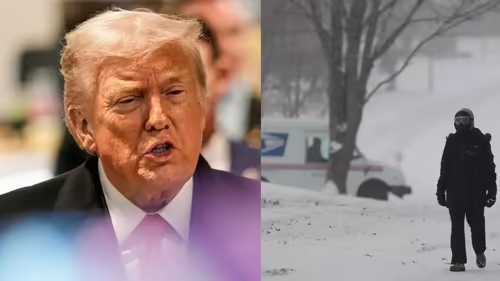
Trump Declares Emergency for 10 States Amid Historic US Winter Storm
A powerful winter storm has brought much of America’s heartland and East Coast to a standstill, dumping feet of snow and coating roads in treacherous ice. In response, Trump approves emergency declarations for ten states—mobilizing FEMA, the National Guard, and other federal agencies to assist with rescue operations, power restoration, and public safety.
Table of Contents
- What the Emergency Declaration Means
- Which States Are Affected?
- Impact on Travel and Daily Life
- Federal Response Coordination
- Climate Context and Future Preparedness
- Conclusion: A Nation in Freeze Mode
- Sources
What the Emergency Declaration Means
When a president issues an emergency declaration under the Stafford Act, it unlocks a suite of federal capabilities. This isn’t just symbolic—it’s a lifeline. The move allows the Federal Emergency Management Agency (FEMA) to coordinate directly with state and local officials, deploy personnel, provide equipment, and fund critical services like debris removal, emergency shelter, and medical support.
In this case, the declaration specifically authorizes the Department of Homeland Security and FEMA to pre-position assets before conditions worsen—a proactive strategy that can save lives when roads become impassable and communication lines fail.
Which States Are Affected?
The ten states currently under emergency declarations include:
- Ohio
- Indiana
- Kentucky
- Tennessee
- West Virginia
- Pennsylvania
- New York
- Michigan
- Missouri
- Illinois
These states are experiencing a mix of blizzard conditions, freezing rain, and wind chills plunging below -20°F. Power outages have already impacted over 800,000 households, with utility crews working around the clock in near-impossible conditions .
Impact on Travel and Daily Life
The storm’s timing—coinciding with peak weekend travel—has caused chaos across the transportation network. Major hubs like Chicago O’Hare, Detroit Metro, and Pittsburgh International have canceled more than 4,200 flights as of Sunday morning . Amtrak has suspended service on multiple routes, and interstate highways from I-75 to I-95 are partially closed due to whiteout conditions.
Schools, government offices, and businesses have shut down from St. Louis to Syracuse. Grocery stores report empty shelves as residents stock up on essentials, while hospitals are on high alert for cold-exposure emergencies and traffic-related injuries.
Federal Response Coordination
With Trump approves emergency declarations, the federal machinery has shifted into high gear. FEMA has activated its Regional Response Coordination Centers and is working alongside the Department of Energy to restore grid stability. The U.S. Army Corps of Engineers is on standby to assist with infrastructure damage, while the National Weather Service continues issuing life-threatening advisories.
Notably, the White House emphasized that all assistance is being provided “in full coordination with governors,” respecting state sovereignty while ensuring no community is left behind. This collaborative model has been critical in past disasters, from Hurricane Maria to the 2021 Texas freeze .
Climate Context and Future Preparedness
While individual storms can’t be directly attributed to climate change, scientists warn that warming Arctic temperatures are destabilizing the polar vortex—leading to more frequent and intense cold-air outbreaks in mid-latitude regions like the U.S. .
This raises urgent questions about infrastructure resilience. Many of the affected states still rely on aging power grids not designed for extreme ice loads. As [INTERNAL_LINK:climate-resilience-infrastructure] experts argue, reactive emergency declarations must be paired with long-term investment in weatherization and grid modernization.
Conclusion: A Nation in Freeze Mode
The decision to Trump approves emergency declarations reflects both immediate crisis management and the broader challenge of governing in an era of escalating climate volatility. While federal aid provides crucial short-term relief, the true test will be whether this event spurs systemic upgrades to protect vulnerable communities from the next inevitable storm. For now, millions remain hunkered down, waiting for the snow to stop—and for help to arrive.
Sources
- Times of India. “US winter storm: Donald Trump approves emergency declarations across multiple states.” https://timesofindia.indiatimes.com/world/us/us-winter-storm-donald-trump-approves-emergency-declarations-across-multiple-states/articleshow/127435037.cms
- Federal Aviation Administration (FAA). “Flight Delay and Cancellation Data – January 2026.” https://www.faa.gov
- FEMA. “Stafford Act Declarations.” https://www.fema.gov/disasters/stafford-act
- National Oceanic and Atmospheric Administration (NOAA). “Arctic Amplification and Mid-Latitude Weather.” https://www.noaa.gov