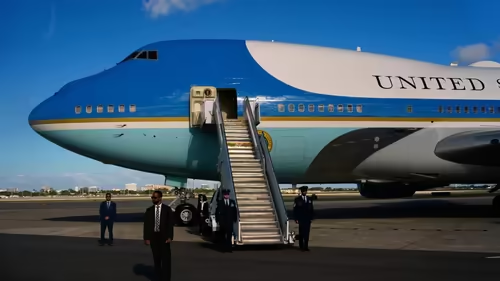
In a scene that felt ripped from a political thriller, the iconic blue-and-white aircraft carrying President Donald Trump was forced into an unexpected about-face on its way to the glitzy slopes of Davos. The world watched as Air Force One, the ultimate symbol of American power, turned around and headed back to Joint Base Andrews less than an hour after takeoff. But what exactly went wrong, and why is this seemingly minor event such a big deal?
Table of Contents
- The Mid-Air Emergency: What We Know
- Why a ‘Minor Issue’ Is a Major Deal for Air Force One
- The Impact on Trump’s Davos 2026 Agenda
- Air Force One Safety Protocols Explained
- Conclusion
- Sources
The Mid-Air Emergency: What We Know
The drama unfolded on the evening of January 20, 2026. President Trump had just boarded his VC-25A, the aircraft designated as Air Force One when the President is on board, bound for the World Economic Forum in Davos, Switzerland. However, the journey was abruptly halted when the crew identified a “minor electrical issue” during the flight .
Acting with extreme caution—a standard, non-negotiable protocol for any presidential transport—the decision was made to abort the mission and return immediately to Joint Base Andrews in Maryland. The White House later confirmed the incident, emphasizing that the President was never in any danger and that the move was purely out of an “abundance of caution” .
Within hours, the President and his delegation were transferred to a backup aircraft, another VC-25A from the fleet, to ensure his arrival in Davos with minimal delay. This seamless switch is a testament to the meticulous planning and redundancy built into the Presidential Airlift Group’s operations.
Why a ‘Minor Issue’ Is a Major Deal for Air Force One
To the average traveler, a “minor electrical issue” might mean a flickering cabin light or a malfunctioning seatback screen—annoying, but not a reason to turn the plane around. For Air Force One, however, the stakes are astronomically higher.
This isn’t just any airplane; it’s a flying command center, a mobile fortress equipped with advanced secure communications, anti-missile defenses, and the ability to refuel in mid-air. Every single system on board is critical to the safety and operational capability of the President of the United States. There is no room for ambiguity or risk.
The maintenance and safety standards for these aircraft are among the most rigorous in the world. They follow strict guidelines like those outlined in Air Force Instruction 21-101, which mandates comprehensive and proactive maintenance to ensure peak performance at all times . Even the smallest anomaly is treated as a potential major threat, triggering an immediate and thorough response. This zero-tolerance policy for mechanical uncertainty is what makes the U.S. presidential air transport system the gold standard for global leaders.
The Impact on Trump’s Davos 2026 Agenda
Despite the mid-air scare, the logistical machine of the White House ensured that President Trump’s high-stakes appearance at the World Economic Forum Annual Meeting 2026 was not derailed. The event, running from January 19-23 in Davos-Klosters, Switzerland, is a key platform for global leaders to shape economic and political discourse .
Trump’s speech, scheduled for January 21, 2026, as a special session, remains a central fixture on the agenda . His attendance is particularly significant as it marks his first in-person appearance at the forum since 2020, coming at a time of complex international relations . The brief delay caused by the aircraft swap is unlikely to have any tangible impact on his planned meetings or his address to the global elite. If anything, the incident has added a layer of dramatic intrigue to his arrival, a narrative he is known to masterfully navigate.
Air Force One Safety Protocols Explained
The swift and decisive action taken on January 20th is a perfect case study in the extraordinary safety culture surrounding the President’s travel. Here’s a breakdown of the key principles at play:
- Redundancy is King: The Air Force maintains multiple VC-25A aircraft. A backup is always ready to deploy, ensuring continuity of the mission is never compromised.
- Abundance of Caution: This is the official mantra. Any technical irregularity, no matter how small it may seem, is grounds for immediate action. The priority is absolute safety, not schedule adherence.
- Rigorous Maintenance: These aircraft undergo constant, intensive maintenance. As noted in various Air Force manuals, they are subject to preventative maintenance schedules that far exceed commercial aviation standards, designed to catch potential issues before they become problems .
- Elite Crew Training: The pilots and crew of Air Force One are among the most experienced and highly trained in the U.S. Air Force, prepared for every conceivable scenario.
This entire ecosystem of protocols exists to guarantee one thing: the President’s safety is never left to chance. The U-turn wasn’t a sign of failure; it was a successful execution of a flawless safety plan.
Conclusion
The unexpected U-turn of President Trump’s Air Force One was a powerful reminder of the immense responsibility and sophisticated systems that protect the leader of the free world. While the cause—a minor electrical issue—was technically simple, the response was a complex, well-rehearsed ballet of security, logistics, and unwavering caution. The incident caused a brief stir but ultimately served as a demonstration of the robust safety net that ensures the President can fulfill his duties, even from 35,000 feet in the air. His mission to Davos continues, backed by the full might and precision of the United States Air Force.
Sources
- Times of India: Trump’s plane makes U-turn: US President’s flight to Davos returns midair — what went wrong?
- Associated Press Report on Air Force One Incident
- Air Force Instruction 21-101: Aircraft and Equipment Maintenance Management
- World Economic Forum Official Site: Annual Meeting 2026
- [INTERNAL_LINK:world-economic-forum-davos-2026-key-takeaways]
- [INTERNAL_LINK:history-of-air-force-one-presidential-aircraft]