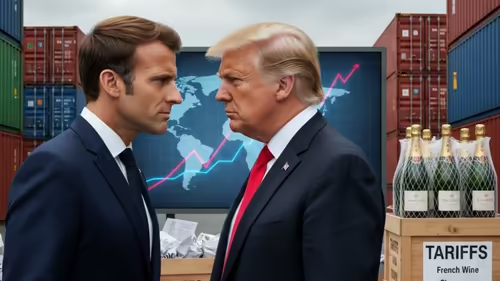
In a stunning display of political brinkmanship, former U.S. President Donald Trump has reignited transatlantic tensions with a bombshell threat: a staggering 200% tariff on French goods. The catalyst? A perceived snub from French President Emmanuel Macron over Trump’s proposed ‘Board of Peace’ initiative. This isn’t just a trade dispute; it’s a high-stakes game of geopolitical chess played out in public texts and economic threats.
Table of Contents
- The ‘Board of Peace’ Snub That Sparked the Crisis
- Trump’s 200% Tariff Threat: What It Means
- The Unprecedented Leak of Private Diplomacy
- Historical Context: Trump’s Legacy of Trade Wars
- Global Economic Implications and Market Reactions
- Conclusion: A New Era of Personalized, Volatile Diplomacy?
- Sources
The ‘Board of Peace’ Snub That Sparked the Crisis
The core of this international spat revolves around an initiative Trump has been championing: the ‘Board of Peace.’ While details remain somewhat vague, it appears to be a forum or agreement Trump hoped to establish, likely during a major international summit like Davos. President Macron’s apparent reluctance to join this initiative was interpreted by Trump not as a policy disagreement, but as a personal insult—a direct snub . This perception of disrespect is a well-known trigger for the former president, who often blends personal and political grievances in his foreign policy approach.
Trump’s 200% Tariff Threat: What It Means
The Trump 200% tariff threat is a deliberate escalation far beyond typical trade measures. Standard tariffs are usually in the single or low double digits. A 200% duty would effectively double the price of targeted French exports, making them prohibitively expensive for American consumers. The primary targets are widely understood to be iconic French luxury goods, specifically French wine and champagne . These products are not just commodities; they are symbols of French culture and significant contributors to its economy. Such a move would be a direct assault on a key French industry, designed to inflict maximum economic and symbolic pain.
Why Wine and Champagne?
Targeting these specific items is a strategic choice. They are politically sensitive in France, representing a powerful agricultural lobby. In the U.S., they are popular among a consumer base that may not align with Trump’s core supporters, thus minimizing domestic political fallout. This precision strike is a hallmark of Trump’s transactional view of international relations, where economic leverage is the primary tool of diplomacy.
The Unprecedented Leak of Private Diplomacy
Perhaps even more damaging than the tariff threat itself is Trump’s decision to make public a private text message exchange with President Macron. By sharing this confidential communication, Trump has shattered long-standing norms of diplomatic discretion . This act serves two purposes: it publicly shames Macron, framing him as uncooperative on the world stage, and it demonstrates Trump’s willingness to weaponize personal communications for political gain. The leak transforms a private disagreement into a global spectacle, forcing Macron into a defensive position and complicating future diplomatic channels between the two nations.
Historical Context: Trump’s Legacy of Trade Wars
This incident is not an isolated event but a continuation of a well-established pattern from Trump’s first term. His administration was defined by its aggressive use of tariffs as a primary foreign policy instrument, most notably in the protracted trade war with China. The “America First” doctrine prioritized bilateral deals and used the threat of economic sanctions to extract concessions. The current Trump France trade war threat fits neatly into this playbook, suggesting that a potential second term would see a return to these confrontational tactics, not just with strategic rivals but with traditional allies like those in the European Union.
Global Economic Implications and Market Reactions
A 200% tariff on French goods would have ripple effects far beyond the US-France relationship. It could trigger a broader trade conflict with the European Union, which would likely retaliate with its own tariffs on American products. This scenario would create significant uncertainty in global markets, disrupt established supply chains, and potentially contribute to inflationary pressures on both sides of the Atlantic. Investors are already wary of a second Trump term due to the prospect of renewed trade volatility, and this latest threat is a stark reminder of that risk. For businesses engaged in transatlantic trade, this represents a major source of strategic uncertainty that could impact investment decisions for years to come.
Conclusion: A New Era of Personalized, Volatile Diplomacy?
The Trump 200% tariff threat over the ‘Board of Peace’ snub is a potent symbol of a new, more volatile style of international relations. It underscores a shift away from multilateral institutions and quiet diplomacy towards a model driven by personal relationships, public ultimatums, and economic coercion. Whether this is a negotiating tactic or a genuine policy intention, it has successfully placed the issue at the center of the political discourse. For France, the EU, and the global trading system, it serves as a clear warning of the potential turbulence ahead. As we navigate an increasingly fragmented world order, the lessons from this episode will be crucial for understanding the future of global diplomacy. For more on how trade policies affect global markets, see our deep dive on [INTERNAL_LINK:global-trade-war-impacts].