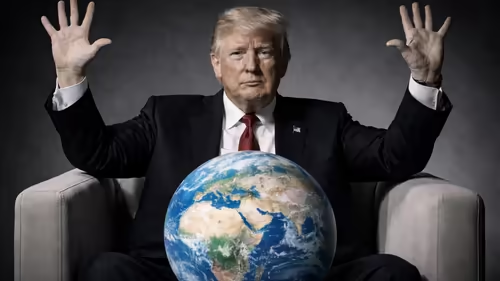
The world is holding its breath as Trump 2.0 takes the reins in Washington. For many nations, this signals a return to unpredictable, transactional diplomacy. But in New Delhi, the mood is less panic and more calculated pragmatism. India isn’t just reacting to the new American reality; it’s actively shaping its own path through it. The question on everyone’s mind is: has India truly figured out the art of dealing with a second Trump presidency?
Table of Contents
- The Trump 2.0 Challenge for India
- India’s Two-Pronged Strategy: Hedge and Engage
- The Delicate Trade Tango
- Defense Ties: A Shared Interest
- The Bigger Picture: China and Strategic Autonomy
- Conclusion: Navigating the Trump 2.0 Era
- Sources
The Trump 2.0 Challenge for India
Donald Trump’s return to the White House brings a familiar yet amplified set of challenges for India. His “America First” doctrine is expected to be even more pronounced, potentially leading to aggressive trade policies, demands for defense burden-sharing, and a transactional approach to alliances [[12]]. Unlike some allies who are bracing for impact, India entered 2025 with a surprising degree of optimism, viewing a second Trump term as an opportunity for a more direct, deal-making style of engagement [[15]]. However, this optimism has been tempered by early signs of friction, reminding New Delhi that the relationship will be anything but steady [[11]].
India’s Two-Pronged Strategy: Hedge and Engage
India’s response to Trump 2.0 is a masterclass in strategic hedging. It’s a dual-track approach that balances public cooperation with private contingency planning. On one hand, India is keen to keep high-level communication channels open, recognizing the institutional resilience that has sustained the partnership through previous turbulence [[2]]. On the other, it is quietly diversifying its partnerships and reinforcing its own strategic autonomy to avoid over-reliance on a single, volatile partner [[14]].
This strategy manifests in several key ways:
- Public Diplomacy: Maintaining a positive and respectful public tone, avoiding the kind of confrontational rhetoric that can trigger a Trump backlash.
- Private Fortification: Accelerating efforts to build domestic manufacturing capabilities (Atmanirbhar Bharat) and deepening ties with other global powers like the EU, Russia, and even exploring new avenues in the Global South [[1]].
- Institutional Anchoring: Leaning on the strong foundation of defense and security dialogues that have been built over the past two decades, which are less susceptible to political whims [[6]].
The Delicate Trade Tango
Trade is the most likely flashpoint in the India-US relationship under Trump 2.0. The former president has long criticized India’s trade barriers and has threatened steep tariffs. Early reports from his second term already point to renewed tensions over market access and tariffs, with some analysts noting a souring of relations on this front [[12]].
India’s counter-move is to position itself not just as a market, but as a critical alternative manufacturing hub in a de-risking global economy. By championing its role in resilient supply chains, India aims to shift the conversation from a zero-sum trade deficit to a mutually beneficial economic partnership. This is a high-stakes gamble, but one that aligns with its long-term economic vision.
Defense Ties: A Shared Interest
Despite the commercial headwinds, the defense and security pillar of the relationship remains a powerful anchor. Both nations share a deep, structural concern about China’s rise, which continues to underpin their strategic alignment [[6]]. The Major Defense Partnership status is a testament to this shared interest.
While Trump may demand more financial contributions, the shared threat perception makes this a domain where cooperation is not just convenient but essential for both parties. India is likely to leverage this common ground to manage disagreements in other areas, using defense collaboration as a stabilizing force in the overall relationship.
The Bigger Picture: China and Strategic Autonomy
Ultimately, India’s entire strategy towards Trump 2.0 is filtered through the lens of its primary geopolitical challenge: China. A strong, if sometimes difficult, partnership with the US is a key element of India’s strategy to counterbalance Beijing’s influence in the Indo-Pacific [[6]].
However, India is fiercely protective of its strategic autonomy. It will not allow its partnership with the US to dictate its independent foreign policy choices, such as its continued engagement with Russia or its leadership ambitions in the Global South. The goal is to extract maximum benefit from the US relationship without becoming a formal ally or a junior partner—a delicate balance that defines India’s unique place in the world order [[4]].
Conclusion: Navigating the Trump 2.0 Era
India hasn’t just “figured out” how to deal with Trump 2.0; it’s playing a sophisticated, long-game strategy. By publicly playing along and privately planning ahead, New Delhi is attempting to navigate the stormy waters of a second Trump term without capsizing its own national interests. The relationship will be tested repeatedly—on trade, on technology, and on global alignments—but India’s commitment to its strategic autonomy and its focus on the China challenge provide a clear compass. The success of this balancing act will be a defining feature of Indian foreign policy in the coming years.
Sources
- Gateway House: 2026: India’s foreign policy challenges [[1]]
- Vivekananda International Foundation: One Year of Trump 2.0; The Future of India – US Major Defence Partnership [[2]]
- East Asia Forum: Strained India–US relations under Trump 2.0 test India’s strategic autonomy [[12]]
- CIDOB: Why India Is Confident vis-à-vis Trump 2.0 [[14]]
- Global Affairs: How Trump Changed India’s Relationship with the US [[15]]
- RSIS: India–US Relations: Shifts and Continuity under Trump 2.0 [[6]]