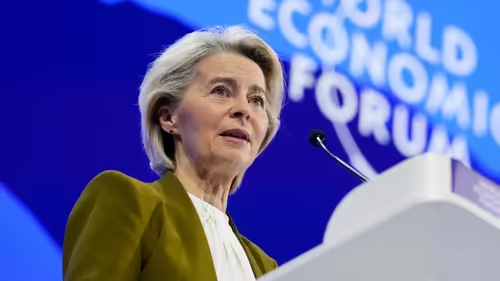
In a dramatic escalation of transatlantic tensions, former U.S. President Donald Trump has reignited controversy by threatening to impose 100% tariffs on European goods—this time over an unexpected flashpoint: Greenland. The icy Arctic territory, an autonomous part of the Kingdom of Denmark, has become the unlikely center of a geopolitical storm. But Europe isn’t backing down. European Commission President Ursula von der Leyen delivered a firm rebuttal: “A deal is a deal.” Her message was clear—punitive trade measures over territorial ambitions won’t be tolerated, and could severely damage one of the world’s most critical economic partnerships.
Table of Contents
- Why Is Greenland Suddenly a Geopolitical Flashpoint?
- What Exactly Is the Trump 100% Tariff Threat?
- EU’s Forceful Pushback: Von der Leyen’s ‘A Deal Is a Deal’ Doctrine
- Historical Context: Trump’s Obsession with Greenland
- Potential Economic Fallout for the US and EU
- Europe’s Countermove: Investment and Arctic Security Cooperation
- Conclusion: A Test of Rules-Based Order vs. Transactional Diplomacy
- Sources
Why Is Greenland Suddenly a Geopolitical Flashpoint?
Greenland may seem like an odd catalyst for a trade war, but its strategic value is immense. Rich in rare earth minerals essential for clean energy tech and defense systems, and positioned at the crossroads of Arctic shipping routes, the island is a linchpin in 21st-century geopolitics. While Denmark handles Greenland’s foreign policy and defense, the territory enjoys broad autonomy—and has repeatedly rejected any notion of being “for sale.” Trump’s renewed interest appears less about diplomacy and more about asserting American influence in a region where Russia and China are also expanding their footprint.
What Exactly Is the Trump 100% Tariff Threat?
The Trump 100% tariff threat is a blunt economic weapon aimed at pressuring the European Union—specifically Denmark and its allies—over Greenland. By proposing to double the price of key European exports like automobiles, pharmaceuticals, and luxury goods, Trump seeks to coerce political concessions. This isn’t just protectionism; it’s economic coercion tied to territorial ambition. Experts warn that such a move would violate World Trade Organization (WTO) norms and undermine decades of carefully negotiated trade frameworks between the U.S. and EU.
Targeted Sectors
- German and French automobiles
- Danish dairy and agricultural products
- Italian fashion and luxury goods
- European green technology exports
EU’s Forceful Pushback: Von der Leyen’s ‘A Deal Is a Deal’ Doctrine
Ursula von der Leyen didn’t mince words. In a strongly worded statement, she declared that using tariffs as leverage over sovereign matters like Greenland’s status is “a mistake” that risks long-term trust. “A deal is a deal,” she emphasized—a direct echo of Trump’s own past rhetoric, now turned against him. Her stance reflects a broader EU strategy: uphold the rules-based international order, honor existing agreements like the EU-U.S. Trade and Technology Council (TTC) framework, and resist transactional bullying. The EU is signaling that economic partnerships cannot be held hostage to unilateral geopolitical fantasies.
Historical Context: Trump’s Obsession with Greenland
This isn’t the first time Trump has fixated on Greenland. In 2019, during his presidency, he openly mused about purchasing the island, calling it a “large real estate deal.” When Denmark dismissed the idea as absurd, Trump canceled a state visit in protest. Now, in early 2026, with another presidential run looming, he’s reviving the narrative—not to buy Greenland, but to pressure Europe into accepting greater U.S. influence there. Critics argue this reflects a pattern: using trade as a cudgel to achieve foreign policy goals that diplomacy alone cannot secure.
Potential Economic Fallout for the US and EU
A 100% tariff would trigger immediate retaliation. The EU has a robust anti-coercion instrument designed precisely for such scenarios. American exporters—from Boeing to bourbon producers—could face counter-tariffs, hurting rural and industrial heartlands. More broadly, investor confidence in U.S.-EU economic stability could wane, disrupting supply chains already fragile from post-pandemic adjustments. According to the Peterson Institute for International Economics, a full-blown transatlantic trade war could cost both economies tens of billions in GDP losses within a year .
Europe’s Countermove: Investment and Arctic Security Cooperation
Instead of escalating, the EU is offering a constructive alternative. Von der Leyen proposed increased European investment in Arctic infrastructure, scientific research, and climate resilience—all while deepening security cooperation with NATO allies, including the U.S. The message? We’re open to partnership, but not coercion. This approach aligns with the EU’s 2021 Arctic Policy, which emphasizes sustainability, indigenous rights, and multilateral governance over militarization or resource grabs.
Conclusion: A Test of Rules-Based Order vs. Transactional Diplomacy
The Trump 100% tariff threat over Greenland is more than a trade spat—it’s a litmus test for the future of international relations. Will global order be governed by mutual agreements and institutions, or by the whims of powerful leaders wielding economic weapons? Von der Leyen’s firm stance shows Europe is choosing the former. For businesses, investors, and citizens on both sides of the Atlantic, the stakes couldn’t be higher. As we head into a volatile election year, this clash may foreshadow a much larger battle over the soul of Western alliances. Stay informed with our [INTERNAL_LINK:us-eu-trade-relations-2026] coverage for ongoing analysis.