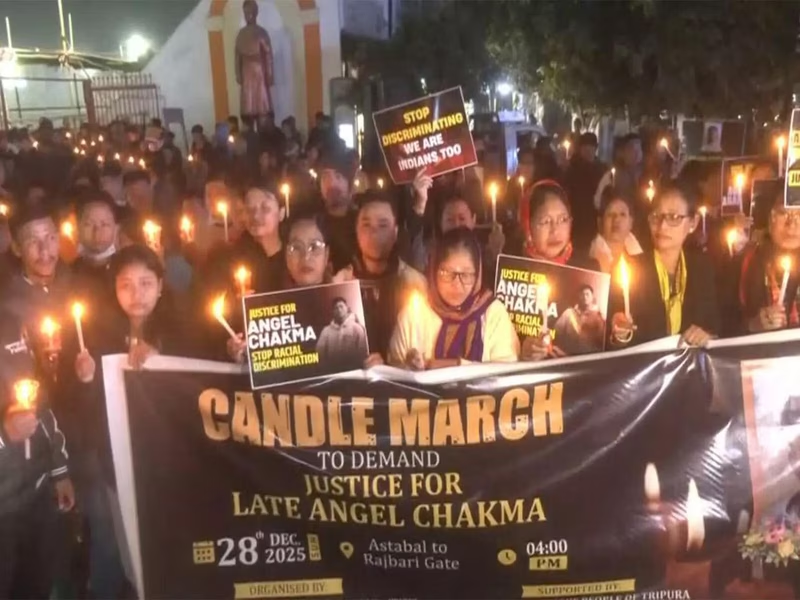
In a case that has reignited national debate over racial bias and justice for Northeast Indians, the family of a 22-year-old man from Tripura has firmly rejected the Uttarakhand police’s early assertion that his brutal killing had “no racial motive.” The incident—occurring in Dehradun on December 30, 2025—has sparked outrage across the Northeast and among civil rights groups, who warn that dismissing racism so hastily could derail the truth and deny a grieving family closure.
Table of Contents
- What Happened: The Tripura Youth Killing
- Police Claim ‘No Racism’—Family Calls It Premature
- A Pattern of Prejudice: Northeast Indians in Mainland India
- Legal and Social Implications of the Case
- What Needs to Happen Next
- Conclusion
- Sources
What Happened: The Tripura Youth Killing
On the night of December 30, 2025, in Dehradun, Uttarakhand, a group altercation outside a local eatery turned fatal for a young man from Tripura. According to eyewitnesses and initial reports, the victim—identified as 22-year-old Manik Debbarma—was allegedly targeted with racial slurs before being attacked by multiple individuals. He was rushed to a hospital but succumbed to his injuries shortly after.
Within hours, the Uttarakhand Police confirmed the incident and arrested three suspects. However, in their first official statement, authorities declared there was “no indication of racial motivation” behind the assault—a conclusion that drew immediate skepticism. The family, still in shock, traveled from Agartala to identify the body and demand answers. They were met not with empathy, they say, but with a rushed and dismissive narrative.
Police Claim ‘No Racism’—Family Calls It Premature
“It’s only been a day. How can they say there’s no racism without even speaking to his friends, without examining the context?” asked Manik’s elder sister, visibly distraught in a televised interview. The family has labeled the police’s early declaration as not just premature but dangerously insensitive.
They point to a pattern: Northeasterners in North Indian cities often face microaggressions, name-calling, and even physical violence based on their distinct physical features. Manik, who had recently moved to Dehradun for vocational training, had previously confided in his family about feeling “unwelcome” due to his appearance—a detail they say investigators have ignored. For them, the Tripura youth killing is not an isolated brawl but a symptom of deeper societal prejudice.
A Pattern of Prejudice: Northeast Indians in Mainland India
This is not the first time a student or professional from India’s Northeast has faced hostility in urban centers like Delhi, Bengaluru, or Dehradun. High-profile cases—such as the 2012 attack on Nido Taniam in Delhi or the 2014 assault on African nationals in Greater Noida—have highlighted systemic discrimination that Northeast communities endure.
According to a 2020 report by the North East Support Centre & Helpline, over 70% of Northeastern students in metropolitan Indian cities reported experiencing some form of racial abuse during their stay. While the Indian Constitution guarantees equality under Article 14, enforcement and social integration remain major gaps.
Organizations like the North East Students’ Organisation (NESO) have been vocal, urging the central government to implement the recommendations of the Bezbaruah Committee—which was formed after the 2014 Meghalaya student attacks to address racial crimes. Yet, many of its key suggestions, including fast-track courts and dedicated police cells, remain unimplemented [[INTERNAL_LINK:northeast-india-racism-solutions]].
Legal and Social Implications of the Case
The police’s early dismissal of racism in the Tripura youth killing carries serious legal consequences. If racial motivation is ignored, the case may be treated as a standard assault or murder, potentially missing the hate crime dimension that warrants stricter punishment and broader societal accountability.
Currently, India does not have a standalone “hate crime” law, though provisions under the Indian Penal Code (IPC)—such as Sections 153A (promoting enmity) and 509 (word/gesture intended to insult)—can be invoked in cases of racial abuse. However, these are rarely applied consistently, especially outside the Northeast.
Human rights advocates argue that this case must be investigated with full sensitivity. “Dismissing racism as a factor without thorough inquiry perpetuates impunity,” said Anjali D’souza, a legal expert with the Commonwealth Human Rights Initiative .
What Needs to Happen Next
To restore public trust and ensure justice, several steps are essential:
- Independent Probe: The case should be reviewed by a special investigation team (SIT) or handed over to the National Investigation Agency (NIA) to eliminate potential local bias.
- Witness Protection: Friends and eyewitnesses—many of whom are also from the Northeast—must be protected to encourage truthful testimony.
- Community Dialogue: Uttarakhand authorities should initiate outreach programs with Northeast student associations to address systemic distrust.
- Policy Action: The central government must finally enact the long-pending anti-racial discrimination law recommended by the Bezbaruah Committee.
Conclusion
The tragic Tripura youth killing is more than a crime—it’s a mirror reflecting India’s unresolved struggle with internal diversity and inclusion. While the police may claim neutrality, families and communities rightly demand thoroughness, not haste. As the nation watches, this case could become a turning point: either a missed opportunity for reform or a catalyst for real change in how racial violence is recognized and addressed in India.