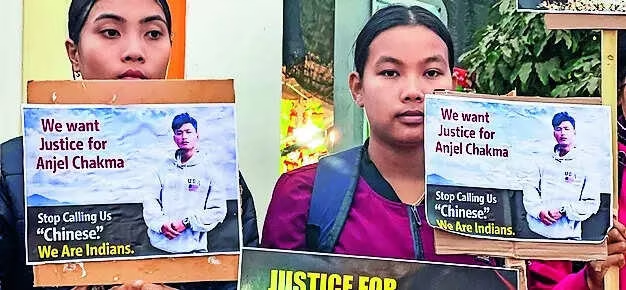
“You’ve done enough for us, Dad. Now take VRS.”
These were the last words 24-year-old Anjel Chakma shared with his father over the phone—just days after landing his first government job in Uttarakhand. Full of hope, responsibility, and filial love, he wanted his retired schoolteacher father to rest easy, knowing his son had finally secured a stable future.
But that future was cruelly cut short. On December 28, 2025, Anjel was fatally injured in a road accident in Dehradun while commuting to his new workplace. His story—equal parts inspiring and heartbreaking—has since resonated across India, especially among families in the Northeast who send their children far from home in search of opportunity .
This is not just a tale of personal loss. It’s a mirror to the dreams, risks, and systemic gaps faced by thousands of young job-seekers from marginalized regions. In this article, we honor Anjel’s journey, unpack the broader context, and examine what must change to protect others like him.
Table of Contents
- Who Was Anjel Chakma?
- The Final Call: ‘Take VRS, Dad’
- The Accident That Cut a Dream Short
- Why So Many Northeastern Youth Head North for Jobs
- Safety, Bias, and Isolation: Hidden Risks for Northeast Students
- The Long Road to a Government Job
- What Can Be Done to Protect Young Job Seekers?
- Conclusion: A Son’s Promise, A Nation’s Wake-Up Call
- Sources
Who Was Anjel Chakma?
Anjel hailed from a modest family in Simna, Tripura. His father, a retired primary school teacher, had spent his life ensuring his children received a good education—often making ends meet through frugal living and extra tutoring. Anjel, the eldest son, carried that legacy forward with quiet determination.
After earning a bachelor’s degree in political science, he prepared relentlessly for competitive exams. His perseverance paid off when he cleared the Uttarakhand Public Service Commission (UKPSC) exam for a lower division clerk (LDC) post—a coveted entry-level government position that promised stability and dignity .
For families in Tripura, where unemployment hovers near 15%, a government job isn’t just employment—it’s a lifeline.
The Final Call: ‘Take VRS, Dad’
Just days before his death, Anjel called his father with excitement in his voice. “I’ve joined my office, Dad. You’ve sacrificed so much. Please take VRS [Voluntary Retirement Scheme] now. I’ll take care of everything,” he said, according to family members .
His father, overwhelmed with pride, shared the conversation with relatives. In tribal and rural communities across Northeast India, a child’s success is seen as the family’s collective triumph. Anjel wasn’t just working for himself—he was repaying a lifetime of parental struggle.
The Accident That Cut a Dream Short
On the morning of December 28, Anjel was riding a rented scooter to his office in Dehradun when a speeding truck collided with him near Patel Nagar. Despite immediate medical attention, he succumbed to severe head injuries at a local hospital .
Local authorities confirmed the accident was due to reckless driving by the truck operator, who has since been arrested under Section 304-A (causing death by negligence) of the IPC. But for Anjel’s family, justice won’t bring back their son—their beacon of hope.
Why So Many Northeastern Youth Head North for Jobs
Anjel’s journey reflects a larger trend. Every year, thousands of educated youth from Tripura, Manipur, Nagaland, and other Northeastern states migrate to cities like Delhi, Dehradun, and Chandigarh in search of government jobs or private sector roles. Key reasons include:
- Limited local opportunities: Despite high literacy rates, the Northeast suffers from industrial underdevelopment.
- Reservation benefits: Many central and state government exams offer relaxed criteria for Northeast candidates.
- Affordable coaching hubs: Cities like Dehradun host coaching centers specializing in civil service prep at lower costs.
According to a 2024 report by the Ministry of Development of Northeastern Region, over 60% of Northeastern graduates seek employment outside their home states .
Safety, Bias, and Isolation: Hidden Risks for Northeast Students
While the promise of opportunity draws them, the reality can be harsh. Northeastern students often face:
- Racial profiling and harassment: Derogatory slurs and stereotyping remain common in parts of North India.
- Limited social support: Far from family, many struggle with mental health and cultural alienation.
- Inadequate accommodation and transport: Many live in shared hostels with poor infrastructure and rely on unsafe transport options.
Anjel’s scooter ride wasn’t a choice—it was necessity. Public transport in Dehradun’s outskirts is sparse, and ride-hailing services are expensive on a clerk’s salary.
For more on this issue, see our feature on [INTERNAL_LINK:northeast-students-safety-in-india].
The Long Road to a Government Job
Landing a government job can take years of preparation. For Anjel, it meant:
- Studying 10+ hours daily for over two years.
- Living in a ₹5,000/month rented room in Dehradun.
- Supporting his younger siblings’ education from his meager savings.
His success was hard-earned—not handed. And that makes his loss even more tragic.
What Can Be Done to Protect Young Job Seekers?
To prevent future tragedies, experts recommend:
- Safe transit programs for new government employees in remote postings.
- Mandatory orientation on local laws, transport, and emergency contacts.
- Stronger anti-discrimination enforcement in urban centers hosting Northeast migrants.
- Regional job creation to reduce forced migration.
As one Tripura-based NGO leader said: “We shouldn’t have to send our children into danger just to earn a dignified life.”
Conclusion: A Son’s Promise, A Nation’s Wake-Up Call
The story of the Tripura youth killed in Uttarakhand is more than a news headline—it’s a national parable about aspiration, sacrifice, and systemic neglect. Anjel Chakma didn’t just want a job; he wanted to lift his family out of struggle. And in his final act of love, he asked his father to rest.
Now, it’s on us—as a society and as a state—to ensure that the next Anjel doesn’t have to risk his life just to fulfill a dream. Because every young person who leaves home for opportunity deserves safety, dignity, and a future that lasts longer than a phone call.
Sources
- Times of India: ‘You’ve done enough for us, Dad’: Anjel Chakma asked father to take VRS after landing first job
- The Hindu: Tripura youth killed in Uttarakhand days after joining govt job
- Hindustan Times: Northeast youth killed in Dehradun road accident
- Ministry of DoNER: Annual Report on Northeast Youth Migration and Employment, 2024
- India Today: Tripura student Anjel Chakma killed in Dehradun after landing first job