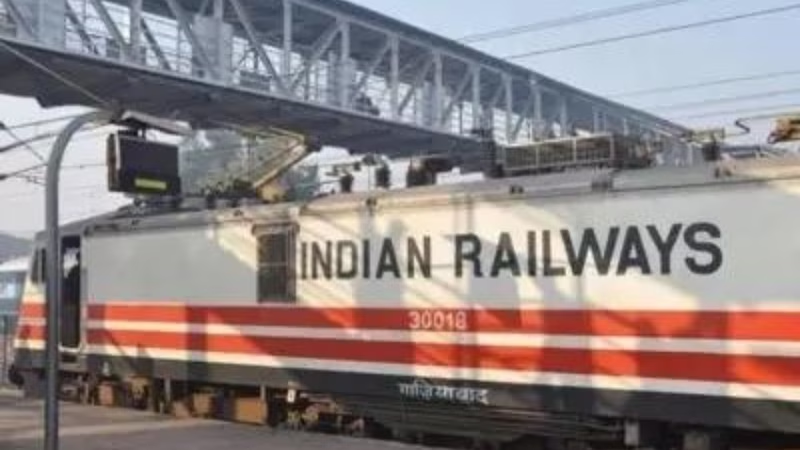
Imagine paying for a product—but never being told how the price was set. That’s the reality for millions of Indian passengers who rely on the railways every day. In a recent and controversial development, Indian Railways has officially declared its train fare formula a “trade secret,” refusing to disclose it even under the Right to Information (RTI) Act.
The statement came in response to an RTI query, with the Railways telling the Central Information Commission (CIC) that revealing the pricing methodology could harm its “competitive position.” The CIC, after reviewing the submission, noted there was “no infirmity in reply”—effectively siding with the Railways .
But this decision has sparked outrage among transparency advocates, economists, and ordinary citizens. After all, Indian Railways isn’t a private corporation—it’s a public service funded by taxpayers. So why is something as fundamental as fare calculation being treated like Coca-Cola’s secret recipe?
Table of Contents
- What Is the Train Fare Formula?
- Why Did Railways Call It a ‘Trade Secret’?
- The RTI Act and the Public’s Right to Know
- Global Comparisons: How Other Countries Handle Rail Pricing
- Implications for Passengers and Policy
- Could This Be Challenged in Court?
- Conclusion: Transparency or Convenience?
- Sources
What Is the Train Fare Formula?
While the exact train fare formula remains undisclosed, experts believe it factors in variables like:
- Distance traveled
- Train category (e.g., Rajdhani, Shatabdi, Mail/Express)
- Class of travel (Sleeper, AC 3-tier, etc.)
- Operating costs and fuel surcharges
- Dynamic pricing during peak seasons
Historically, fares were based on a fixed per-kilometer rate. But since the introduction of flexi-fare systems and dynamic pricing models around 2016, calculations have grown more complex—and less transparent .
Why Did Railways Call It a ‘Trade Secret’?
In its submission to the CIC, Indian Railways argued that disclosing the fare structure could allow competitors—like private airlines or bus operators—to “reverse-engineer” pricing strategies and gain an unfair advantage .
This reasoning has drawn sharp criticism. Legal experts point out that Indian Railways holds a near-monopoly on long-distance surface transport in India. With no real private rail competition (despite recent reforms), the “competitive harm” argument seems flimsy at best.
Moreover, calling a public utility’s pricing model a “trade secret” sets a dangerous precedent. As one RTI activist put it: “If the government can hide how your ticket is priced, what else can it hide?”
The RTI Act and the Public’s Right to Know
The Right to Information Act, 2005 was designed to promote transparency in governance. Section 2(f) explicitly defines “information” to include “records, documents, memos, e-mails, opinions, advices… and contracts.”
Section 8(1)(d) does allow exemptions for “commercial confidence, trade secrets, or intellectual property”—but only if disclosure would harm the competitive position of a third party. Crucially, courts have repeatedly ruled that this exemption does not apply to public authorities acting in their sovereign capacity .
So why did the CIC accept Railways’ claim? Critics argue the commission may have erred by not probing deeper into whether the “trade secret” label was being misapplied to avoid accountability.
Global Comparisons: How Other Countries Handle Rail Pricing
Let’s look beyond India:
- UK: National Rail publishes detailed fare manuals online, including formulas for off-peak, advance, and anytime tickets.
- Germany (Deutsche Bahn): Provides clear breakdowns of base fare + reservation + supplements.
- Japan: JR Group fares are calculated using a transparent distance-based system, publicly documented.
In none of these cases is fare calculation treated as confidential. If democracies with robust private transport sectors can be open about pricing, why can’t India?
Implications for Passengers and Policy
The secrecy around the train fare formula has real-world consequences:
- Lack of trust: Passengers can’t verify if fare hikes are justified.
- Poor policy feedback: Economists and researchers can’t analyze efficiency or equity in pricing.
- Barriers to reform: Without transparency, it’s hard to design better subsidy models or introduce fairer dynamic pricing.
For instance, during the pandemic, Railways introduced “premium” Tatkal fares with little explanation. Had the base formula been public, such decisions could have been scrutinized and debated openly.
Could This Be Challenged in Court?
Absolutely. The CIC’s order is not final. An appeal can be filed in the Delhi High Court under Section 19(3) of the RTI Act. In fact, similar cases—like the disclosure of coal block allocation formulas—have succeeded in higher courts .
Civil society groups like the Commonwealth Human Rights Initiative (CHRI) or the PUCL could take up this issue, arguing that fare transparency is essential for democratic oversight of a public monopoly.
Conclusion: Transparency or Convenience?
Indian Railways carries over 12 million passengers daily. It is not just a transporter—it’s a lifeline for the nation. Treating its train fare formula as a “trade secret” undermines the very principles of accountable governance.
Yes, pricing models can be complex. But complexity is not an excuse for secrecy. In an era demanding open data and citizen empowerment, hiding how public fares are set feels like a step backward—not forward.
Sources
- Times of India: Train fare formula is a trade secret, cannot be disclosed, Railways tells CIC
- The Hindu: Railways’ flexi-fare system explained
- Right to Information Act, 2005 (Official PDF)
- Supreme Court Judgment on RTI and Commercial Confidence (2014)
- Internal: How Indian Railways Makes Money – Beyond Ticket Sales