In a stunning and unusually blunt admission, the state of the long-anticipated India-US trade deal has been thrown into sharp relief. The culprit, according to America’s top commerce official? A simple, yet critical, phone call that never happened.
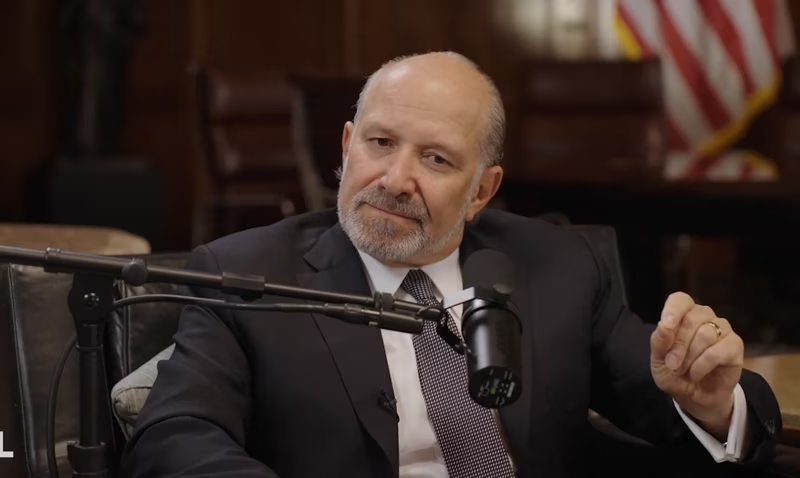
On a podcast aired Thursday, January 8, 2026, US Commerce Secretary Howard Lutnick dropped a political bombshell, claiming that a comprehensive trade agreement between the world’s largest and oldest democracies remains unsigned because Prime Minister Narendra Modi did not personally call then-President Donald Trump to seal the deal .
Table of Contents
- Lutnick’s Explosive Claim: The Call That Never Came
- Why the India-US Trade Deal Matters for Your Wallet
- A History of Near-Misses in Indo-American Trade Talks
- What’s Next for the Stalled Agreement?
- Conclusion: The Cost of Diplomatic Silence
- Sources
Lutnick’s Explosive Claim: The Call That Never Came
Lutnick’s statement cuts to the heart of a diplomatic impasse that has frustrated businesses and policymakers on both sides of the Pacific for years. He didn’t mince words: “I set the deal up, but Modi didn’t call Trump,” he stated plainly . According to the Secretary, he had personally facilitated the framework for an agreement and had directly asked PM Modi to make the final, decisive call to President Trump to close the negotiations .
The reason for the Indian government’s reluctance, Lutnick suggested, was that they were “uncomfortable” making such a direct appeal . This public airing of what is typically private diplomatic friction is highly unusual and underscores the deep frustration within the US administration over the lack of progress.
Why the India-US Trade Deal Matters for Your Wallet
This isn’t just about high-level politics; it’s about real economic impact for millions of people. A successful India-US trade deal would have far-reaching consequences:
- For Indian Exporters: Sectors like pharmaceuticals, textiles, and electronics could see a massive boost as punitive US tariffs are lifted, opening up lucrative markets .
- For American Consumers: Reduced tariffs on Indian goods could lead to lower prices on a variety of products, from clothing to generic medicines.
- For Global Markets: A strong economic alliance between these two giants would send a powerful signal of stability and growth, potentially strengthening the Indian rupee and attracting more foreign investment .
Without this deal, Indian exporters are at risk of losing valuable US orders, and the prolonged tariff uncertainty continues to weigh on India’s otherwise robust economic growth, which is projected at 7.4% for 2026 .
A History of Near-Misses in Indo-American Trade Talks
This latest stalemate is not an isolated incident. The path to a bilateral trade agreement has been fraught with obstacles for nearly a decade. During Trump’s first term, his administration was known for its aggressive “America First” stance, which often clashed with India’s own protectionist policies.
Talks have repeatedly reached an advanced stage, only to collapse over core issues like US demands for greater market access for dairy and medical devices, and India’s concerns over H-1B visas for its tech workers. In fact, just months before the end of Trump’s term, reports indicated that a “limited trade pact” was imminent, but it ultimately fizzled out .
The current impasse, as highlighted by Lutnick, seems to be less about technical details and more about a fundamental breakdown in the personal diplomacy that is often required to bridge the final gap in complex international negotiations.
What’s Next for the Stalled Agreement?
Despite this significant setback, all hope is not lost for the India-US trade deal. Many analysts and experts still believe a breakthrough is possible in 2026. Ian Bremmer, president of the Eurasia Group, has publicly stated his belief that a deal “will happen and likely in the first half of this year” .
The economic incentives for both nations are simply too powerful to ignore indefinitely. For India, securing a stable trade relationship with its largest export market outside of Asia is a strategic priority. For the US, deepening ties with a key democratic counterweight in Asia is a cornerstone of its foreign policy.
However, Lutnick’s comments have undeniably raised the stakes. They have shifted the narrative from a complex negotiation over tariffs and quotas to a question of political will and personal commitment at the highest levels of government. The ball, it seems, is now firmly in India’s court to demonstrate its seriousness about closing this long-standing chapter.
Conclusion: The Cost of Diplomatic Silence
The revelation from US Commerce Secretary Howard Lutnick has transformed the stalled India-US trade deal from a bureaucratic logjam into a dramatic story of missed opportunity. It serves as a stark reminder that in international relations, grand strategy is often executed through simple, human actions—a handshake, a meeting, or in this case, a phone call.
While the technical hurdles to an agreement remain significant, the primary barrier now appears to be one of trust and direct communication between the leaders of these two critical nations. The economic cost of this silence is mounting for businesses and consumers on both sides, making a resolution not just a diplomatic nicety, but an economic necessity.