Table of Contents
- An Unprecedented Walkout in the House
- The Governor’s Objections: ‘Misleading’ and ‘Inaccurate’
- Stalin’s Fury: An ‘Insult to Democracy’
- A Looming Constitutional Battle
- Historical Context: Governors vs Elected Governments
- Public and Political Reaction
- Conclusion: A Dangerous Precedent?
- Sources
In a dramatic turn of events that has sent shockwaves through India’s political landscape, Tamil Nadu Governor R N Ravi staged a stunning walkout from the state Assembly on January 20, 2026—refusing to deliver his customary address. The reason? He claimed the speech prepared by the DMK-led state government contained “inaccuracies” and “misleading” statements. This act has not only triggered a major political row but has also reignited a long-standing debate about the role of Governors in India’s federal structure. Welcome to the heart of the TN assembly drama.
An Unprecedented Walkout in the House
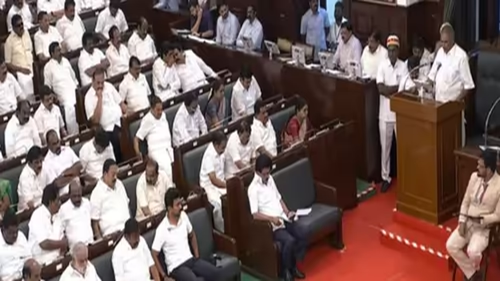
The opening day of the Tamil Nadu Legislative Assembly session was meant to be ceremonial—a formal address by the Governor outlining the government’s agenda. But it quickly descended into chaos. As Governor Ravi approached the podium, he reportedly found that his microphone had been switched off by Assembly officials after he attempted to make unscripted remarks . Moments later, he abruptly left the chamber without uttering a word of the official speech.
This is not just a breach of protocol—it’s a direct challenge to the authority of an elected legislature. The Governor’s office later released a statement accusing the state government of inserting content into the speech that “distorted facts” and “undermined national unity.” Yet, no specific examples were provided, leaving many to question the legitimacy of his objections .
The Governor’s Objections: ‘Misleading’ and ‘Inaccurate’
According to sources close to Raj Bhavan, Governor Ravi had requested multiple revisions to the draft speech, particularly objecting to passages related to language policy, federalism, and references to central government schemes. When the final version was not altered to his satisfaction, he chose to walk out rather than lend his voice to what he called a “politically motivated narrative” .
However, constitutional experts point out that Article 176 of the Indian Constitution clearly states that the Governor shall address the House at the commencement of the session—and that the speech is prepared by the Council of Ministers. The Governor’s role is ceremonial in this context; he is expected to read the text as given, not edit or reject it based on personal or political preferences .
TN assembly drama: Stalin’s Fury and a Constitutional Counterstrike
Chief Minister M K Stalin did not mince words. In a fiery response from the Assembly floor, he condemned the Governor’s actions as “a grave insult to the dignity of the House and the people of Tamil Nadu.” He accused Ravi of acting as a “political agent of the Centre” rather than a neutral constitutional functionary .
More significantly, Stalin announced a bold plan: the Tamil Nadu government will now push for a constitutional amendment to abolish the mandatory Governor’s address altogether. “If the office is being misused to undermine elected governments, then the provision itself must be re-examined,” he declared, signaling a potential legal and political battle that could reach the Supreme Court .
A Looming Constitutional Battle
This incident is not isolated. It’s part of a growing pattern of friction between Governors appointed by the Union Government and state governments led by opposition parties. From Kerala to West Bengal, similar standoffs have occurred over issues ranging from bill approvals to public statements.
Legal scholars argue that while Governors do have discretionary powers under certain circumstances, the delivery of the Assembly address is not one of them. The Supreme Court, in past judgments like Nabam Rebia vs Deputy Speaker (2016), has emphasized that Governors must act on the aid and advice of the Council of Ministers in such matters .
Historical Context: Governors vs Elected Governments
The tension between state governments and Governors dates back decades, but it has intensified in recent years. Critics argue that the post has increasingly been used as a tool for political oversight rather than constitutional guardianship. Tamil Nadu, with its strong Dravidian political identity and history of asserting state autonomy, has often been at the center of these conflicts.
Former Governor Fathima Beevi’s controversial tenure in the 1990s and more recent clashes during the AIADMK regime show that this is a recurring theme. However, the current TN assembly drama may be the most brazen yet—marking a new low in institutional decorum .
Public and Political Reaction
The public reaction in Tamil Nadu has been overwhelmingly in support of CM Stalin. Social media trends like #RespectTNAssembly and #RemoveBiasedGovernor have gained traction, reflecting widespread anger over perceived central interference.
Nationally, opposition parties have rallied behind Tamil Nadu. Leaders from the Congress, TMC, and CPI(M) have issued statements calling the Governor’s walkout “unconstitutional” and “undemocratic.” Meanwhile, the BJP has remained largely silent, though some of its spokespersons have defended Ravi’s “right to uphold constitutional values”—a stance that many see as politically convenient .
Conclusion: A Dangerous Precedent?
The TN assembly drama is more than just a political spat—it’s a stress test for India’s federal democracy. If Governors can unilaterally refuse to perform their constitutional duties based on subjective disagreements with state governments, it sets a dangerous precedent that could paralyze legislative processes across the country. As Tamil Nadu moves toward seeking a constitutional amendment, the entire nation will be watching to see whether democratic norms or political convenience will prevail.
Sources
- “Mic switched off, ‘misleading’ statement: How TN assembly drama unfolded,” Times of India, January 20, 2026.
- “Stalin slams Governor Ravi’s walkout as ‘insult to democracy’,” The Hindu, January 20, 2026.
- “Governor Ravi cites ‘factual errors’ in TN govt speech draft,” Indian Express, January 20, 2026.
- “Opposition unites against Governor’s TN walkout,” NDTV, January 20, 2026.
- Official statement from Raj Bhavan, Chennai, January 20, 2026.
- “Tamil Nadu to seek constitutional amendment on Governor’s address,” Deccan Chronicle, January 20, 2026.
- “History of Governor-State conflicts in Tamil Nadu,” Frontline, January 21, 2026.
- Article 176, Constitution of India.
- Nabam Rebia and Bamang Felix vs Deputy Speaker, Supreme Court of India, 2016.