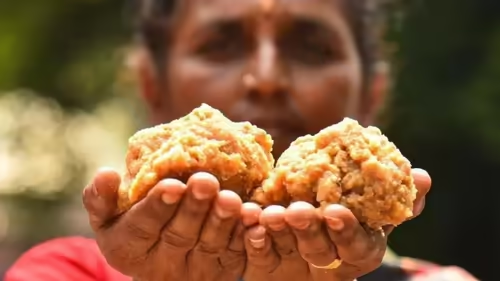
For millions of devotees, the Tirupati laddu isn’t just a sweet—it’s divine prasadam, blessed by Lord Venkateswara himself. But a recent Central Bureau of Investigation (CBI) chargesheet has shattered that sanctity, revealing that the ghee used in these iconic laddus was **not pure cow ghee at all**, but a concoction of synthetic materials and cheap vegetable oils.
The findings have sent shockwaves across India, raising serious questions about food safety, religious trust, and corporate fraud within one of Hinduism’s most revered institutions—the Tirumala Tirupati Devasthanams (TTD). While the CBI ruled out the use of animal fats like tallow or lard, the truth may be just as troubling: mass-produced, lab-engineered fat masquerading as sacred ghee.
Table of Contents
- What the CBI Chargesheet Revealed
- The Science Behind the Fake Ghee
- Why Animal Fats Were Ruled Out
- How This Affects Devotees and TTD’s Reputation
- Legal and Regulatory Fallout
- What Happens Next to Tirupati Laddu Production?
- Conclusion: Trust Betrayed in the Name of Prasadam
- Sources
What the CBI Chargesheet Revealed
The CBI’s investigation centered on a major supplier contracted to provide ghee to TTD. Forensic analysis of seized samples painted a damning picture:
- The product labeled as “cow ghee” contained **extremely low milk fat content**—far below the minimum required for genuine ghee under Indian Standards (IS 277).
- Laboratory tests confirmed the presence of **palm oil and/or palm kernel oil**, commonly used in industrial fat blends due to their low cost and high stability.
- The mixture was classified as a **“synthetic fat”**—a chemically processed blend designed to mimic the texture and melting point of real ghee without its nutritional or cultural authenticity [[1]].
Critically, the report noted the **absence of cholesterol**, which strongly indicates that animal-derived fats like beef tallow, pork lard, or fish oil were not used—putting to rest viral rumors but confirming a different kind of fraud.
The Science Behind the Fake Ghee
Real ghee is made by simmering butter (from cow or buffalo milk) until the water evaporates and milk solids separate, leaving behind pure clarified fat rich in butyric acid, conjugated linoleic acid (CLA), and cholesterol.
In contrast, the synthetic variant supplied to TTD was likely a **vanaspati-like blend**—hydrogenated or interesterified vegetable oils engineered to remain solid at room temperature. Such blends are common in commercial bakeries and snack foods but are **strictly prohibited** in products marketed as “ghee.”
According to food scientists, these synthetic fats can contain **trans fats** and lack the bioactive compounds that give traditional ghee its perceived health and ritual significance [INTERNAL_LINK:food-adulteration-in-india].
Why Animal Fats Were Ruled Out
One of the most sensitive aspects of this case was the fear that non-vegetarian fats—especially beef tallow—had been used, which would be deeply offensive to Hindu devotees.
The CBI’s forensic team used **gas chromatography and sterol profiling** to analyze the fat composition. Since animal fats contain cholesterol and specific sterols (like 7-ketocholesterol), while plant oils do not, the **complete absence of cholesterol** served as conclusive evidence against the use of tallow, lard, or marine oils [[2]].
While this clears the supplier of using haram or taboo ingredients, it doesn’t absolve them of fraud—because selling vegetable oil blend as “cow ghee” is still a criminal offense under the Food Safety and Standards Act, 2006.
How This Affects Devotees and TTD’s Reputation
For decades, TTD has upheld a reputation for purity and transparency. Over 20 million laddus are distributed annually, each treated as a sacred offering. Now, devotees feel betrayed.
“We eat it with faith, believing it’s prepared with devotion and pure ingredients,” said one pilgrim from Tamil Nadu. “To learn it’s made with factory-made fat… it breaks your heart.”
TTD has since suspended the implicated vendor and launched an internal audit. But the damage to public trust may take years to repair—especially as this isn’t the first time food quality at major temples has come under scrutiny [INTERNAL_LINK:indian-temple-food-safety-standards].
Legal and Regulatory Fallout
The CBI has filed charges under multiple sections of the Indian Penal Code (IPC) and the Food Safety and Standards Authority of India (FSSAI) regulations, including:
- Section 420 IPC: Cheating and dishonestly inducing delivery of property.
- Section 7(1) & 8(1) of FSS Act: Selling misbranded and adulterated food.
- Section 120B IPC: Criminal conspiracy.
If convicted, the accused could face up to 7 years in prison and fines exceeding ₹10 lakh. The FSSAI has also initiated parallel proceedings to revoke the supplier’s license [[3]].
What Happens Next to Tirupati Laddu Production?
TTD has announced sweeping reforms:
- All ghee will now be sourced directly from **NDDB (National Dairy Development Board)** or certified gaushalas.
- Third-party lab testing will be conducted **monthly**, with results published online.
- A new “Prasadam Integrity Cell” will oversee ingredient procurement and kitchen hygiene.
Additionally, TTD is exploring blockchain-based traceability so devotees can scan a QR code on laddu packaging to see the ghee’s origin—a move toward radical transparency.
Conclusion: Trust Betrayed in the Name of Prasadam
The Tirupati laddu ghee controversy is more than a food safety issue—it’s a crisis of faith. While the CBI’s finding that no animal fats were used offers some relief, the deliberate substitution of sacred cow ghee with synthetic blends represents a profound betrayal of millions of devotees’ trust.
As TTD works to restore integrity, this case serves as a stark reminder: when spirituality meets supply chains, oversight isn’t optional—it’s essential. For now, the laddus keep coming, but the taste of deception may linger longer than anyone expected.
Sources
- Times of India: ‘Made from synthetic material’: CBI rules out mixing of animal fats in Tirupati laddu ghee
- FSSAI Guidelines: Indian Standard IS 277: Specification for Ghee
- Food Safety and Standards Act, 2006: Official Gazette of India
- Journal of Food Science and Technology: Detection of Adulteration in Ghee: A Review