Table of Contents
- The End of Chinese Control in the U.S.
- Who Really Owns TikTok Now?
- TikTok Ownership and the USDS Model Explained
- What This Means for Your Data
- ByteDance’s Role After the Deal
- Geopolitical Implications and Public Trust
- Conclusion: A New Era for TikTok?
- Sources
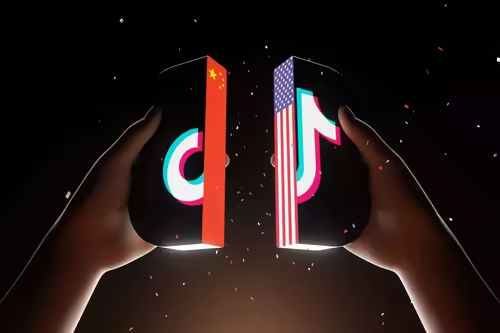
For years, TikTok has been at the center of a high-stakes geopolitical tug-of-war. Lawmakers in Washington warned that the app—owned by Beijing-based ByteDance—posed a national security threat, fearing that user data could be accessed by the Chinese government. Now, after months of intense negotiations and looming bans, a dramatic transformation has taken place: TikTok ownership in the United States is no longer Chinese. A new, American-controlled structure has been put in place to satisfy U.S. regulators and keep the wildly popular app available to over 170 million American users.
The End of Chinese Control in the U.S.
In a landmark move aimed at ending years of regulatory uncertainty, TikTok has officially transitioned to U.S.-led governance. The company announced the creation of a new legal entity—TikTok USDS Joint Venture LLC—which now exclusively manages all U.S. operations. This isn’t just a rebrand; it’s a complete structural overhaul designed to insulate American user data from foreign influence .
The “USDS” stands for “U.S. Data Security,” a framework approved by the Committee on Foreign Investment in the United States (CFIUS). Under this model, every aspect of TikTok’s U.S. business—from content moderation to data storage—is now under the oversight of a majority-American board and U.S.-based executives.
Who Really Owns TikTok Now?
So, who actually owns TikTok in America today? The answer is more nuanced than a simple name change:
- TikTok USDS Joint Venture LLC is the new operating entity for all U.S. activities.
- The board of directors is composed primarily of American citizens with no ties to the Chinese government.
- Oracle serves as the “technological steward,” managing cloud infrastructure, data storage, and algorithmic integrity.
- ByteDance retains a minority financial stake but has zero operational control over U.S. TikTok.
This structure ensures that even if ByteDance wanted to access U.S. user data, it legally cannot—thanks to strict firewalls and third-party audits built into the USDS agreement.
TikTok Ownership and the USDS Model Explained
The USDS model is TikTok’s answer to U.S. national security concerns. Think of it as a digital quarantine zone:
- All U.S. user data is stored on Oracle’s cloud servers located within the United States.
- The recommendation algorithm that powers your “For You Page” is now trained exclusively on American user behavior—no data from China or other regions is used.
- Independent auditors, approved by the U.S. government, conduct regular compliance checks.
- Any attempt to modify the system without authorization triggers automatic alerts to U.S. authorities.
This level of oversight is unprecedented for a social media platform and represents a major concession by ByteDance to keep TikTok alive in its most lucrative market.
What This Means for Your Data
For everyday users, the immediate experience on TikTok won’t change—you’ll still scroll, like, and duet as before. But behind the scenes, your data is now far more protected from foreign access. The TikTok ownership shift means:
- Your videos, messages, location, and viewing habits are stored only on U.S. soil.
- Content moderation decisions for U.S. users are made by teams based in Texas and California—not Beijing.
- Even ByteDance engineers cannot access the U.S. codebase or database without multi-factor approval from Oracle and U.S. trustees.
While no system is 100% hack-proof, this new architecture drastically reduces the risk of state-sponsored data exploitation—a key concern raised by the FBI and Department of Justice for years.
ByteDance’s Role After the Deal
It’s important to clarify: ByteDance hasn’t sold TikTok outright. Instead, it has agreed to a “managed separation” where it remains a passive investor in the U.S. business. The company still owns TikTok globally (outside the U.S.), but its influence in America is now purely financial—and heavily restricted.
According to internal documents, ByteDance receives a share of U.S. profits but has no voting rights on strategic decisions. This compromise allows the Chinese parent company to retain some economic benefit while ceding all operational authority to American hands.
Geopolitical Implications and Public Trust
This restructuring marks a turning point in the tech cold war between the U.S. and China. By accepting the USDS model, TikTok has set a precedent that could influence how other Chinese-owned apps (like Shein or Temu) operate in sensitive Western markets.
However, skepticism remains. Some lawmakers argue the deal doesn’t go far enough, while others welcome it as a pragmatic solution that protects both national security and free expression. For users, the real test will be whether this new TikTok ownership model can rebuild trust. As one digital rights advocate noted, “Transparency isn’t just about where data lives—it’s about who can pull the strings.”
For deeper insights into data sovereignty in the digital age, see our analysis on [INTERNAL_LINK:data-privacy-laws-us-eu].
For an independent perspective on global tech regulation, refer to the Reuters Technology section, which provides ongoing coverage of U.S.-China tech tensions.
Conclusion: A New Era for TikTok?
TikTok’s transformation from a Chinese-owned app to a U.S.-governed platform is more than a corporate reshuffle—it’s a geopolitical milestone. With Oracle as its tech guardian and a fully American board at the helm, the TikTok ownership structure in the U.S. now aligns with national security demands. Whether this satisfies critics long-term remains to be seen, but for now, TikTok stays in America—with a new identity, new rules, and a new promise to protect user data from foreign interference.
Sources
- Times of India: “TikTok is no longer Chinese in America, here are the company’s new owners” (January 2026)
- U.S. Department of Treasury – CFIUS Public Statements on TikTok USDS Agreement
- Oracle Cloud Infrastructure Press Releases on TikTok Partnership
- Reuters & Bloomberg reporting on ByteDance’s retained stake and governance changes