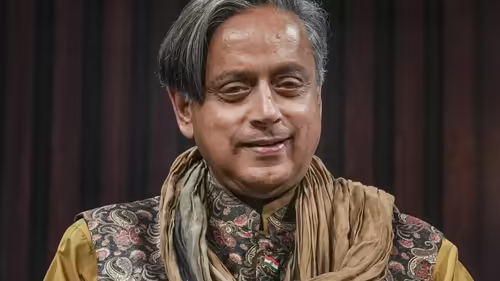
In the high-stakes chess game of Indian politics, few moves are as intriguing as Shashi Tharoor’s recent articulation of an alternative government for Kerala. Coming on the heels of persistent whispers about a growing chasm between the Thiruvananthapuram MP and the Congress high command, his statement is less a policy paper and more a political declaration—one that could define the United Democratic Front’s (UDF) battle plan for the 2026 Kerala Assembly elections.
But what exactly does Tharoor mean by an ‘alternative government’? And can the Congress, a party struggling to find its national footing, successfully rally behind this vision in a state where the Left Democratic Front (LDF) has been dominant? Let’s cut through the noise and analyze the realpolitik at play.
Table of Contents
- Tharoor’s ‘Alternative Government’ Vision Explained
- The Rift Rumours: Are They Founded?
- Congress’s Grand Strategy for Kerala 2026
- Why Kerala is the Battleground
- Conclusion: A Unified Front or a Future Fracture?
- Sources
Tharoor’s ‘Alternative Government’ Vision Explained
Tharoor’s call for an alternative government isn’t a new concept in Indian politics, but its framing in the context of Kerala is significant. He’s not just talking about a change in administration; he’s pitching a complete ideological and administrative counter-narrative to the incumbent LDF government led by Pinarayi Vijayan.
This vision likely encompasses a platform built on:
- Administrative Efficiency: Countering the LDF’s strong governance model with promises of a more responsive and transparent system.
- Economic Revitalization: Focusing on job creation and support for the MSME sector, which has been a point of contention under the current regime.
- Development Agenda: Presenting a clear, actionable plan for infrastructure, healthcare, and education that contrasts with the LDF’s approach.
For the UDF, having a charismatic and nationally recognized figure like Tharoor as the face of this alternative government is a strategic asset. Recent surveys even suggest he is the leading choice among voters for the UDF’s chief ministerial candidate [[9]].
The Rift Rumours: Are They Founded?
The timing of Tharoor’s statement is crucial. It follows his conspicuous absence from a key Congress meeting in Kerala, which fueled intense speculation about a serious rift with the party leadership [[1]]. Critics pointed to his past comments, sometimes perceived as being too conciliatory towards the BJP, as evidence of a growing disconnect.
However, Tharoor has moved swiftly to quash these rumours. In a decisive show of unity, he met with both Congress President Mallikarjun Kharge and Leader of the Opposition Rahul Gandhi in Parliament. Following the meeting, he declared, “We’re on the same page. We’re moving forward together” [[24]]. This public display of solidarity is a classic political maneuver designed to project a united front ahead of a major electoral contest.
Congress’s Grand Strategy for Kerala 2026
The Congress is leaving nothing to chance for the 2026 polls. The party has already signaled its intent for a “no-mercy contest,” aiming to win at least 100 seats in the 140-member assembly [[14]]. Their strategy appears to be multi-pronged:
- Centralized Candidate Selection: To avoid internal squabbles, the party has decided that District Congress Committee proposals will be the primary basis for finalizing candidates, ensuring a top-down, disciplined approach [[15]].
- Leveraging Star Power: Tharoor is not just a local MP; he’s a global brand. His active campaigning and potential candidacy from his stronghold of Nemom are central to the UDF’s hopes [[3]].
- Coalition Cohesion: The Congress is working to solidify the UDF alliance, recognizing that a fragmented opposition is the LDF’s greatest ally.
This coordinated effort suggests that Tharoor’s ‘alternative government’ vision is not a solo act but the official, party-sanctioned narrative for the upcoming election.
Why Kerala is the Battleground
Kerala holds a unique place in India’s political landscape. It’s a state where the Congress, despite its national decline, remains a formidable force as the leader of the UDF. A victory here would be a massive morale booster for the party and a significant setback for the ruling LDF, which is seeking a historic third consecutive term—a feat no alliance has achieved in the state’s history [[12]].
For Tharoor personally, a successful campaign in Kerala could elevate his stature within the party and on the national stage, potentially positioning him for a larger role in a future non-BJP coalition at the Centre. The stakes couldn’t be higher for both the man and the party.
Conclusion: A Unified Front or a Future Fracture?
Shashi Tharoor’s vision of an alternative government is a bold and necessary gambit for the Congress in Kerala. By publicly dismissing rift rumours and aligning himself with the party leadership, he has presented a picture of unity that is essential for their 2026 campaign. Whether this unity is skin-deep or a genuine strategic alignment will be tested on the ground in the coming months. One thing is certain: the battle for Kerala is not just about who governs the state, but about the future direction of the Congress party itself.
Sources
- [[1]] India Today: “Shashi Tharoor Skips Congress Kerala Poll Meet Amid Rift”
- [[3]] The Hindu: “Congress may field Shashi Tharoor from Nemom”
- [[9]] Mathrubhumi: “Shashi Tharoor for Kerala CM in 2026? Survey signals”
- [[12]] Telangana Today: “Kerala Assembly polls 2026: LDF faces rising challenge from UDF and BJP”
- [[14]] The South First: “Congress signals a no-mercy contest for 2026 Kerala elections”
- [[15]] The Hindu: “Congress to finalise candidates for Kerala Assembly polls soon”
- [[24]] Times of India: “‘We’re on same page’: Shashi Tharoor dismisses rift with Congress ahead of Kerala polls”