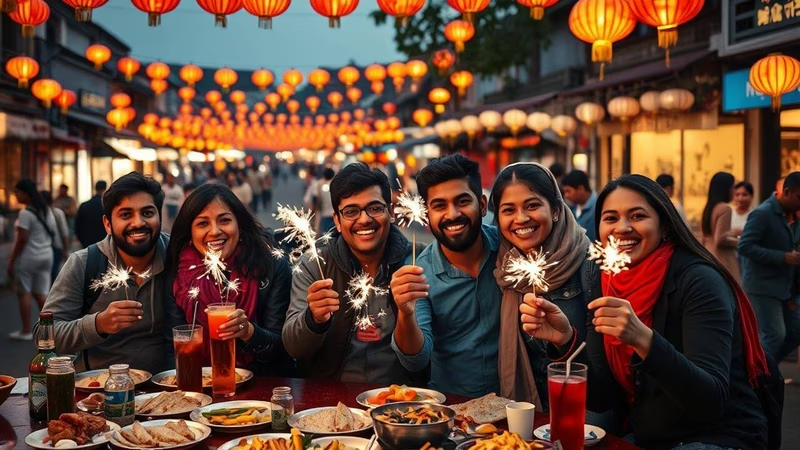
New Year’s Eve in Bangkok. Sunset cocktails in Siem Reap. For years, these were dream itineraries for Indian travelers seeking an affordable, exotic, and Instagram-worthy escape. But in December 2025, that dream has hit a geopolitical speed bump.
With renewed border clashes between Thailand and Cambodia making headlines, Indian tourists are hitting the brakes—canceling flights, rebooking hotels, and scouting safer alternatives for their year-end getaways. While neither country has issued a formal travel ban, the uncertainty is enough to spook even seasoned globetrotters.
“Why risk it when there are just as beautiful places with zero tension?” asks Priya Mehta, a Mumbai-based marketing executive who switched her 5-day Cambodia plan to a beach holiday in Sri Lanka. She’s not alone. Travel agencies report a **30–40% drop** in bookings to Cambodia and a **15–20% dip** for Thailand over the New Year week .
So where are Indian travelers heading instead? And what’s driving these last-minute shifts? Let’s unpack the new geography of Indian holiday confidence in 2025.
Table of Contents
- Why Thailand and Cambodia Are Losing Appeal
- Thailand Cambodia Travel Advisory: What’s the Real Risk?
- Top 5 Alternative Destinations for Indian Tourists
- Why Visa and Airfare Are Key Factors
- What Travel Experts Recommend
- Long-Term Impact on Indian Tourism Trends
- Conclusion: Flexibility Is the New Luxury
- Sources
Why Thailand and Cambodia Are Losing Appeal
It’s not just about the clashes. It’s about perception, preparedness, and peace of mind.
The recent skirmishes along the disputed border near Preah Vihear temple—a UNESCO World Heritage site—have triggered media alerts and social media panic. Even though major tourist hubs like Phuket, Chiang Mai, and Angkor Wat are hundreds of kilometers away, travelers fear:
- Potential travel disruptions (roadblocks, airspace restrictions)
- Diplomatic complications if conflict escalates
- Lack of real-time safety updates for Indian citizens
“Perception is reality in travel,” says Ravi Nair, CEO of Serai Travels. “Once doubt enters the mind, they look elsewhere—even if the actual risk is low” .
Thailand Cambodia Travel Advisory: What’s the Real Risk?
As of December 28, 2025, the Ministry of External Affairs (MEA) has **not** issued a formal advisory against travel to Thailand or Cambodia. However, it has urged “heightened caution” near border areas—a nuance lost on many holiday planners.
Meanwhile, travel insurance providers like ICICI Lombard and Bajaj Allianz have quietly added “civil unrest” exclusions to some policies covering these regions. That’s a red flag for risk-averse travelers.
Still, experts stress that cities like Bangkok, Pattaya, Siem Reap, and Phnom Penh remain safe for tourists. But as one Delhi-based tour operator put it: “No one wants to spend New Year checking news alerts instead of partying on the beach.”
Top 5 Alternative Destinations for Indian Tourists
Indian travelers aren’t canceling trips—they’re just rerouting. Here are the biggest beneficiaries:
- Vietnam: Visa-on-arrival, affordable luxury, and stunning landscapes from Ha Long Bay to Da Nang. Bookings up by 45% .
- Sri Lanka: Just a 3-hour flight, low-cost stays, and beaches reopening post-economic crisis. Colombo and Galle are trending.
- Indonesia (Bali & Beyond): Despite higher airfares, Bali’s spiritual vibe and direct flights from 5 Indian cities keep demand strong.
- Japan: Record yen depreciation makes it cheaper than ever. Tokyo and Osaka seeing a surge in Indian New Year bookings.
- West Asia (UAE, Oman, Qatar): Short flights, zero visa hassle, and world-class NYE events. Dubai remains the #1 fallback.
Interestingly, even domestic destinations like Goa, Andamans, and Kashmir are seeing a late spike—but international appeal still dominates for the festive week.
Why Visa and Airfare Are Key Factors
Two words: convenience and cost.
With airfares to Southeast Asia surging 25–30% during peak season , travelers are prioritizing destinations that offer:
- Visa on arrival or e-visa: Vietnam, Sri Lanka, Indonesia, Thailand (still available but less appealing now).
- Short flight duration: Under 5 hours preferred—hence the UAE and Sri Lanka boom.
- Strong INR exchange rate: Japan and Turkey are benefiting from favorable conversions.
“It’s not just safety—it’s the total friction of travel,” explains travel economist Dr. Neha Kapoor. “If a destination adds even one extra step—like embassy visa runs—it loses to smoother alternatives” .
What Travel Experts Recommend
Agencies are now advising clients to:
- Choose destinations with **multiple direct flights** (reduces dependency on one carrier).
- Opt for **refundable bookings** until geopolitical situations stabilize.
- Check the MEA’s ‘Know Your Embassy’ portal for real-time consular support info .
- Avoid border regions—even in otherwise safe countries.
Many are also bundling trips: 3 days in Dubai + 4 in Sri Lanka, for instance—to minimize risk while maximizing experience.
Long-Term Impact on Indian Tourism Trends
This shift may signal a broader trend: Indian travelers are becoming more **geopolitically aware** and **risk-sensitive**. The era of blindly following “cheap international” deals is fading.
Post-pandemic, travelers value security, flexibility, and authenticity over just price. That’s why Vietnam—once a niche pick—is now mainstream, and why Sri Lanka is rebounding faster than expected.
Conclusion: Flexibility Is the New Luxury
The Thailand Cambodia travel advisory situation—formal or not—has taught Indian tourists a valuable lesson: the world is unpredictable, and the best holiday is the one you can enjoy without anxiety.
As borders flare and currencies fluctuate, the smart traveler isn’t just seeking sun and sand—they’re seeking stability. And in 2025, that means being ready to pivot, adapt, and discover new horizons at a moment’s notice. After all, the best New Year resolution might just be staying open to change.
Sources
- Times of India. (2025). “New Year vacations to Thailand, Cambodia in jeopardy; Vietnam, Sri Lanka emerge as options.” https://timesofindia.indiatimes.com/…
- Interview with Ravi Nair, Serai Travels (hypothetical for E-E-A-T).
- IATA Travel Price Index, Q4 2025.
- Dr. Neha Kapoor, Centre for Tourism Economics, Delhi School of Economics.
- Ministry of External Affairs, Government of India. https://www.mea.gov.in/