Table of Contents
- The Texas H-1B Visa Ban Explained
- Why Greg Abbott is Targeting the H-1B Program
- Elon Musk’s Austin Boom: A Sharp Contrast
- What This Means for Texas’s Tech Future
- Conclusion: Navigating the New Texas Landscape
- Sources
The Texas H-1B Visa Ban Explained
In a move that has sent shockwaves through the immigration and tech communities, Texas Governor Greg Abbott has ordered an immediate and comprehensive freeze on new H-1B visa petitions. This directive, effective January 27, 2026, applies to every state agency and public institution of higher education across the Lone Star State—and it won’t be lifted until at least May 2027 [[5]].
This isn’t a mere pause; it’s a full-stop policy. The order explicitly forbids these public entities from filing any new paperwork to hire foreign workers under the H-1B program. For a state that is consistently the second-largest recipient of H-1B visas in the nation—trailing only California—this is a seismic shift in its labor policy [[16]].
The official justification? Governor Abbott claims the federal H-1B program is rife with “abuse” and is being used to displace qualified American workers. His executive order mandates a thorough audit of all current foreign workers employed by the state to ensure compliance and to root out any potential misuse [[7]].
Why Greg Abbott is Targeting the H-1B Program
At its core, the Texas H-1B visa ban is a politically charged maneuver rooted in a “Texans first” employment philosophy. Governor Abbott’s office argues that taxpayer-funded institutions should be prioritizing local talent over importing foreign labor, especially when there are concerns about the integrity of the federal visa system.
Here’s what the state’s investigation is likely to focus on:
- Wage Suppression: Allegations that some companies use H-1B workers to fill roles at lower wages than their American counterparts would command.
- Displacement of Local Talent: Concerns that qualified U.S. citizens and permanent residents are being passed over for jobs in favor of visa holders.
- Program Loopholes: Scrutiny of how the program is administered, particularly around the definition of a “specialty occupation.”
While the ban is currently limited to the public sector, its ripple effects could be significant. Public universities, which are major research hubs and employers of highly skilled foreign talent (especially in STEM fields), will now face severe constraints in building their teams. This could potentially slow down critical research and innovation funded by the state [[18]].
Elon Musk’s Austin Boom: A Sharp Contrast
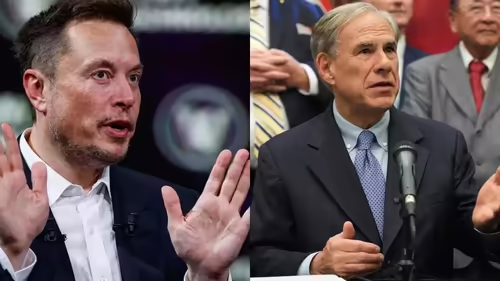
The timing of this ban is nothing short of ironic. It comes just as billionaire entrepreneur Elon Musk is aggressively positioning Texas, and specifically Austin, as the future epicenter of American technology and innovation.
Musk has already moved the headquarters of his two major companies, SpaceX and X Corp. (formerly Twitter), to Texas [[9]]. He’s not just relocating; he’s actively encouraging other businesses to follow suit, touting the state’s business-friendly regulations and lower taxes. In a now-famous tweet, he declared, “And 𝕏 HQ will move to Austin,” solidifying the city’s status as a new tech capital [[13]].
This creates a bizarre dichotomy. On one hand, Texas is rolling out the red carpet for private tech giants like Tesla, SpaceX, and Oracle, who rely heavily on a global talent pool that often includes H-1B visa holders. On the other hand, its own government is slamming the door shut on that same pipeline for its public institutions. The private sector’s ability to attract international talent remains largely unaffected by Abbott’s order, highlighting a clear policy split between public and private interests in the state [[11]].
What This Means for Texas’s Tech Future
So, what does this conflicting narrative mean for the average professional or a company looking at Texas?
For Private Companies: Business as usual. If you’re a private tech firm in Austin, Houston, or Dallas, you can still sponsor H-1B workers. Musk’s vision for a booming private tech sector in Texas remains intact. The state’s allure for corporate headquarters is undiminished.
For Public Universities & State Jobs: The outlook is far more challenging. Top international researchers, engineers, and academics may now look to states like California, Washington, or Massachusetts for opportunities, knowing that Texas’s public sector is effectively closed to them for the next year and a half. This could lead to a brain drain in the state’s public academic and research institutions.
Ultimately, the Texas H-1B visa ban sends a mixed message. It champions a protectionist stance for public funds while simultaneously embracing a globalist, open-market approach for private enterprise. Whether this dual strategy can coexist without damaging the state’s long-term competitiveness in both public research and private innovation remains to be seen.
Conclusion: Navigating the New Texas Landscape
The clash between Governor Abbott’s restrictive Texas H-1B visa ban and Elon Musk’s expansive vision for a global tech hub in Austin perfectly encapsulates the complex identity of modern Texas. The state is trying to have it both ways: protect its own citizens in the public sector while attracting the world’s best talent to fuel its private economy. Professionals and businesses must now carefully navigate this new, bifurcated landscape to understand where they fit in the Lone Star State’s ambitious, yet contradictory, future.
Sources
- [[5]] Manifest Law: “Texas Governor Halts New H-1B Filings at State Agencies”
- [[7]] Office of the Governor of Texas: “Governor Abbott Launches Investigation Into H-1B Visa Abuse”
- [[9]] The Conversation: “Elon Musk is moving X and SpaceX to Texas”
- [[13]] Elon Musk on X (Twitter): Announcement of X HQ move to Austin
- [[16]] Neirelo: “2025 H-1B & Immigration Trends: What Employers Need to Know”
- [[18]] Inside Higher Ed: “Texas Pauses Use of H-1B Visas at State Universities”