Musk’s Unshakable Tesla Promise: A Lifeline or a Liability?
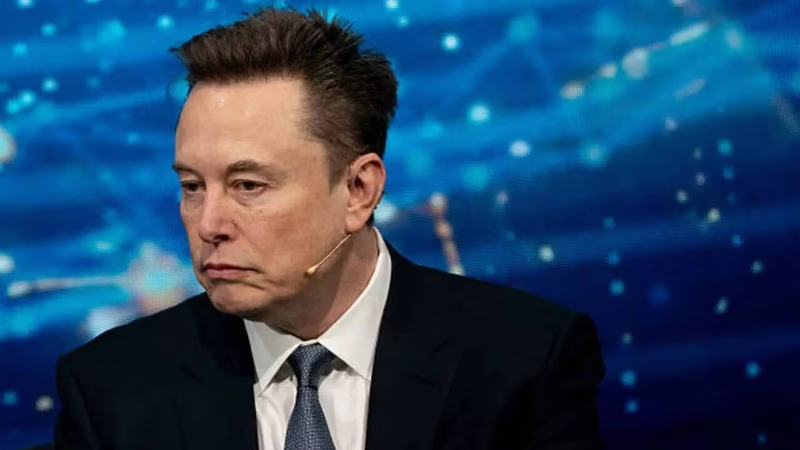
Elon Musk just dropped a bombshell that sent ripples through Wall Street and Silicon Valley alike. At the Qatar Economic Forum on December 31, 2025, the world’s most polarizing tech visionary made a sweeping—and almost theatrical—commitment: “Unless I die, I will remain Tesla CEO for at least five more years.”
This declaration, delivered with characteristic Musk flair, is more than just a personal vow—it’s a direct rebuttal to mounting criticism from institutional investors who argue that Musk’s focus is dangerously split between Tesla, SpaceX, X (formerly Twitter), Neuralink, The Boring Company, and even his new AI startup xAI. The Tesla promise aims to reassure shareholders, but will it be enough?
Table of Contents
- The Qatar Announcement: Context and Controversy
- Investor Backlash: Why Some Want Musk Gone
- Musk’s Five-Year Vision for Tesla
- Leadership Challenges: Can One Man Do It All?
- What This Means for Tesla Stock and Strategy
- Conclusion: A Promise Built on Genius—or Hubris?
- Sources
The Qatar Announcement: Context and Controversy
Musk’s appearance at the Qatar Economic Forum wasn’t just a routine CEO talk—it was a strategic intervention. Over the past year, Tesla’s stock has faced volatility, not due to poor sales, but because of investor anxiety over Musk’s bandwidth.
Critics, most notably asset manager Ross Gerber of Gerber Kawasaki, have publicly called for Musk to step down as CEO. Gerber argues that while Musk is a brilliant innovator, his attention is “spread dangerously thin,” and Tesla deserves a leader fully dedicated to its mission .
By making his Tesla promise on an international stage, Musk is attempting to reframe the narrative: he’s not distracted—he’s committed. And he’s betting his legacy on it.
Investor Backlash: Why Some Want Musk Gone
The pressure on Musk isn’t coming from small-time traders—it’s from major institutional stakeholders. Their concerns are threefold:
- Strategic drift: Tesla’s product roadmap, especially around affordable EVs and next-gen automation, has faced delays.
- Brand dilution: Musk’s controversial posts on X and polarizing public statements have alienated some consumers and partners.
- Leadership vacuum: Unlike Apple (with Tim Cook) or Microsoft (with Satya Nadella), Tesla lacks a clear, empowered #2 who can operate independently.
Ross Gerber’s open letters have been particularly blunt, stating, “Tesla is too important to be run as a side project” . This sentiment resonates with ESG-focused funds and long-term investors who prioritize stable governance over charismatic leadership.
Musk’s Five-Year Vision for Tesla
While Musk didn’t unveil a detailed roadmap in Qatar, insiders and past statements suggest his five-year plan likely includes:
- Robotaxi rollout: Full-scale launch of autonomous, driverless Tesla taxis by 2027.
- $25,000 mass-market EV: Bringing a truly affordable electric car to market to dominate global adoption.
- AI integration: Embedding Tesla’s Dojo supercomputer and Full Self-Driving (FSD) v12+ into every vehicle.
- Energy expansion: Scaling Megapack and Solar Roof deployments to make Tesla a top-3 energy company.
Each of these goals is ambitious—but achievable only with relentless focus. Musk seems to be saying: Give me five years, and I’ll deliver the future.
Leadership Challenges: Can One Man Do It All?
Skeptics point to history: Steve Jobs returned to Apple and focused solely on it. Jeff Bezos stepped down as Amazon CEO to concentrate on Blue Origin and other ventures—but only after building a robust leadership team.
Musk, however, continues to lead six companies simultaneously. At SpaceX, he’s racing to land humans on Mars. At xAI, he’s in a high-stakes AI arms race with OpenAI and Google. At X, he’s battling regulatory scrutiny and advertiser boycotts.
The real question isn’t Musk’s capability—it’s sustainability. Can even a genius operate at this intensity for five more years without burning out or making a catastrophic mistake? [INTERNAL_LINK:tech-ceo-burnout-trends]
What This Means for Tesla Stock and Strategy
In the short term, Musk’s Tesla promise may calm jittery markets. Long-term, the impact depends on execution.
Positive signals:
- Reinforces Musk’s skin in the game—his net worth is still overwhelmingly tied to Tesla.
- Signals continuity in vision, which is crucial for R&D-heavy projects like FSD and robotaxis.
Risks remain:
- If Tesla misses 2026–2027 milestones, the promise could backfire spectacularly.
- Regulatory scrutiny on AI and autonomous driving could escalate, demanding CEO-level attention.
For investors, this is a high-risk, high-reward bet on one man’s stamina and genius.
Conclusion: A Promise Built on Genius—or Hubris?
Elon Musk’s Tesla promise is the ultimate double-edged sword. It reassures loyalists and aligns his personal fate with Tesla’s success. But it also doubles down on a leadership model that many governance experts warn is unsustainable.
Over the next five years, the world will watch: Will Musk deliver a new era of transport, energy, and AI under the Tesla banner—or will the weight of his empire prove too much, even for him? One thing is certain—whether through triumph or turmoil, Tesla’s story will remain inseparable from the man at its helm.
For deeper insights into corporate governance in tech, refer to the U.S. Securities and Exchange Commission guidelines on executive leadership and fiduciary duty.
Sources
Times of India. “Elon Musk makes a Tesla promise: says unless I die, I will…” https://timesofindia.indiatimes.com/…
CNBC. “Ross Gerber calls for Elon Musk to step down as Tesla CEO.”
Bloomberg. “Musk’s Five-Year Tesla Plan: What to Expect by 2030.”
Reuters. “Tesla investors split on Musk’s leadership amid multi-company focus.”
U.S. Securities and Exchange Commission (SEC). “Executive Leadership and Corporate Governance Standards.” https://www.sec.gov/