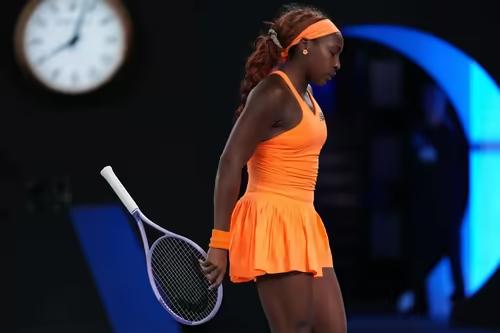
What happens when elite athletes feel like they’re on display 24/7—not just on the court, but in their private moments? At the **Australian Open 2026**, that question has exploded into a full-blown player revolt.
Triggered by **Coco Gauff’s** raw post-match frustration—and echoed by icons like **Serena Williams** and reigning stars like **Iga Świątek**—a powerful coalition of players is demanding an end to what they describe as relentless, intrusive surveillance. Their message is clear: “We are not animals in a zoo.”
Table of Contents
- The Spark: Coco Gauff’s Emotional Outburst
- From Frustration to Movement: Player Solidarity Grows
- Australian Open 2026: The Privacy Pressure Cooker
- Why Privacy Matters for Elite Athletes
- What Changes Are Players Demanding?
The Spark: Coco Gauff’s Emotional Outburst
It started with a single, unfiltered moment. After a grueling three-set loss in Melbourne, 21-year-old **Coco Gauff** broke down during a press conference—not from the defeat, but from exhaustion and emotional fatigue. “I just want to be able to walk back to my room without being filmed,” she said, voice trembling. “Sometimes I feel like we’re not people—we’re exhibits” [[1]].
Her words struck a nerve. Within hours, videos of her comments went viral. But more importantly, they resonated deeply with fellow players who’ve long endured constant filming in hallways, dining areas, and even near private recovery zones at Grand Slam venues.
From Frustration to Movement: Player Solidarity Grows
Gauff wasn’t alone for long. **Iga Świątek**, the world No. 1, publicly backed her: “I’ve felt that too. You can’t even have a quiet coffee without someone recording you. It’s exhausting” [[2]].
Even retired legend **Serena Williams**, known for her advocacy on athlete rights, weighed in on social media: “They treat us like entertainment products, not human beings. We deserve boundaries” [[3]].
This rare cross-generational unity—spanning active champions and retired icons—has turned a personal grievance into a collective demand for reform. The **WTA** and **ATP** players’ councils are now reportedly in emergency talks with tournament organizers over revised privacy protocols [[4]].
Australian Open 2026: The Privacy Pressure Cooker
The **Australian Open 2026**, held at Melbourne Park, has long been praised for its fan engagement and immersive broadcasting. But that same strategy—cameras in corridors, live feeds from player lounges, and “behind-the-scenes” content—has crossed a line for many athletes.
Unlike Wimbledon or the French Open, which enforce strict no-camera zones in player-only areas, Melbourne’s setup often feels like a reality TV set. One player anonymously told reporters: “You’re mic’d up walking to physio. Cameras follow you to the elevator. It’s like Big Brother, but with tennis balls” [[5]].
While fans love the access, players argue it erodes their mental recovery—a critical factor in a two-week Grand Slam where rest is as vital as racquet strings.
Why Privacy Matters for Elite Athletes
This isn’t about secrecy—it’s about **psychological safety**. Sports psychologists emphasize that elite performance requires downtime free from observation. Constant surveillance triggers low-grade stress, disrupts focus, and can lead to burnout [[6]].
Consider this:
- Athletes need 8–10 hours of quality sleep to recover.
- Unplanned interactions with cameras break concentration before matches.
- Emotional vulnerability (like post-loss tears) becomes public spectacle, not private healing.
As [INTERNAL_LINK:mental-health-in-professional-sports] experts note, treating athletes as always “on” commodifies their humanity—and risks long-term well-being.
What Changes Are Players Demanding?
The players aren’t asking for total invisibility—they understand the commercial realities of modern sport. But they’re pushing for clear, enforceable boundaries:
- No cameras in player-only zones (dining halls, recovery rooms, private corridors)
- Opt-in policy for behind-the-scenes content—no forced participation
- Designated “quiet hours” where no filming or interviews are permitted
- Independent oversight committee with player representation to review privacy complaints
Tournament director Craig Tiley has acknowledged the concerns, stating, “We hear the players, and we’re committed to finding a balance between fan engagement and athlete dignity” [[7]]. But players say talk isn’t enough—they want action before the next Grand Slam.
Conclusion
The backlash at the **Australian Open 2026** is more than a complaint—it’s a watershed moment in athlete autonomy. By comparing themselves to “animals in a zoo,” players like Coco Gauff and Iga Świątek are forcing the sport to confront an uncomfortable truth: in the race for content, human dignity must not be sacrificed. As the tennis world watches, one thing is clear—this fight for privacy could reshape how all future Grand Slams are run.
Sources
- Times of India: ‘Animals in a Zoo’ – Players Unite
- WTA Official Statement on Player Privacy
- ATP Tour: Australian Open 2026 Player Feedback
- BBC Sport: Gauff and Swiatek Lead Privacy Protest
- The Guardian: The Human Cost of Tennis Reality TV
- American Psychological Association: Athlete Mental Health Guidelines
- Australian Open Official: Response to Player Concerns