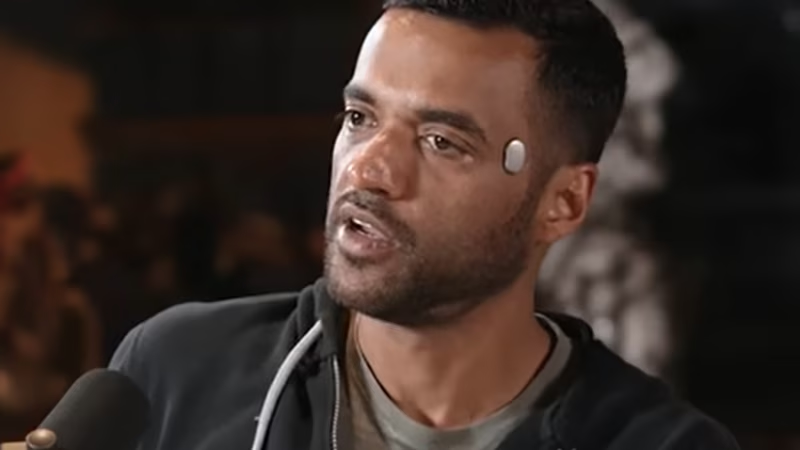
When Zomato founder Deepinder Goyal unveiled his new health wearable—the **Temple device**—he didn’t just enter the crowded wellness market. He made a bold, scientific claim: that this sleek headband could monitor your brain’s blood flow and even predict aging based on his self-proposed “Gravity Aging Hypothesis.”
But not everyone’s buying it. Literally *or* figuratively.
Dr. Suvrankar Datta, a senior physician at the prestigious All India Institute of Medical Sciences (AIIMS), has publicly questioned the **scientific basis of the Temple device**, calling it a “fancy toy for billionaires” that lacks clinical trials, peer-reviewed research, or even basic regulatory validation. And he’s not alone.
So, is the Temple device a revolutionary leap in personal neuro-monitoring—or just another Silicon Valley-style health gimmick dressed in tech jargon? Let’s cut through the hype.
Table of Contents
- What Is the Temple Device?
- The Gravity Aging Hypothesis: Explained (and Scrutinized)
- AIIMS Doctor’s Criticism of the Temple Device
- Why Clinical Trials Matter for Wearables Like This
- The Risk of Celebrity-Backed Health Tech
- What Regulatory Bodies Say (or Don’t Say)
- Conclusion: Be Skeptical, Not Cynical
- Sources
What Is the Temple Device?
Launched by Deepinder Goyal—a tech entrepreneur with no formal medical or neuroscience background—the **Temple device** is a lightweight, headband-style wearable that claims to use “advanced optical sensors” to measure cerebral blood flow (CBF).
According to Goyal, fluctuations in CBF correlate with cognitive performance, stress levels, and even biological aging. The device syncs with a mobile app that offers “personalized insights” and tracks “brain vitality” over time. It’s marketed as a tool for “biohackers,” longevity enthusiasts, and elite wellness seekers.
But here’s the catch: **no independent studies**, no FDA clearance, and no clinical data have been published to support these claims.
The Gravity Aging Hypothesis: Explained (and Scrutinized)
At the core of the Temple device is Goyal’s self-developed “Gravity Aging Hypothesis,” which posits that gravity slowly reduces blood flow to the brain over decades, accelerating aging and cognitive decline.
While reduced cerebral perfusion *is* associated with aging and conditions like dementia, the scientific community has **never validated** gravity as a primary or independent driver of this process. Aging is multifactorial—genetics, vascular health, inflammation, and lifestyle all play major roles.
As Dr. Datta told The Times of India, “You can’t build a medical device on a hypothesis you invented in your living room without testing it in a lab, let alone on humans.”
AIIMS Doctor’s Criticism of the Temple Device
Dr. Suvrankar Datta’s critique is scathing—and grounded in medical ethics:
- No Clinical Validation: “There are zero peer-reviewed papers, no randomized control trials, nothing,” he stated.
- Misleading Marketing: The device implies medical-grade monitoring, but it’s sold as a “wellness product” to bypass regulatory scrutiny.
- Exploiting Health Anxiety: “It preys on people’s fear of aging and cognitive decline,” he warned, calling it a “luxury placebo.”
His final verdict? “It’s a **fancy toy for billionaires**, not a medical device.”
Why Clinical Trials Matter for Wearables Like This
Not all wearables need FDA approval—but when they make **health claims**, the bar rises dramatically.
The U.S. Food and Drug Administration (FDA) classifies devices that “diagnose, treat, or prevent disease” as medical devices, requiring rigorous testing . Similarly, India’s Central Drugs Standard Control Organisation (CDSCO) mandates clinical evidence for health claims.
Yet the Temple device skirts these rules by using vague language like “track your wellness” or “optimize brain vitality”—terms that sound scientific but carry no clinical meaning.
Compare this to validated neuro-wearables like EEG headsets used in sleep studies or fNIRS devices in research labs—both backed by decades of peer-reviewed science.
The Risk of Celebrity-Backed Health Tech
Deepinder Goyal’s fame as Zomato’s CEO lends the Temple device instant credibility—even though his expertise lies in food delivery, not neuroscience.
This is a growing trend: tech founders launching health products with minimal oversight, banking on brand trust rather than scientific merit. Remember Theranos? While the Temple device isn’t accused of fraud, it operates in the same gray zone: **promising medical insights without proof**.
Consumers should ask: Would I trust a heart monitor built by a travel blogger? Then why trust a brain monitor built by a food-tech CEO?
What Regulatory Bodies Say (or Don’t Say)
As of now, the Temple device is **not approved** by the FDA, CE, or CDSCO as a medical device. It’s sold globally as a “general wellness product”—a legal loophole that avoids safety and efficacy requirements.
The FDA’s guidance on general wellness products states they must pose “low risk” and make only “general claims” (e.g., “promotes relaxation”)—not specific diagnostic or therapeutic assertions .
Yet the Temple website and marketing materials blur this line, suggesting users can “understand your brain’s aging trajectory”—a claim that edges dangerously close to medical diagnosis.
Conclusion: Be Skeptical, Not Cynical
Innovation in health tech is exciting—but it must be anchored in evidence. The Temple device may be sleek, expensive, and backed by a famous name, but without clinical trials, peer review, or regulatory approval, it remains an unproven experiment on consumers.
As Dr. Datta’s critique reminds us: just because something *looks* scientific doesn’t mean it *is* scientific. Until independent researchers validate its claims, the Temple device should be viewed not as a health tool, but as an intriguing—but risky—luxury accessory.
For now, your best “brain monitor” remains a healthy diet, good sleep, and regular check-ups with a real doctor—not a headband sold online.
Sources
- The Times of India: AIIMS doctor questions the scientific basis of Deepinder Goyal’s Temple device
- U.S. Food and Drug Administration (FDA): General Wellness: Policy for Low-Risk Devices
- National Institutes of Health (NIH): Cerebral Blood Flow and Aging: A Review