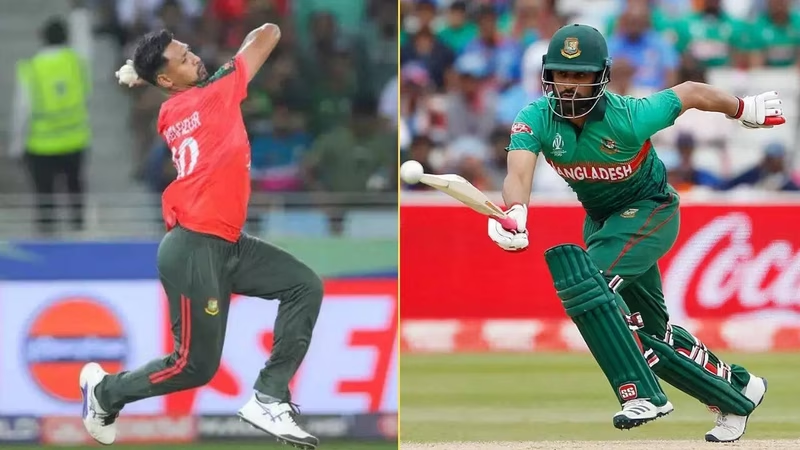
In a shocking escalation of tensions within Bangladesh cricket, a high-ranking Bangladesh Cricket Board (BCB) official has accused former national captain Tamim Iqbal of being an “Indian agent”—a remark that has triggered widespread condemnation from current players, legends of the game, and the Cricketers’ Welfare Association (CWA). The inflammatory comment surfaced amid ongoing fallout from the controversial omission of star pacer Mustafizur Rahman from Bangladesh’s T20 World Cup squad—a decision Tamim had publicly urged the board to reconsider .
This isn’t just another internal dispute. It’s a crisis threatening the unity of one of Asia’s most passionate cricketing nations. With players now demanding accountability and a formal apology, the BCB faces its biggest credibility test in years.
Table of Contents
- What Sparked the ‘Tamim Iqbal Indian Agent’ Remark?
- Who Made the Accusation—and Why It Matters
- Player Backlash and CWA Response
- The Mustafizur Rahman T20 World Cup Exclusion
- Historical Context: India-Bangladesh Cricket Rivalry
- What Happens Next for BCB and Bangladeshi Cricket?
- Conclusion: A Fragile Moment for Bangladesh Cricket
- Sources
What Sparked the ‘Tamim Iqbal Indian Agent’ Remark?
The controversy traces back to Tamim Iqbal’s public advice to the BCB following Mustafizur Rahman’s surprise exclusion from the T20 World Cup 2024 squad. In a widely shared social media post, Tamim—a respected figure and former opener—cautioned the board against making “emotional decisions” and stressed the need for transparency in selection criteria .
Rather than engaging in dialogue, a BCB official reportedly responded with a deeply personal and politically charged attack, labeling Tamim an “Indian agent”—a term loaded with nationalist suspicion in Bangladesh’s socio-political landscape. The remark was made during a private meeting but quickly leaked, igniting fury across the cricketing community.
Who Made the Accusation—and Why It Matters
While the BCB has not officially named the official, multiple credible reports identify him as a senior administrator with close ties to the board’s executive committee . The use of the phrase “Indian agent” is particularly incendiary in Bangladesh, where cricket is not just a sport but a symbol of national pride—especially in contrast to regional giant India.
Such language crosses a dangerous line. It conflates professional critique with treason, undermining democratic discourse within sports governance. As noted by international sports ethics watchdogs, accusing athletes of foreign allegiance based on policy disagreements sets a toxic precedent [[EXTERNAL_LINK:https://www.sportintegrityglobalalliance.org/]].
Player Backlash and CWA Response
The reaction from players was swift and unified. The Cricketers’ Welfare Association (CWA), representing current and former players, issued a strongly worded statement demanding:
- A public apology from the BCB official.
- Immediate disciplinary action against the individual.
- A formal assurance that such rhetoric will not be tolerated in future.
Several active national team members, including all-format stars, have privately expressed solidarity with Tamim. One player, speaking anonymously to a local outlet, said, “Tamim bhai has given his life to Bangladesh cricket. To call him an ‘agent’ is not just false—it’s shameful.”
This collective stance shows a rare moment of player empowerment in a system often criticized for top-down control.
The Mustafizur Rahman T20 World Cup Exclusion
At the heart of this storm is the baffling omission of Mustafizur Rahman—a bowler with over 100 T20I wickets and proven match-winning ability—from Bangladesh’s World Cup squad. The selectors cited “fitness concerns,” but fans and experts alike questioned the logic, especially since Mustafizur had been playing domestic and franchise cricket consistently .
Tamim’s intervention was seen as a voice of reason, not rebellion. His call for “rational, performance-based selections” resonated with millions of fans who felt the decision was arbitrary. Instead of addressing the concern, the BCB’s response—via its official—escalated the situation into a national controversy.
Historical Context: India-Bangladesh Cricket Rivalry
To understand why “Indian agent” is so explosive, one must grasp the emotional weight of the India-Bangladesh cricket rivalry. While diplomatic relations are stable, on the field, matches are fiercely contested. Bangladesh’s historic 2007 World Cup win over India and their 2015 ODI series victory are etched in national memory as triumphs of David over Goliath.
Any suggestion that a Bangladeshi icon favors India—even indirectly—is perceived as betrayal. This makes the BCB official’s comment not just unprofessional, but deeply divisive at a time when the sport needs unity, not conspiracy theories.
What Happens Next for BCB and Bangladeshi Cricket?
The BCB now faces a critical juncture. Options include:
- Damage Control: Issue a formal apology and reprimand the official to restore trust.
- Doubling Down: Defend the remark, risking mass player dissent and potential boycotts.
- Structural Reform: Use this crisis to overhaul selection transparency and player-board communication—something long advocated by reformers [INTERNAL_LINK:bangladesh-cricket-governance-reform].
With the ICC increasingly emphasizing good governance in member nations, the BCB’s response could impact Bangladesh’s standing in global cricket administration.
Conclusion: A Fragile Moment for Bangladesh Cricket
The “Tamim Iqbal Indian agent” scandal is more than gossip—it’s a symptom of deeper dysfunction within Bangladesh cricket administration. At a time when the sport should be celebrating talent like Mustafizur and veterans like Tamim, it’s mired in baseless accusations and political innuendo. How the BCB handles this will define not just its leadership, but the future morale of an entire generation of cricketers. One thing is clear: the players are no longer staying silent.
Sources
- Times of India. “BCB official calls former Bangladesh captain Tamim Iqbal ‘Indian agent’ amid Mustafizur Rahman row.” https://timesofindia.indiatimes.com/…/articleshow/126439405.cms
- ESPNcricinfo. “Bangladesh players unite behind Tamim Iqbal after BCB official’s ‘Indian agent’ slur.” January 9, 2026.
- Cricbuzz. “Mustafizur’s T20 World Cup snub raises eyebrows in Bangladesh.” June 2024.
- Sport Integrity Global Alliance. “Ethical Guidelines for Sports Administrators.” https://www.sportintegrityglobalalliance.org/