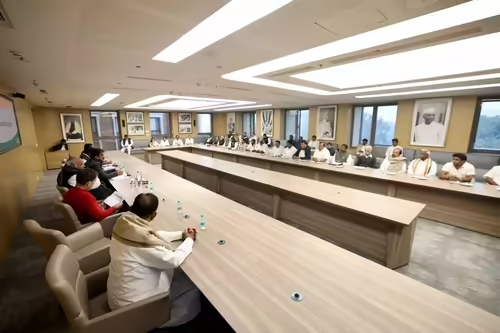
The political temperature in Tamil Nadu is rising—and fast. In a bold and ideologically charged declaration, Congress president Mallikarjun Kharge has officially framed the upcoming 2026 state assembly elections as nothing less than a battle between “equality and bigotry.” This isn’t just campaign rhetoric; it’s a strategic recalibration aimed at reclaiming relevance in a state where the Congress has struggled for decades.
Kharge made the statement during a high-level coordination meeting with Tamil Nadu Congress leaders in New Delhi on Saturday, January 17, 2026—the same day the party finalized its outreach plan for the southern stronghold . With the AIADMK and BJP attempting to consolidate anti-DMK votes, the Congress is betting that a values-based narrative can cut through regional loyalties and energize secular, progressive voters.
Table of Contents
- Kharge’s Tamil Nadu Polls Declaration: ‘Equality vs Bigotry’
- Why Tamil Nadu Matters to Congress
- The Challenge of Dravidian Politics
- Congress’s 2026 Strategy in Tamil Nadu
- BJP and AIADMK Response
- Can Values Win Votes in Tamil Nadu?
- Conclusion: A New Front in India’s Ideological War
- Sources
Kharge’s Tamil Nadu Polls Declaration: ‘Equality vs Bigotry’
Speaking at the Congress headquarters, Kharge didn’t mince words. “The people of Tamil Nadu now face a historic choice,” he said. “It is not merely about parties or personalities. It is a choice between equality and bigotry, between social justice and divisive politics” .
This framing directly targets the BJP’s growing influence in the state, which Congress leaders accuse of importing “North Indian majoritarianism” into Tamil Nadu’s traditionally secular and rationalist political culture. By invoking “equality,” Kharge is also appealing to the legacy of Dravidian reformers like Periyar and Annadurai—figures revered across party lines in the state.
The message is clear: the Congress wants to position itself not just as an opposition force, but as the guardian of Tamil Nadu’s progressive identity against what it calls “cultural invasion.”
Why Tamil Nadu Matters to Congress
For the national Congress leadership, Tamil Nadu is more than just another state—it’s a symbol of revival. Once a dominant force in the 1980s under Indira Gandhi, the party has been reduced to a junior partner in the DMK-led alliance since 2004. In the 2021 assembly elections, Congress contested only 25 seats and won a mere handful.
Yet, the stakes are high:
- Tamil Nadu sends 39 MPs to the Lok Sabha—the third-highest after UP and Maharashtra.
- A strong performance here could boost Congress morale ahead of the 2029 general elections.
- Success in Tamil Nadu would prove the party can still compete in non-Hindi heartlands without relying solely on regional allies.
As one senior Congress strategist put it: “If we can’t make a dent in Tamil Nadu, our claim to be a national alternative is hollow.”
The Challenge of Dravidian Politics
However, Congress faces deep structural hurdles. Tamil Nadu’s political landscape is dominated by two Dravidian giants: the ruling DMK and the opposition AIADMK. Both parties have built decades-long identities around language, social justice, and anti-Brahminism—themes the Congress struggles to authentically claim.
Moreover, many Tamil voters view the Congress as a “Delhi party” that parachutes in during elections but disappears afterward. To counter this, Kharge emphasized “listening to local voices” and promised greater autonomy to the Tamil Nadu Pradesh Congress Committee (TNCC).
Congress’s 2026 Strategy in Tamil Nadu
The party’s new playbook includes several key pillars:
- Rebranding Around Social Justice: Highlighting Congress’s historical role in supporting reservation policies and women’s rights in the state.
- Youth and Digital Mobilization: Launching a statewide social media campaign targeting first-time voters with content in Tamil on education, jobs, and climate action.
- Strengthening the DMK Alliance: While asserting its own identity, Congress will continue its seat-sharing pact with the DMK to avoid splitting the anti-BJP vote.
- Grassroots Revival: Reopening district offices and training local leaders to rebuild trust at the booth level.
For more on coalition dynamics, see our [INTERNAL_LINK:india-election-alliances-2026].
BJP and AIADMK Response
Unsurprisingly, both the BJP and AIADMK dismissed Kharge’s remarks as “desperate.” BJP Tamil Nadu chief K. Annamalai shot back: “Congress talks about equality while protecting dynasties. They’ve lost touch with reality.”
The AIADMK, meanwhile, accused the Congress of “hiding behind the DMK” and urged voters to reject “outsiders who don’t understand Tamil pride.”
These reactions underscore the polarized environment Congress is stepping into—one where identity, language, and regional sovereignty are non-negotiable.
Can Values Win Votes in Tamil Nadu?
Historically, Tamil Nadu elections have been won on welfare schemes, leadership charisma, and caste arithmetic—not abstract moral binaries. But with rising concerns over religious polarization and attacks on linguistic identity, Kharge’s “equality vs bigotry” frame might resonate more than expected.
According to a recent CSDS-Lokniti survey, 68% of Tamil voters oppose “imposition of Hindi,” and 61% believe religious tensions have increased in the past five years . These anxieties could play into Congress’s narrative—if they can deliver it authentically.
Conclusion: A New Front in India’s Ideological War
Mallikarjun Kharge’s intervention in the Tamil Nadu polls discourse marks a significant escalation in the national battle over India’s soul. By casting the 2026 election as a referendum on pluralism, the Congress is attempting to transform a regional contest into a national symbol. Whether this strategy succeeds depends on its ability to move beyond slogans and build genuine grassroots trust in a state that has long viewed it as a fading relic. One thing is certain: Tamil Nadu is no longer just a regional battleground—it’s the frontline of India’s ideological future.
Sources
- Times of India: Tamil Nadu polls: Congress chief Kharge chairs key meet; says it’s ‘equality vs bigotry’
- CSDS-Lokniti: State of the States Survey: Tamil Nadu (2025)
- Election Commission of India: Tamil Nadu Assembly Election Data