Table of Contents
- The Dramatic Walkout in the TN Assembly
- Tamil Nadu Governor Walkout: The Official Allegations
- The DMK Response: A Clash of Narratives
- A History of Tension: Ravi and the DMK
- The Political Stakes Ahead of Upcoming Elections
- Constitutional Questions: Who Holds the Power?
- Conclusion: A State on the Brink of a Constitutional Crisis?
- Sources
The Dramatic Walkout in the TN Assembly
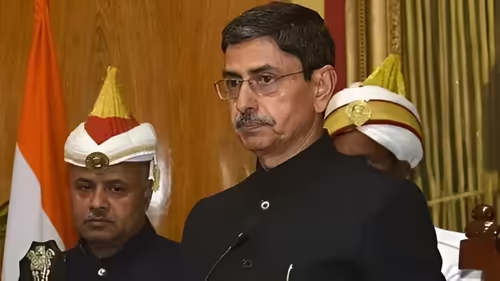
The hallowed halls of the Tamil Nadu Legislative Assembly were the scene of high-octane political drama this week. In a move that stunned legislators and observers alike, Governor RN Ravi abruptly walked out of the chamber moments before he was scheduled to deliver his customary address at the start of the budget session .
The Governor’s office later released a statement claiming that the National Anthem was not played with the “dignity and respect” it deserves, and that his microphone had been deliberately switched off as he attempted to begin his speech. This extraordinary act of protest has thrown the state into a fresh political firestorm, just months before crucial elections.
Tamil Nadu Governor Walkout: The Official Allegations
The Raj Bhavan’s official communication laid out a series of grievances that led to the Tamil Nadu Governor walkout. Beyond the immediate issues of the anthem and the microphone, the statement alleged a deeper, more systemic problem. It claimed that the draft of the Governor’s speech, which is traditionally prepared by the state government for him to read, had been heavily edited to omit critical subjects .
Specifically, the Governor’s office stated that references to serious issues like atrocities against Dalits, the protection of women and children, and other matters of national importance were “conspicuously absent” from the final version provided to him. From the Governor’s perspective, this was not just a procedural slight but an attempt to muzzle his constitutional voice on vital social justice issues.
The DMK Response: A Clash of Narratives
The ruling DMK government has offered a starkly different account of events. Party leaders have dismissed the Governor’s claims as “baseless” and politically motivated. They argue that the National Anthem was played as per protocol and that the technical issue with the microphone was a minor glitch, not a deliberate act of disrespect.
Chief Minister M.K. Stalin’s camp has accused Governor Ravi of overstepping his constitutional boundaries. They maintain that the content of the Governor’s address is a matter for the elected government to decide, as it reflects the policies and priorities of the state administration, not the personal views of the appointed Governor. This fundamental disagreement lies at the heart of the current crisis.
A History of Tension: Ravi and the DMK
This is far from the first clash between RN Ravi and the Tamil Nadu government. In fact, it’s a near-repeat of an incident from last year when the Governor similarly walked out of the assembly, citing identical concerns about the National Anthem and his speech . This recurring pattern suggests a deep-seated, unresolved conflict that goes beyond a single event.
The tension stems from a long-standing ideological divide. Governor Ravi, a former IPS officer with a background in central government and security affairs, is seen as being aligned with the BJP’s national agenda. The DMK, a staunchly regional and secular party, often finds itself at odds with the Centre on various policy and cultural matters. The Governor’s office has become the primary battleground for this larger political struggle.
The Political Stakes Ahead of Upcoming Elections
The timing of this latest confrontation is highly significant. With state and national elections on the horizon, both sides are using this incident to galvanize their support bases. The DMK is framing the Governor’s actions as an assault on Tamil Nadu’s autonomy and an attempt by the Centre to interfere in state affairs.
Conversely, the BJP and its allies are likely to use the “National Anthem insult” narrative to paint the DMK as disrespectful of national symbols, a potent charge in the current political climate. This manufactured crisis is a classic example of how constitutional offices can be weaponized for electoral gain.
Constitutional Questions: Who Holds the Power?
Beyond the political mudslinging, this incident raises serious constitutional questions. Article 176 of the Indian Constitution mandates the Governor to address the state legislature at the start of a new session. However, it also states that the “matters referred to in the address” are those on which the government of the state proposes to take action.
This creates an inherent ambiguity. Is the Governor merely a ceremonial reader of the government’s script, or does he have the right to insist on including his own points? Legal experts are divided, but the prevailing convention in most states is that the government drafts the speech. The Governor’s repeated attempts to deviate from this norm in Tamil Nadu have created a unique and volatile situation that tests the limits of gubernatorial authority.
Conclusion: A State on the Brink of a Constitutional Crisis?
The Tamil Nadu Governor walkout is more than just a political spat; it’s a symptom of a deeper dysfunction in the state’s governance. The repeated breakdown in the relationship between the elected government and the appointed head of state threatens to paralyze the legislative process and erode public trust in democratic institutions. Unless a modicum of mutual respect and a clear understanding of constitutional roles are restored, Tamil Nadu risks being trapped in a cycle of perpetual conflict that serves no one but the most partisan political actors.
Sources
[1] Times of India: High drama in TN assembly: Governor walks out; alleges ‘national anthem insulted’
[4] Web Search Result: RN Ravi’s previous walkout from Tamil Nadu assembly in 2025
[8] Constitution of India, Article 176 (https://www.india.gov.in/my-government/constitution-india)