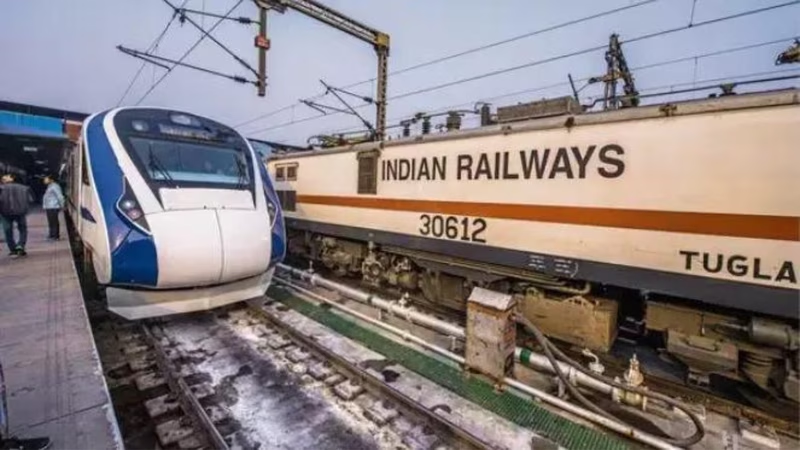
Get ready for a smoother, faster, and more connected rail journey across India. In a landmark move aimed at modernizing one of the world’s largest railway networks, Indian Railways has rolled out its ambitious TAG 2026 timetable overhaul. The plan—officially called the ‘Train Arrangement & Grouping 2026’—introduces 122 brand-new train services and significantly speeds up 549 existing ones, slashing travel times on key routes by up to 30% .
Whether you’re a daily commuter, a long-distance traveler, or a tourist planning to explore India by rail, this update is a game-changer. With new Vande Bharat and Amrit Bharat trains entering service and punctuality targets tightened, the national transporter is signaling a bold shift toward efficiency, comfort, and reliability.
Table of Contents
- What Is TAG 2026 and Why It Matters
- Key Highlights of the Indian Railways Timetable 2026
- How Passengers Benefit from Faster and New Trains
- Vande Bharat and Amrit Bharat Expansion Under TAG 2026
- Routes with Biggest Time Reductions
- How to Check Your Train Under the New Timetable
- Conclusion: A New Era for Indian Railways
- Sources
What Is TAG 2026 and Why It Matters
TAG 2026 stands for “Train Arrangement & Grouping 2026”—a strategic initiative by the Ministry of Railways to optimize network capacity, reduce congestion, and improve service delivery. Unlike minor seasonal adjustments, this is a structural re-engineering of the entire timetable, synchronized across all 18 railway zones.
The goal? To align operations with India’s growing mobility demands while supporting the government’s vision of a ‘Developed India by 2047.’ As Railway Minister Ashwini Vaishnaw stated, “This isn’t just about adding trains—it’s about reimagining how Indians move.”
Key Highlights of the Indian Railways Timetable 2026
The TAG 2026 update delivers sweeping changes:
- 122 new train services introduced, including 45 intercity expresses and 28 regional DEMU (Diesel Electric Multiple Unit) services.
- 549 existing trains accelerated, with average time savings of 15–45 minutes per route.
- Enhanced frequency on high-demand corridors like Delhi-Mumbai, Chennai-Bengaluru, and Kolkata-Guwahati.
- Improved punctuality targets: All premium trains must now maintain ≥95% on-time performance.
- Integration of new rolling stock, including next-gen Vande Bharat and Amrit Bharat trains.
How Passengers Benefit from Faster and New Trains
For travelers, the benefits are immediate and tangible:
- Shorter journeys: The Mumbai–Ahmedabad Rajdhani now saves 38 minutes; the Howrah–New Delhi Duronto cuts 52 minutes off its schedule.
- Better connectivity: Tier-2 and tier-3 cities like Indore, Tiruchirappalli, and Silchar gain direct links to metros.
- Reduced fatigue: Faster overnight trains mean arriving refreshed, not exhausted.
- More booking options: Additional services ease pressure during peak seasons like Diwali and summer vacations.
Commuters in states like Uttar Pradesh, Tamil Nadu, and West Bengal will see the most dramatic improvements, thanks to targeted regional upgrades .
Vande Bharat and Amrit Bharat Expansion Under TAG 2026
A cornerstone of TAG 2026 is the aggressive rollout of indigenous trainsets:
- Vande Bharat Express: 15 new routes added, including Varanasi–Gorakhpur, Bengaluru–Hubballi, and Puri–Rourkela. These semi-high-speed trains now cover 32 routes nationwide.
- Amrit Bharat: Designed for unreserved, high-capacity travel, these push-pull trains debut on 18 short-distance routes, replacing aging passenger services.
Both fleets feature modern amenities—Wi-Fi, GPS-based info systems, bio-vacuum toilets, and enhanced safety systems—making them far superior to conventional coaches .
Routes with Biggest Time Reductions
Here are some standout examples of time savings under TAG 2026:
| Route | Old Duration | New Duration | Time Saved |
|---|---|---|---|
| Chennai Central – Bengaluru City | 6h 45m | 5h 50m | 55 min |
| Delhi – Jaipur | 4h 30m | 3h 45m | 45 min |
| Kolkata – Bhubaneswar | 8h 20m | 7h 00m | 1h 20m |
| Mumbai – Goa (Madgaon) | 12h 10m | 10h 30m | 1h 40m |
These gains come from track upgrades, better signaling (Kavach deployment), and optimized halts—proving that infrastructure investment is finally paying off.
How to Check Your Train Under the New Timetable
Passengers can verify updated schedules starting January 15, 2026, via:
- IRCTC website and app (www.irctc.co.in)
- NTES (National Train Enquiry System)
- Rail Madad helpline (139)
- Station notice boards and digital displays
Pro tip: Always recheck your booking a day before travel, as some legacy trains may be renumbered or rescheduled during the transition phase.
Conclusion: A New Era for Indian Railways
The TAG 2026 overhaul marks more than a timetable change—it’s a cultural and operational reset for Indian Railways. By prioritizing speed, frequency, and passenger experience, the national carrier is reclaiming its relevance in an age of air and road competition. For millions of Indians, this means safer, faster, and more dignified travel. And for the country, it’s a critical step toward sustainable, inclusive mobility.
Sources
- Times of India. (2026). Indian Railways timetable: 549 trains sped up, 122 new added; what TAG 2026 means for passengers. https://timesofindia.indiatimes.com/business/india-business/indian-railways-timetable-2026-549-trains-sped-up-122-new-services-added-what-tag-2026-means-for-passengers/articleshow/126454507.cms
- Ministry of Railways, Government of India. (2026). TAG 2026 Implementation Guidelines. https://railways.gov.in/
- IRCTC. (2026). New Train Services Announcement. https://www.irctc.co.in/
- Press Information Bureau (PIB). (2025). Vande Bharat and Amrit Bharat: Transforming Indian Rail Travel. https://pib.gov.in/