Table of Contents
- How an IPL Snub Sparked a Global Crisis
- BCB President Aminul Islam Bulbul Breaks His Silence
- The Real Story Behind Mustafizur’s Security Concerns
- The Political Undertones of the Standoff
- What This Means for the ICC and Future Tours
- Conclusion: Cricket on the Brink
- Sources
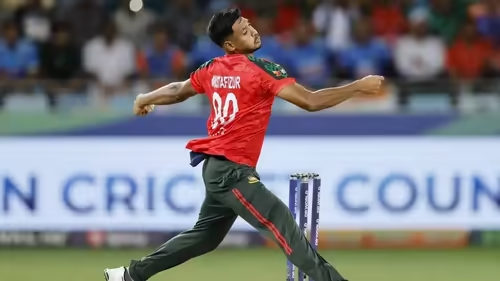
The world of cricket is facing a potential earthquake, and it all started with a single, seemingly routine decision in the Indian Premier League. In a stunning revelation, Bangladesh Cricket Board (BCB) president Aminul Islam Bulbul has confirmed that the T20 World Cup standoff between his nation and the tournament hosts, India, was directly triggered by the IPL’s controversial move to remove star pacer Mustafizur Rahman from his franchise over unspecified security concerns . This isn’t just about logistics or player availability; it’s a crisis of trust that threatens to derail one of the sport’s biggest events.
How an IPL Snub Sparked a Global Crisis
On the surface, the IPL’s decision might have appeared as a standard risk-assessment protocol. Franchises are notoriously cautious about insuring their multi-million dollar assets, and any hint of a security threat can lead to a player being benched. However, for Bangladesh, this wasn’t a simple business decision—it was a profound signal. If one of their most valuable and globally recognized players wasn’t deemed safe enough to play in a domestic Indian league, how could the entire national team be expected to travel to the same country for a high-profile, high-pressure World Cup?
This logic, while perhaps understandable from Dhaka’s perspective, has created a massive headache for the International Cricket Council (ICC). The T20 World Cup is a cornerstone of the global cricket calendar, and the absence of a full-strength Bangladesh team would be a significant blow to the tournament’s credibility and competitive balance [INTERNAL_LINK:t20-world-cup-2026-preview].
BCB President Aminul Islam Bulbul Breaks His Silence
In a candid and unprecedented statement, BCB chief Aminul Islam Bulbul laid bare the sequence of events that led to the current impasse. “We were deeply concerned,” he stated, confirming that the Mustafizur incident was the primary catalyst for their hardened position . This is the first time a senior official has so directly linked the two issues, moving the conversation beyond vague “security concerns” into the realm of specific, actionable grievances.
Bulbul’s admission shifts the narrative significantly. It’s no longer just Bangladesh being difficult; it’s a board reacting to what it perceives as a direct slight and a genuine safety issue for its players. This puts immense pressure on both the IPL governing council and the Board of Control for Cricket in India (BCCI) to provide a transparent and satisfactory explanation for their actions regarding Mustafizur.
The Real Story Behind Mustafizur’s Security Concerns
So, what were these security concerns that led to Mustafizur’s removal? While the exact details remain shrouded in secrecy—common in such matters—the timing is critical. The incident occurred in the lead-up to the T20 World Cup, a period of heightened geopolitical tension in the region. For a player of Mustafizur’s stature, who is a national hero in Bangladesh, any perceived threat is taken with the utmost seriousness by his home board.
The core of the issue seems to be a fundamental lack of communication and reassurance. The BCB likely felt blindsided by the IPL’s unilateral decision. They were not consulted, nor were they given a clear, detailed briefing on the nature of the threat. This information vacuum allowed fear and suspicion to flourish, ultimately poisoning the well for the upcoming World Cup tour. The situation highlights a critical flaw in the current ecosystem: the disconnect between private T20 leagues and national boards when it comes to player welfare and security protocols.
The Political Undertones of the Standoff
While framed as a security and player-welfare issue, it’s impossible to ignore the broader political context. Relations between India and Bangladesh, while generally cooperative, have experienced periods of strain. Cricket, in the subcontinent, is never just a game; it’s a powerful proxy for national pride and identity. The T20 World Cup standoff has quickly become a symbol of this complex relationship.
For the BCB, taking a firm stand is also a matter of domestic politics. Backing down without a solid guarantee of safety could be seen as a sign of weakness by the Bangladeshi public and media. Conversely, the BCCI is under its own pressure to ensure the World Cup is a resounding success on home soil. This creates a classic diplomatic stalemate where both sides are entrenched in their positions, making a swift resolution incredibly difficult.
What This Means for the ICC and Future Tours
The ICC now finds itself in the unenviable role of mediator. Its primary objectives are clear: ensure the tournament goes ahead as planned and guarantee the safety of all participating teams. To achieve this, the ICC will likely need to step in with an independent, third-party security audit for all venues, providing a neutral and authoritative assessment that both the BCB and other potentially nervous boards can trust.
Beyond this immediate crisis, the fallout from this T20 World Cup standoff could have long-lasting implications:
- Player Insurance & Leagues: Franchises may face stricter regulations on how they handle player security and the communication process with national boards.
- Future Bilateral Series: Trust between the BCB and BCCI has been damaged, which could complicate future tours and scheduling.
- Neutral Venues: This incident may accelerate the trend of hosting major tournaments in politically neutral locations to avoid such conflicts altogether.
Conclusion: Cricket on the Brink
The T20 World Cup standoff is more than a logistical dispute; it’s a crisis of confidence that strikes at the heart of international cricket’s fragile ecosystem. The Mustafizur Rahman IPL snub was the spark, but the fuel was already there—built from years of complex political dynamics and a lack of robust communication channels between the sport’s various power centers. The next few weeks will be critical. Will cooler heads prevail, leading to a compromise that allows the beautiful game to take center stage? Or will this standoff become a defining moment of division in cricket history? The entire sporting world is watching.