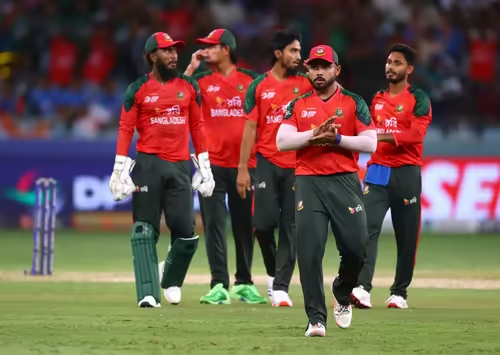
The stage is set for a high-stakes legal and political drama in world cricket. The Bangladesh Cricket Board (BCB) has officially informed the International Cricket Council (ICC) that it will not send its team to India for the upcoming T20 World Cup 2026, citing unresolved security concerns . In a last-ditch effort, the BCB has now appealed to the ICC’s Dispute Resolution Committee (DRC). But here’s the critical question on every fan’s mind: Does this move have any real chance of success?
Table of Contents
- The Core of the T20 World Cup Dispute
- Why the ICC DRC May Be a Dead End for BCB
- What Are the Official T20 World Cup 2026 Venues?
- The Scotland Replacement Rumor, Debunked
- What Happens Next for Bangladesh and the ICC?
- Conclusion
- Sources
The Core of the T20 World Cup Dispute
The conflict erupted in early January 2026 when Bangladesh’s interim government, backing the BCB, declared it would not allow the national team to travel to India for their scheduled group-stage matches. This decision was rooted in deep-seated political tensions and specific security apprehensions following a series of incidents involving Bangladeshi players .
The ICC, however, had already conducted an independent security assessment which reportedly rated the threat level as manageable. In a decisive vote, the ICC Board overwhelmingly approved India as a host nation by a margin of 14-2, effectively rejecting the BCB’s initial request for a venue change .
Why the ICC DRC May Be a Dead End for BCB
This is where the BCB’s latest maneuver comes in. By appealing to the ICC DRC, they are hoping for an impartial review of their case. On the surface, it seems like a logical step. However, experts familiar with the ICC’s internal governance point to a fundamental flaw in this strategy.
The ICC DRC is primarily designed to handle commercial disputes, contractual disagreements between members, or breaches of the ICC’s code of conduct. It is not a body with the authority to override operational decisions made by the ICC Board, such as the finalization of tournament venues—a decision that was ratified months ago .
In essence, the BCB’s appeal appears to be a procedural misfire. They are asking a committee to solve a problem that falls outside its jurisdiction. This move is widely seen as a desperate attempt to buy time and apply public pressure rather than a viable legal pathway to get their matches moved .
What Are the Official T20 World Cup 2026 Venues?
To understand the scale of the BCB’s ask, it’s crucial to know the tournament’s fixed structure. The ICC Men’s T20 World Cup 2026 is a co-hosted event between India and Sri Lanka, running from February 7 to March 8, 2026 .
The ICC has already locked in all eight venues:
- In India: Narendra Modi Stadium (Ahmedabad), Eden Gardens (Kolkata), M. A. Chidambaram Stadium (Chennai), Arun Jaitley Stadium (Delhi), and Wankhede Stadium (Mumbai) .
- In Sri Lanka: R. Premadasa Stadium (Colombo), Pallekele International Cricket Stadium, and Mahinda Rajapaksa International Cricket Stadium (Hambantota) .
Ahmedabad is confirmed to host the final, while Kolkata and Mumbai are the semi-final venues . With logistics, broadcast schedules, and ticket sales likely already in motion, a last-minute venue change for an entire team’s fixtures is logistically near-impossible.
The Scotland Replacement Rumor, Debunked
Rumors have been swirling online that Scotland is “all set” to replace Bangladesh in the tournament. This is categorically false. Scotland failed to qualify for the T20 World Cup 2026 after a heartbreaking loss to Jersey in the Europe Qualifier, ending their streak of four consecutive appearances .
They finished fourth in their regional qualifier, behind the Netherlands and Italy, who secured the two available spots from Europe . There is no official communication or credible report suggesting the ICC is considering Scotland as a replacement. The idea seems to be pure speculation with no basis in the qualification reality.
What Happens Next for Bangladesh and the ICC?
The ball is now firmly in the ICC’s court. The most likely scenario is that the ICC DRC will decline to hear the case on jurisdictional grounds, referring the BCB back to the original Board decision. If Bangladesh sticks to its stance and refuses to travel, they will face severe consequences.
These could include:
- Forfeiture of all group-stage matches, resulting in automatic losses.
- Heavy financial penalties for breaching their participation agreement.
- A potential suspension from future ICC events, which would be a devastating blow to the team and its fans.
The ICC’s priority will be to protect the integrity and smooth running of its flagship T20 event. While the BCB’s security concerns are a sovereign matter, the ICC’s own assessment has deemed the environment safe for competition .
Conclusion
The BCB’s appeal to the ICC DRC is a dramatic but ultimately flawed tactic in the T20 World Cup standoff. The committee lacks the mandate to alter a venue decision that has already been cemented by the ICC Board and integrated into the tournament’s operational blueprint. With Scotland out of the picture as a replacement, Bangladesh faces a stark choice: participate in India or accept the significant sporting and financial repercussions of a withdrawal. For now, the beautiful game finds itself tangled in a web of geopolitics, with the tournament’s success hanging in the balance.
Sources
- Times of India: T20 WC row: BCB’s DRC move hits dead end; Scotland all set to replace Bangladesh
- ICC Official Website: ICC announces venues for Men’s T20 World Cup 2026
- ESPNcricinfo: Bangladesh T20 World Cup Row LIVE Updates
- [INTERNAL_LINK:icc-governance-structure]
- [INTERNAL_LINK:t20-world-cup-2026-schedule-and-teams]