Table of Contents
- The Controversial Claim That Sparked Outrage
- Why Bangladesh Is Hesitant to Play in India
- T20 World Cup Stakes for Different Nations
- The Politics Behind the Pitch
- What the ICC Says About Hosting and Security
- Conclusion: Cricket in a Geopolitical Crossfire
- Sources
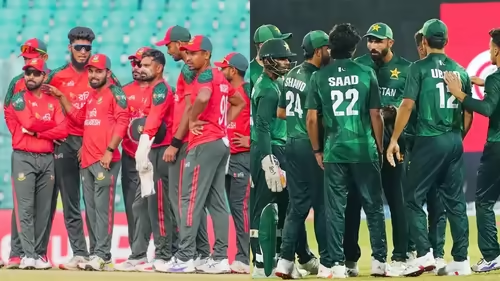
The upcoming T20 World Cup was supposed to be a celebration of fast-paced cricket, global unity, and sporting excellence. But instead, it’s becoming a lightning rod for geopolitical tension—and now, a controversial statement from a former Pakistan international has thrown fuel on the fire. Ex-spinner Danish Kaneria recently claimed that if Bangladesh refuses to play in the 2026 T20 World Cup in India due to security concerns, “it won’t matter.” But, he added ominously, “if Pakistan refuse… that’s a different story.” The remark has sparked fierce debate across the cricketing world, raising uncomfortable questions about equity, influence, and the politicization of sport.
The Controversial Claim That Sparked Outrage
In a candid interview, Danish Kaneria—a once-celebrated leg-spinner who played 61 Tests for Pakistan—defended the International Cricket Council’s (ICC) decision to keep India as the sole host of the 2026 men’s T20 World Cup. He dismissed Bangladesh’s expressed security concerns as exaggerated, arguing that their potential absence would have minimal impact on the tournament’s prestige or commercial success .
“If Bangladesh don’t play, it won’t matter,” Kaneria bluntly stated. “But if Pakistan refuse to go, then yes—it will matter a lot.” His comments were not just about team rankings; they touched on market size, fan base, broadcast revenue, and historical rivalries that drive global viewership. While factually grounded in commercial realities, the phrasing came across as dismissive and insensitive to many fans and officials in Bangladesh, a nation with a passionate cricket culture and a top-10 ICC ranking.
Why Bangladesh Is Hesitant to Play in India
Bangladesh’s concerns aren’t born out of thin air. The country has cited genuine security anxieties, particularly in light of recent regional tensions and past incidents involving its players during tours to India. While no specific threat has been publicly confirmed, the Bangladesh Cricket Board (BCB) has emphasized its duty of care to its athletes—a stance echoed by several other boards in high-risk environments .
Moreover, the political climate between Dhaka and New Delhi has seen strain over issues like water sharing, border disputes, and trade imbalances. Though cricket has often served as a diplomatic bridge, the BCB appears unwilling to take chances without ironclad security guarantees from Indian authorities and the ICC.
T20 World Cup Stakes for Different Nations
Kaneria’s remarks, however tactless, reflect a harsh truth about the modern economics of international cricket:
- India, Pakistan, and Australia are the “Big Three” in terms of revenue generation, TV rights, and fan engagement.
- Bangladesh, while a competitive side with a massive domestic following, contributes less to global broadcast metrics outside South Asia.
- The ICC’s financial model heavily relies on marquee matchups—especially India vs. Pakistan—which can generate upwards of $100 million in ad revenue alone .
This imbalance creates a two-tier system where some teams are deemed “essential” and others “expendable”—a reality that undermines the spirit of inclusive global sport.
The Politics Behind the Pitch
Cricket has long been entangled with politics in South Asia. From the 1971 war influencing early India-Pakistan matches to the 2008 Mumbai attacks halting bilateral series, the sport rarely exists in a vacuum. Kaneria’s comment—that political issues are overshadowing cricket—is ironic, given that his own statement is steeped in geopolitical calculus.
He urged that “cricket should remain separate from politics,” yet his assessment of which team’s participation “matters” is itself a political judgment based on economic clout and media power. This duality is at the heart of the current crisis: everyone claims to want pure sport, but decisions are made through lenses of diplomacy, finance, and national interest.
For more on how politics shapes cricket, see our feature on [INTERNAL_LINK:politics-in-south-asian-cricket].
What the ICC Says About Hosting and Security
The ICC has repeatedly affirmed that India is fully prepared to host the 2026 T20 World Cup and that all necessary security protocols will be in place for every participating nation. In a public statement, an ICC spokesperson said, “Player safety is our highest priority. We are working closely with Indian authorities and all member boards to ensure a safe and successful tournament” .
Still, the ICC faces a delicate balancing act. If Bangladesh withdraws, it could set a precedent for other nations to demand special conditions. If Pakistan participates despite historical tensions, it could be hailed as a diplomatic breakthrough—or backfire spectacularly if an incident occurs. The stakes couldn’t be higher.
For authoritative context on global sports governance, refer to the BBC Sport Cricket section, which provides independent coverage of ICC decisions and international reactions.
Conclusion: Cricket in a Geopolitical Crossfire
Danish Kaneria’s blunt take may have ruffled feathers, but it exposed an uncomfortable truth: not all teams are valued equally in the global cricket economy. While the ideal of sport as a unifying force remains noble, the reality of the T20 World Cup is shaped by markets, geopolitics, and power dynamics. Bangladesh’s concerns deserve serious consideration—not dismissal. And Pakistan’s potential participation, while commercially significant, shouldn’t eclipse the principle that every player, from every nation, deserves equal safety and respect. As the countdown to 2026 begins, the cricket world must decide whether it will prioritize profit or principle.
Sources
- Times of India: “T20 WC drama: ‘If Bangladesh don’t play, it won’t matter; if Pakistan refuse…’” (January 2026)
- Bangladesh Cricket Board (BCB) official statements on security protocols (2025–2026)
- ICC Media Releases on T20 World Cup 2026 Hosting and Safety Measures
- Financial Times & ESPNcricinfo reports on cricket broadcasting economics