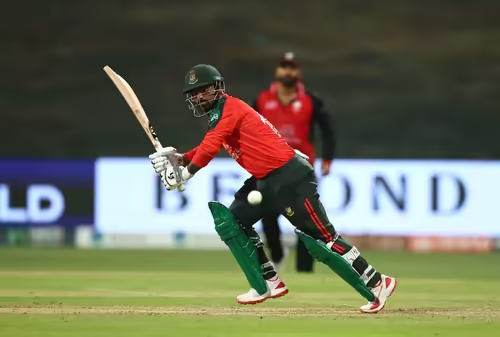
The diplomatic storm swirling around the T20 World Cup just got a lot more personal. Former India fast bowler Atul Wassan has waded into the heated debate over Bangladesh’s request to relocate its matches from India—with a single, pointed sentence that’s echoing across cricketing circles: “Your captain is Hindu.”
Wassan’s remark, referencing Bangladesh skipper Litton Das’s well-known religious identity, cuts straight to the heart of what many see as a contradiction in the BCB’s stance. While citing vague “security concerns” to justify moving games out of India, Bangladesh continues to proudly field a Hindu captain—a fact Wassan says undermines their entire argument. With the ICC firmly stating all matches will remain in India, this controversy has shifted from logistics to legacy, faith, and the very spirit of international sport.
Table of Contents
- The BCB Request—and Why It Backfired
- Atul Wassan’s Rebuttal: ‘Your Captain is Hindu’
- Litton Das: A Symbol of Bangladesh’s Secular Spirit
- Logistics and Security: Why India Is Staying as Host
- ICC Stance: No Changes to T20 World Cup Venues
- Broader Implications for Cricket Diplomacy
- Conclusion: Can Cricket Rise Above Political Narratives?
- Sources
The BCB Request—and Why It Backfired
The Bangladesh Cricket Board recently approached the International Cricket Council (ICC) seeking to shift its group-stage fixtures of the T20 World Cup 2026 from India to a neutral venue. The request cited unspecified “security concerns” for players and officials—a move widely interpreted as politically motivated, especially given regional tensions .
However, the timing raised eyebrows. Just months earlier, the ICC had agreed to move the 2025 Champions Trophy out of Pakistan after India refused to travel there. Bangladesh appeared to be invoking the same precedent—but without the same level of documented risk or government-level backing. Critics quickly labeled the request as opportunistic rather than urgent.
Atul Wassan’s Rebuttal: ‘Your Captain is Hindu’
Enter Atul Wassan. In a candid media interaction, the ex-pacer didn’t hold back. “If India is unsafe for your team, then how can your national captain be a Hindu?” he asked rhetorically. “Doesn’t that show that Bangladesh itself embraces religious diversity at the highest level?”
Wassan’s point was both symbolic and strategic. By highlighting Litton Das’s identity, he exposed a glaring inconsistency: if a Hindu can lead Bangladesh without issue, why assume a Hindu-majority nation like India poses a threat to Bangladeshi citizens? “This isn’t about safety,” Wassan argued. “It’s about narrative.”
Litton Das: A Symbol of Bangladesh’s Secular Spirit
Litton Das isn’t just any cricketer—he’s one of Bangladesh’s most dependable batters and a quiet emblem of the country’s constitutional secularism. He has openly discussed his Hindu faith in interviews, even visiting temples before major matches. His appointment as limited-overs captain was celebrated as a merit-based decision that transcended religion.
In a 2024 interview with a Dhaka newspaper, Das said, “I play for Bangladesh, not for my religion.” That sentiment underscores the irony in the BCB’s current position. If faith doesn’t define a player’s loyalty at home, it shouldn’t be weaponized as a reason for exclusion abroad.
Logistics and Security: Why India Is Staying as Host
Beyond symbolism, Wassan emphasized the sheer impracticality of relocating matches this close to the tournament. The T20 World Cup schedule, broadcast deals, ticketing systems, and security blueprints have been finalized for months. Moving even one fixture would trigger chaos:
- Disruption to team acclimatization and travel plans
- Massive financial losses for local organizers and vendors
- Legal complications with broadcasters like Disney Star and Sky Sports
- Potential domino effect if other teams make similar demands
Moreover, India has a proven track record of hosting high-profile events securely—from the 2011 ODI World Cup to the 2023 Asia Cup. “Every visiting team gets Z-plus or equivalent security,” Wassan noted. “To suggest otherwise is disingenuous.”
ICC Stance: No Changes to T20 World Cup Venues
The ICC has officially confirmed that all matches—including Bangladesh’s—will be played in India as scheduled. In a brief statement, the council said, “Comprehensive security assessments have been conducted in coordination with Indian authorities, and all participating teams will receive equal protection” .
This aligns with ICC protocol: host changes only occur in cases of war, natural disaster, or government-mandated travel bans. None of these apply to India in 2026. The BCB’s request, while within its rights, simply didn’t meet the threshold for emergency intervention.
Broader Implications for Cricket Diplomacy
This episode reflects a growing trend where cricket becomes a proxy for geopolitical friction. Yet experts warn that frequent venue disputes erode the integrity of global tournaments. As the [Marylebone Cricket Club (MCC)](https://www.lords.org/mcc/), custodian of cricket’s laws, states: “The spirit of cricket thrives on mutual respect—not conditional participation.”
If every board begins citing “concerns” without evidence, the sport risks fragmentation. Wassan’s intervention, therefore, isn’t just about India—it’s a defense of consistent standards for all nations.
For fans tracking team dynamics, our [INTERNAL_LINK:t20-world-cup-2026-team-profiles] page offers updated squad analyses and match previews.
Conclusion: Can Cricket Rise Above Political Narratives?
Atul Wassan’s blunt reminder—“Your captain is Hindu”—is more than a retort; it’s a call for honesty, consistency, and sportsmanship. The T20 World Cup should celebrate talent, not amplify suspicion. With the ICC holding firm and India’s security apparatus fully engaged, the ball is now in Bangladesh’s court: will it let its team compete on merit, or let ambiguity overshadow its cricketing pride?
Sources
- Times of India: ‘Your captain is Hindu’: Ex-India cricketer warns Bangladesh over shifting T20 WC matches
- International Cricket Council (ICC): Official Statements on T20 World Cup Hosting
- ESPNcricinfo: Profile and Interviews with Litton Das
- Marylebone Cricket Club (MCC): The Spirit of Cricket Guidelines