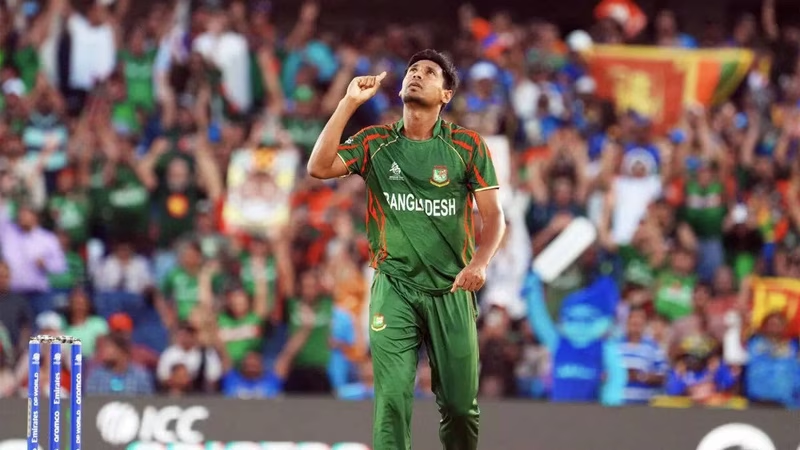
The beautiful game of cricket has once again been held hostage by geopolitics. In an unprecedented and dramatic escalation, the Bangladesh Cricket Board (BCB) has announced its team’s official withdrawal from the upcoming T20 World Cup 2026 in India. This nuclear option was taken in direct response to the Board of Control for Cricket in India’s (BCCI) directive to the Kolkata Knight Riders (KKR) to release their star overseas player, Mustafizur Rahman, from his IPL contract . The fallout has been swift and severe, with the Bangladesh government even suspending all IPL broadcasts in the country .
Table of Contents
- The Mustafizur Incident: What Really Happened?
- T20 World Cup 2026: The Point of No Return
- Beyond Cricket: The IPL Broadcast Ban
- The Political Backdrop: A Diplomatic Freefall
- Global Reactions and ICC Dilemma
- Conclusion: Can Cricket Ever Be Just a Game?
- Sources
The Mustafizur Incident: What Really Happened?
Mustafizur Rahman, affectionately known as ‘The Fizz,’ was a key part of KKR’s bowling attack for the IPL 2026 season, having been retained for a hefty sum of ₹9.20 crore . However, in a sudden and stunning move, the BCCI instructed KKR to release him from his contract. The official reason cited by BCCI secretary Devajit Saikia was vague, referring only to “developments all around” .
Multiple reports, however, point to a deeper, more troubling cause. The decision is widely believed to be linked to recent reports of violence against the Hindu minority community in Bangladesh in December . The move was reportedly influenced by political pressure from India’s ruling party, which called for action against players from nations perceived as hostile to Indian interests . This transformed a simple player retention issue into a high-stakes diplomatic incident.
T20 World Cup 2026: The Point of No Return
For Bangladesh, the BCCI’s action was the final straw. The BCB declared that it would not send its national team to India for the T20 World Cup 2026, citing grave concerns for the “safety and well-being” of its players . They have formally requested the International Cricket Council (ICC) to relocate their matches to a neutral venue .
This is a massive blow to the tournament’s integrity and commercial success. Bangladesh is a passionate cricketing nation with a huge global fanbase. Their absence not only creates a logistical nightmare for the ICC but also robs the event of one of its most exciting and competitive teams. The decision effectively ends the hopes of a billion fans and casts a long, dark shadow over what was supposed to be a celebration of the sport.
Beyond Cricket: The IPL Broadcast Ban
The fallout wasn’t confined to the international stage. The Bangladesh interim government took its own retaliatory measure by issuing a formal order to all television channels in the country to suspend the broadcast of the IPL 2026 . This decision, made just two days after the Mustafizur news broke , is a significant economic and cultural move.
The IPL is one of the most-watched sporting events in Bangladesh. Banning its broadcast is a direct message to the BCCI and the Indian establishment, showing that Dhaka is willing to make its own population pay a price to make a political point. It’s a stark illustration of how quickly sporting ties can evaporate when political tensions rise.
The Political Backdrop: A Diplomatic Freefall
While the BCCI and BCB are the public faces of this crisis, the real drivers are clearly political. The “recent regional and administrative developments” that prompted the BCCI’s action are rooted in a long-simmering diplomatic feud between the two neighboring nations.
Cricket, in South Asia, has never been just a sport. It is a proxy for national pride, identity, and, increasingly, foreign policy. The Mustafizur controversy is a textbook case of this dangerous conflation. What should have been a matter for cricket boards to handle—a player’s availability—was weaponized by political forces on both sides, leading to a complete breakdown in sporting relations.
Global Reactions and ICC Dilemma
The global cricketing community has been left stunned. The ICC now faces its biggest crisis since the pandemic. Its core mandate is to govern the sport, but it is powerless against sovereign governments and their political agendas.
The dilemma is immense:
- Should the ICC force Bangladesh to play in India, potentially risking player safety and defying a government order?
- Or should it relocate the matches, setting a precedent that could be exploited in future political disputes?
- What message does Bangladesh’s withdrawal send to other nations about the stability of hosting major ICC events?
There are no easy answers, and the ICC’s handling of this situation will be scrutinized for years to come.
Conclusion: Can Cricket Ever Be Just a Game?
The T20 World Cup 2026 was meant to be a festival of cricket. Instead, it has become a grim reminder of how easily sport can be corrupted by politics. The loss of Bangladesh from the tournament is not just a blow to fans; it’s a failure of the cricketing ecosystem to insulate itself from external forces. The Mustafizur Rahman controversy has laid bare the fragile nature of international sport in an age of rising nationalism. One can only hope that cooler heads will prevail soon, for the sake of the game we all love. Until then, the silence from Bangladesh will be deafening on India’s cricket fields. For more on the future of international cricket governance, see our analysis on [INTERNAL_LINK:icc-future-reforms]. You can also find official tournament regulations on the ICC’s official website.
Sources
- Times of India. “Mustafizur controversy: Big loss for Bangladesh cricket not playing in India.” Accessed January 2026.
- Multiple news reports on Bangladesh’s withdrawal from T20 World Cup 2026 [[1], [2], [3], [5], [6], [7]].
- Reports on BCCI’s directive to KKR regarding Mustafizur Rahman [[10], [11], [12], [14], [15], [17]].
- Reports on the Bangladesh government’s ban on IPL broadcasts [[19], [20], [21], [22], [23], [24]].