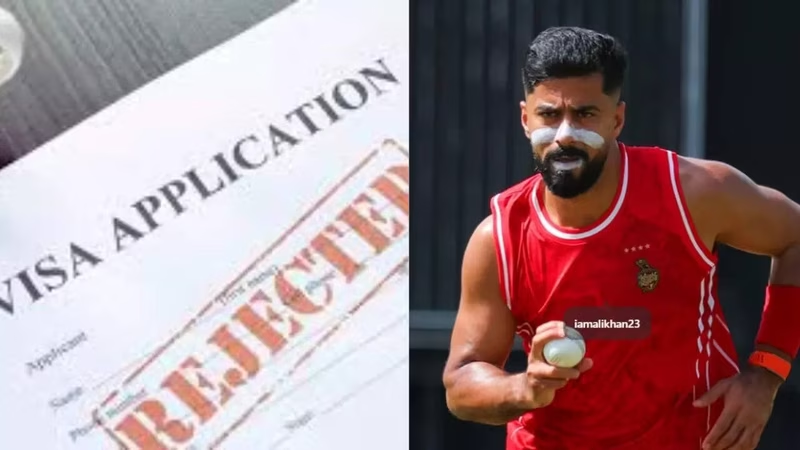
The stage was set for a historic moment: the United States men’s cricket team, fresh off their breakthrough 2024 campaign, ready to compete on Indian soil in the T20 World Cup 2026. But that dream has hit a devastating roadblock. Fast bowler Ali Khan—a cornerstone of the USA squad and a naturalized U.S. citizen—has been denied an Indian visa solely because he was born in Pakistan .
Khan confirmed the news in a heartfelt Instagram post on January 10, 2026, writing, “Despite proudly representing the United States of America… I’ve been denied a visa to compete in the T20 World Cup in India.” His exclusion isn’t just a personal blow; it’s a stark reminder that even in the global arena of sport, geopolitics can cast a long, dark shadow.
Table of Contents
- Who Is Ali Khan? From Lahore to Team USA
- The T20 World Cup 2026 Visa Denial: What Happened?
- Why India Denies Visas to Pakistan-Born Citizens (Even Naturalized Ones)
- Historical Precedents: When Politics Blocked Athletes
- Impact on USA Cricket and the T20 World Cup 2026
- ICC Response and the Future of Global Cricket
- Conclusion: Can Sport Truly Be Borderless?
- Sources
Who Is Ali Khan? From Lahore to Team USA
Born in Lahore, Pakistan, in 1990, Ali Khan moved to the United States as a teenager. He became a U.S. citizen in 2016 and has since dedicated his life to elevating American cricket. A right-arm pacer known for his pinpoint yorkers and death-bowling prowess, Khan was instrumental in USA’s qualification for the 2024 T20 World Cup—their first appearance in 15 years .
He made history in 2020 as the first USA player ever signed by an IPL franchise (Kolkata Knight Riders), though he never played a match. For Khan, representing Team USA isn’t just a career—it’s a statement of identity and belonging.
The T20 World Cup 2026 Visa Denial: What Happened?
As teams finalized travel plans for the tournament co-hosted by India and Sri Lanka, Khan’s visa application was rejected without a detailed explanation. While other USA squad members—including those of South Asian descent—received their visas, Khan’s Pakistani birthplace appears to have triggered India’s strict security protocols .
This decision comes despite Khan holding a valid U.S. passport, having undergone FBI background checks, and being cleared by the International Cricket Council (ICC) as an eligible player under its nationality regulations.
Why India Denies Visas to Pakistan-Born Citizens (Even Naturalized Ones)
India maintains one of the world’s most restrictive visa policies for individuals born in Pakistan, rooted in decades of conflict, espionage concerns, and the unresolved Kashmir dispute. The Ministry of External Affairs rarely grants exceptions, even for dual or naturalized citizens of allied nations like the U.S. or U.K. .
While business or family visas may occasionally be approved after intense scrutiny, participation in high-profile international events on Indian soil is often deemed too sensitive. This policy has previously affected artists, academics, and now, athletes.
Historical Precedents: When Politics Blocked Athletes
Sport and politics have long been entangled:
- 1980 & 1984 Olympics: The U.S. and USSR led boycotts of each other’s Games during the Cold War.
- 2009: The attack on the Sri Lankan cricket team bus in Lahore led to a decade-long exile of international cricket from Pakistan.
- 2022 FIFA World Cup: Several Iranian players faced government pressure over anthem protests, highlighting state control over athletes .
However, denying entry based purely on country of birth—despite full legal citizenship elsewhere—sets a troubling new precedent for inclusive global tournaments.
Impact on USA Cricket and the T20 World Cup 2026
Ali Khan’s absence is a massive tactical loss. As USA’s lead fast bowler and most experienced T20 performer, his ability to execute under pressure was seen as critical against power-hitting lineups like India, South Africa, or England. His leadership in the dressing room is equally irreplaceable .
For the T20 World Cup 2026, this incident undermines the ICC’s stated mission to “globalize the game.” If emerging nations like USA, Nepal, or Uganda cannot bring their best players to host countries due to birthplace-based restrictions, the tournament’s credibility as a truly world championship is compromised.
ICC Response and the Future of Global Cricket
The ICC has acknowledged the situation and confirmed it is “in urgent dialogue with Indian authorities” . However, the governing body has limited power to override sovereign immigration laws. This exposes a critical flaw in the current system: the ICC can certify player eligibility, but cannot guarantee their physical access to the event.
Going forward, the ICC may need to implement stricter host-nation agreements that mandate non-discriminatory entry for all accredited participants—a move that could influence future bidding processes. [INTERNAL_LINK:future-of-icc-tournaments] explores how governance reforms could prevent similar crises.
Conclusion: Can Sport Truly Be Borderless?
The denial of Ali Khan’s visa for the T20 World Cup 2026 is more than an administrative setback—it’s a test of cricket’s soul. At a time when the sport is actively courting new fans in non-traditional markets, excluding a legitimate representative of a full ICC member nation sends a message that old rivalries still dictate who gets to play. The hope now is that diplomacy, reason, and the spirit of fair play can prevail before the first ball is bowled.
Sources
- Times of India. “T20 World Cup: Pakistan-born USA pacer denied Indian visa…” https://timesofindia.indiatimes.com/…
- ESPNcricinfo. “Ali Khan: Profile and Career Stats.” https://www.espncricinfo.com/…
- Ministry of External Affairs, Government of India. “Visa Guidelines for Pakistani Nationals.” https://www.mea.gov.in/
- International Olympic Committee. “Political Neutrality in Sport.” https://olympics.com/
- USA Cricket. “Official Squad Announcement – T20 World Cup 2026.” https://www.usacricket.org/
- ICC Media Release. “Statement on Player Visa Issues for T20 World Cup 2026.” https://www.icc-cricket.com/…