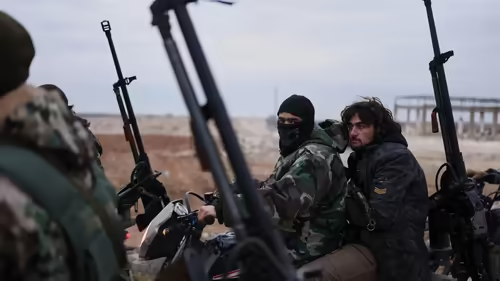
The fragile calm in northeastern Syria has shattered. In a bold and unexpected maneuver, the Syrian Arab Army—backed by Russian airpower and Iranian-linked militias—has surged toward Kurdish-controlled zones, seizing control of a strategically vital military airport near the city of Al-Hasakah .
This isn’t just another skirmish. It’s a direct challenge to the Syrian Democratic Forces (SDF), the U.S.-allied Kurdish-led coalition that has governed much of northeastern Syria since the defeat of ISIS. For years, an uneasy truce held between Damascus and the Kurds, brokered largely by American presence. But with global attention diverted and U.S. commitments wavering, the Assad regime appears ready to reclaim what it sees as sovereign territory—by force if necessary.
The capture of this airbase marks the most significant territorial gain by Syrian government forces in the northeast since 2019. And it raises urgent questions: Is this the beginning of a full-scale offensive? What will the U.S. do? And can the Kurds hold their ground?
Table of Contents
- Syria Army Kurdish Areas: The Strategic Offensive
- Why This Airport Matters
- The Kurdish Dilemma: Trust, Betrayal, and Survival
- Role of Russia, Iran, and the U.S.
- Humanitarian Risks in a New Conflict Zone
- Historical Context: From ISIS to Autonomy
- Conclusion: A Tipping Point for Syria?
- Sources
Syria Army Kurdish Areas: The Strategic Offensive
According to multiple battlefield reports, Syrian government troops, supported by elite Republican Guard units and Liwa al-Quds (a pro-regime Palestinian militia), launched a multi-pronged assault from positions west of Al-Hasakah . Within 48 hours, they overran lightly defended outposts and captured Tabqa Military Airport—a facility once used by ISIS and later by the SDF for logistics and limited air operations.
The Syria army Kurdish areas advance exploits a perceived power vacuum. With U.S. troop numbers in Syria reduced to under 900 and no clear long-term strategy, Damascus sees an opportunity to reassert control without triggering a direct confrontation with Washington.
Why This Airport Matters
Tabqa Airbase isn’t just any airstrip. Its strategic value is immense:
- Geographic Location: Situated midway between Raqqa and Al-Hasakah, it controls key supply routes across the Euphrates corridor.
- Operational Capacity: The runway can handle medium-lift aircraft, enabling rapid troop and equipment deployment deep into Kurdish territory.
- Symbolic Significance: Retaking infrastructure once held by “separatists” reinforces the regime’s narrative of national unity.
Control of this base gives the Syrian military a forward operating platform to threaten SDF strongholds like Qamishli and even the oil-rich Deir ez-Zor province.
The Kurdish Dilemma: Trust, Betrayal, and Survival
For the Kurds, this is a nightmare scenario. Having lost U.S. protection in 2019 when President Trump abruptly withdrew troops—leading to a Turkish invasion—they’ve walked a tightrope ever since, negotiating with Damascus while maintaining autonomy.
Now, with the regime on the move, the SDF faces an impossible choice: fight a war on two fronts (against both Damascus and Ankara) or accept subjugation under Assad’s rule. Neither option guarantees survival. As one Kurdish commander told Reuters, “We defended Syria from ISIS. Now we’re being punished for it” .
Role of Russia, Iran, and the U.S.
This escalation doesn’t happen in a vacuum:
- Russia: Provides air cover and diplomatic backing, viewing the northeast as part of its sphere of influence. Moscow likely approved this operation to counter U.S. presence.
- Iran: Seeks land corridors to Lebanon; a weakened SDF removes a barrier to its regional ambitions.
- United States: Has issued “strong concerns” but stopped short of threatening military action. The Biden administration appears focused on counterterrorism, not territorial defense of Kurdish zones .
For deeper analysis on great-power rivalry in Syria, see our feature on [INTERNAL_LINK:syria-geopolitics-russia-us-iran].
Humanitarian Risks in a New Conflict Zone
Northeastern Syria hosts over 1.5 million displaced people, including residents of the notorious Al-Hol camp filled with ISIS families. Renewed fighting could trigger mass displacement, disrupt food and medical aid, and create conditions for ISIS resurgence.
The UN Office for the Coordination of Humanitarian Affairs (OCHA) has already warned of “catastrophic consequences” if hostilities escalate near civilian centers .
Historical Context: From ISIS to Autonomy
Since 2014, the SDF—led by the Kurdish YPG—has been the primary U.S. partner in defeating ISIS. In return, they established the Autonomous Administration of North and East Syria (AANES), often called Rojava. While never seeking formal independence, they built self-governing institutions in education, justice, and energy.
Damascus has always rejected this autonomy as illegal. Now, with the regime militarily resurgent and internationally rehabilitated, the window for Kurdish self-rule may be closing fast.
Conclusion: A Tipping Point for Syria?
The Syrian army’s push into Syria army Kurdish areas and seizure of a key airbase is more than a tactical victory—it’s a potential turning point in the 14-year Syrian conflict. If unchecked, it could lead to the collapse of Kurdish autonomy, a new refugee crisis, and renewed jihadist activity. The world is watching, but so far, silence speaks louder than action. For the Kurds, the message is clear: in the ruthless calculus of Middle Eastern power politics, allies are temporary—but territory is forever.
Sources
[1] Times of India: Syria: Army moves towards Kurdish-held areas; capture key military airport
[3] Reuters: Kurdish Forces Warn of Regime Offensive in Northeast Syria
[4] U.S. Department of State: Press Briefing on Syria (January 2026)
[5] United Nations OCHA: Syria Humanitarian Needs Overview 2026
[6] International Crisis Group: “The Fragile Calm in Northeast Syria” – Report No. 245