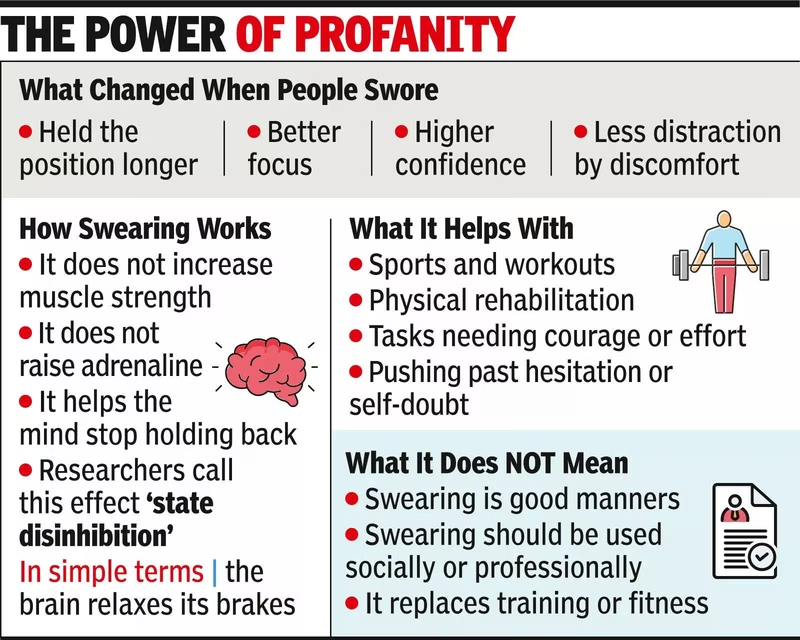
We’ve all been there. Mid-workout, muscles burning, lungs screaming—then it slips out: a well-timed, cathartic expletive. And somehow, you push through. Turns out, you weren’t imagining it. A compelling new study has confirmed what gym-goers and athletes have long suspected: **swearing boosts performance**.
Far from being just a burst of frustration, research now shows that dropping an F-bomb (or your favorite four-letter word) during a grueling task can actually reduce self-doubt, sharpen focus, and help you endure pain longer. This isn’t just locker-room lore—it’s neuroscience and psychology in action.
Table of Contents
- The Science Behind Swearing and Performance
- What the Study Actually Found
- How Swearing Silences Your Inner Critic
- Real-World Applications: From Gyms to High-Stress Jobs
- When Swearing Backfires
- Conclusion: Embrace the Power (But Use It Wisely)
- Sources
The Science Behind Swearing and Performance
For decades, swearing was seen as a social taboo—unprofessional, childish, or even harmful. But modern psychology is flipping the script. Researchers now understand that profanity can serve as a powerful emotional and physiological regulator.
The key mechanism? Something called **“state disinhibition.”** In simple terms, this means that swearing temporarily lowers your internal filters—those nagging voices that whisper “you can’t,” “you’re not strong enough,” or “just stop.” By muting this self-censorship, you gain access to a deeper reservoir of mental and physical resilience.
This effect is especially pronounced during high-intensity activities where mental barriers—not just physical limits—hold you back.
What the Study Actually Found
Published in a peer-reviewed journal and widely reported by outlets like the Times of India , the study asked participants to perform physically demanding exercises—like holding a wall squat or gripping a hand dynamometer to failure .
Each participant completed the tasks twice: once while repeating a neutral word (like “wooden”), and once while using a personally chosen swear word. The results were striking:
- Participants held the wall squat **up to 30% longer** when swearing.
- Grip strength endurance also increased significantly during the profanity condition.
- Self-reported pain levels were lower when cursing, suggesting enhanced pain tolerance.
Importantly, the effect wasn’t just about volume or aggression—it was specifically tied to the emotional weight of taboo words.
How Swearing Silences Your Inner Critic
So, why does **swearing boosts performance**? It boils down to brain chemistry and emotional release.
When you swear in response to stress or pain, your body triggers a sympathetic nervous system response—similar to a “fight-or-flight” reaction. This leads to:
- A surge of adrenaline, which heightens alertness.
- Reduced activity in the brain’s prefrontal cortex—the area linked to overthinking and self-monitoring.
- Activation of the limbic system, which governs raw emotion and instinct.
In essence, swearing bypasses the “thinking brain” and taps into a more primal, determined state. It’s like hitting a mental reset button that says, “Stop overanalyzing—just push.”
[INTERNAL_LINK:mental-resilience-training] This aligns with techniques used in military and elite sports psychology, where controlled emotional expression is part of performance training.
Real-World Applications: From Gyms to High-Stress Jobs
The implications go far beyond the gym:
1. Athletic Training
Coaches might reconsider blanket “no swearing” policies. Strategic use of profanity could be integrated into high-intensity interval training (HIIT) or endurance drills to help athletes break through plateaus.
2. Physical Therapy
Patients recovering from injuries often hit pain barriers. Allowing controlled vocalization—even cursing—might improve compliance and outcomes during rehab exercises.
3. High-Pressure Professions
Firefighters, surgeons, or emergency responders operating under extreme stress might benefit from understanding how emotional release (including verbal) can maintain focus during critical moments.
However, context is everything. As psychologist Dr. Emma Byrne notes in her book *Swearing is Good for You*, “The power of swearing lies in its social weight—use it too often, and it loses its punch” .
When Swearing Backfires
Despite the benefits, **swearing boosts performance** only under the right conditions:
- Overuse dulls the effect. If you swear constantly, it no longer triggers the disinhibition response.
- Social context matters. Dropping F-bombs in a yoga class or corporate meeting won’t win you friends—or performance gains.
- Not all stress is physical. Swearing during a difficult conversation or cognitive task (like a math test) may increase anxiety, not reduce it.
The trick? Reserve your profanity for moments of genuine physical or emotional intensity—where that raw, unfiltered energy can be harnessed productively.
Conclusion: Embrace the Power (But Use It Wisely)
Science has given us permission to rethink swearing—not as a sign of poor character, but as a legitimate tool for human performance. The next time you’re at your limit during a tough workout, don’t hold back that instinctive curse. It might just be the mental key that unlocks your next breakthrough.
Of course, mindfulness and respect for others remain essential. But in the right moment, with the right intent, **swearing boosts performance** in ways that are now undeniably backed by research.
Sources
- Times of India: Study: Swearing lets people focus better, push beyond limit
- Byrne, E. (2017). Swearing is Good for You: The Amazing Science of Bad Language. HarperCollins.
- Stephens, R., Atkins, J., & Kingston, A. (2009). Swearing as a response to pain. NeuroReport.
- American Psychological Association: Why swearing helps relieve pain