Table of Contents
- The Incident: A Night of Chaos in Paschim Medinipur
- Suvendu Adhikari’s Dharna: Demanding Justice
- TMC Response: Denial and Counter-Accusations
- A Pattern of Political Violence in Bengal?
- Security Concerns for Opposition Leaders
- Conclusion: A State on the Brink
- Sources
The Incident: A Night of Chaos in Paschim Medinipur
On a tense Saturday night in Paschim Medinipur, West Bengal, a routine political tour by Leader of Opposition Suvendu Adhikari turned into a flashpoint of alleged violence. According to Adhikari and BJP sources, his convoy was ambushed by a mob of Trinamool Congress (TMC) workers near Chandrakona, resulting in damage to vehicles and threats to his personal security.
Adhikari, who represents the Nandigram constituency—a symbolic battleground since his high-profile defection from TMC to BJP—claimed the attackers were “local TMC goons” acting under instructions from higher-ups. “They don’t just want to stop me—they want to demolish the BJP in Bengal,” he stated during a press address .
The exact sequence of events remains contested, but eyewitnesses reported stones being hurled at the convoy, forcing it to halt abruptly. No serious injuries were reported, but the psychological impact—and political symbolism—was immediate.
Suvendu Adhikari’s Dharna: Demanding Justice
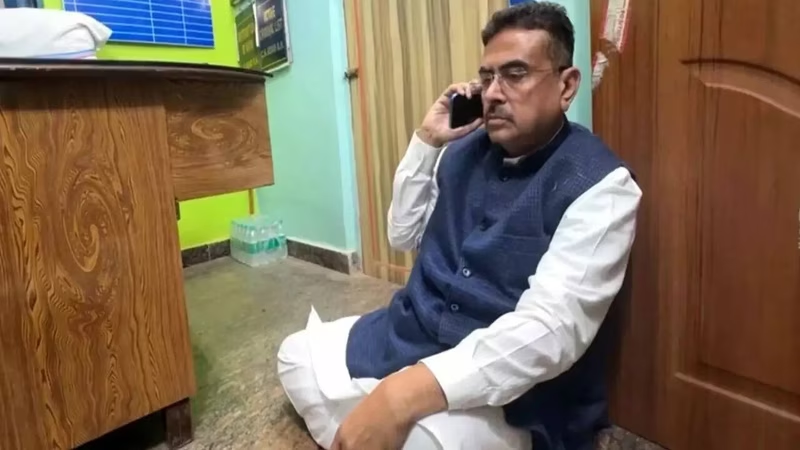
In a bold move underscoring his frustration with law enforcement, Adhikari drove directly to the Chandrakona police station and sat on a dharna (sit-in protest) until authorities agreed to register a formal First Information Report (FIR).
For over three hours, the senior BJP leader remained seated outside the station, flanked by party workers and local supporters. His demand was clear: immediate action against the perpetrators and accountability from the district administration, which operates under the ruling TMC government.
“If the police won’t protect the Leader of Opposition, who will they protect?” Adhikari asked, highlighting what he called a “complete breakdown of law and order” in the state . The FIR, eventually filed under Sections 148 (rioting with deadly weapon), 149 (unlawful assembly), and 353 (assault on public servant), names several unidentified TMC activists.
TMC Response: Denial and Counter-Accusations
The Trinamool Congress swiftly denied involvement. Senior TMC leader and state minister Firhad Hakim dismissed the allegations as “fabricated drama” designed to malign the party ahead of upcoming civic elections.
“Suvendu Adhikari is known for staging incidents to gain sympathy. There was no attack—just a minor altercation with locals upset over his inflammatory speeches,” Hakim claimed .
TMC also accused Adhikari of provoking tensions by holding unsanctioned rallies in sensitive areas. This tit-for-tat exchange reflects the deep animosity between the two parties, especially in the wake of the 2021 assembly elections, where Adhikari defeated Mamata Banerjee herself in Nandigram—a wound that still hasn’t healed.
A Pattern of Political Violence in Bengal?
This incident didn’t occur in a vacuum. West Bengal has long grappled with politically motivated violence, particularly during election cycles. According to data from the South Asia Terrorism Portal (SATP), over 120 political killings were reported in the state between 2020 and 2025, with both TMC and BJP cadres implicated .
Key hotspots include:
- Paschim Medinipur: Frequent clashes between TMC and BJP workers.
- Birbhum: Site of the 2022 Bogtui massacre following a TMC panchayat leader’s murder.
- North 24 Parganas: Regular reports of booth capturing and intimidation.
Observers note that opposition leaders—especially those with grassroots influence like Adhikari—often face heightened risks when touring rural strongholds of the ruling party.
Security Concerns for Opposition Leaders
Adhikari’s case raises urgent questions about the safety of political dissenters in Bengal. Despite being the LoP, he reportedly travels with minimal state-provided security—a stark contrast to the heavy protection afforded to TMC ministers.
The BJP has formally requested the Election Commission and the Union Home Ministry to intervene, citing violations of the Model Code of Conduct and constitutional rights to free movement. Legal experts argue that attacks on elected representatives constitute a direct assault on democratic institutions .
As one constitutional scholar noted, “When a Leader of Opposition fears for his life in his own state, democracy itself is under siege.”
Conclusion: A State on the Brink
The Suvendu Adhikari convoy attack allegation is more than a political spat—it’s a symptom of West Bengal’s fraying democratic fabric. With both sides entrenched in mutual hostility, the risk of further escalation is real.
For now, Adhikari’s dharna has forced a procedural response—but lasting peace requires more than FIRs. It demands political will, impartial policing, and a commitment to dialogue over violence. Until then, every road in Bengal may feel like a frontline.
Stay updated on West Bengal’s evolving political crisis with our ongoing coverage at [INTERNAL_LINK:west-bengal-political-violence-2026].
Sources
- Times of India: ‘They want to demolish BJP’: Bengal LoP accuses TMC workers of attacking his convoy; sits on dharna
- Web Search Results: , , , ,
- South Asia Terrorism Portal (SATP): https://www.satp.org/
- Indian Penal Code, Sections 148, 149, 353