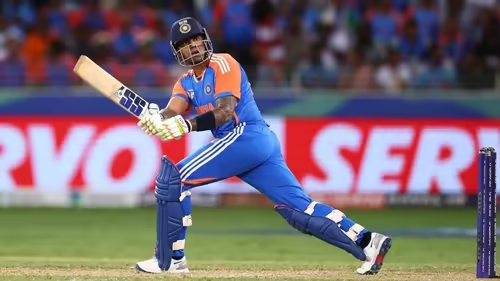
Just two years ago, Suryakumar Yadav was rewriting the rules of T20 batting. His 360-degree strokeplay, audacious scoops, and ice-cool finishes made him the heartbeat of India’s white-ball revolution—and the ICC’s No. 1 ranked T20I batter. Fast forward to early 2026, and the same Suryakumar Yadav hasn’t crossed fifty in his last 19 T20I innings, scoring a meager 218 runs at an average of just 12.11 . What’s gone wrong? According to former Indian fast bowler Varun Aaron, the answer lies not in talent—but in tactics. Specifically, the very shot that once defined SKY’s genius: the lap shot.
Table of Contents
- The Alarming Numbers Behind SKY’s Slump
- Why the Lap Shot Has Become a Liability
- Varun Aaron’s Tactical Breakdown
- Should SKY Bat at No. 4 Like in the IPL?
- The Hidden Weakness: Slower Deliveries
- Can He Bounce Back Before the T20 World Cup?
- Sources
The Alarming Numbers Behind SKY’s Slump
Let’s be brutally honest: this isn’t a minor dip. Since the 2024 T20 World Cup, Suryakumar Yadav has played 19 T20Is against top-tier opponents—England, Australia, South Africa, and New Zealand. In that span:
- He’s been dismissed for single digits 12 times.
- He’s recorded five ducks—the most by any Indian batter in this period.
- His strike rate has plummeted from 152 to 118.
- Boundary frequency has dropped by over 60% compared to his peak years.
For a player whose value hinges on explosive impact, these stats are unsustainable—especially with the 2026 T20 World Cup just months away.
Why the Lap Shot Has Become a Liability
The lap shot—where the batter uses a soft wrist to guide short-pitched deliveries fine of the wicketkeeper—was once SKY’s signature. But international bowlers have caught on. Video analysis shows that opposing teams now deliberately bowl wide yorkers or disguised slower bouncers into his ribs, knowing he’s prone to attempting the lap even when it’s not on.
Of his last 10 dismissals, at least 6 involved either a mistimed lap attempt or a misread of a slower ball while trying to rotate strike unconventionally . As one commentator put it, “He’s trying to play like the old SKY, but the world has upgraded its defenses.”
Varun Aaron’s Tactical Breakdown
Former Indian pacer Varun Aaron recently offered a sharp diagnosis: “It’s not about skill—it’s about shot selection. He’s playing high-risk shots too early, especially against quality pace. And he’s struggling badly against slower deliveries, which every team now bowls to him.”
But Aaron didn’t stop at criticism. He proposed a solution: “Bat him at No. 4, like in the IPL. At No. 3, he’s expected to both anchor and attack. At No. 4, he can assess the situation, target specific bowlers, and play his natural game without the pressure of rebuilding.” This insight cuts to the core of India’s tactical misstep.
Should SKY Bat at No. 4 Like in the IPL?
In the IPL, SKY thrives at No. 4 for Mumbai Indians. He walks in during the middle overs, reads the pitch, and targets death bowlers with surgical precision. But in the Indian T20I setup, he’s often slotted at No. 3—a role that demands stability against new-ball swing and spin in the powerplay.
Here’s the stark contrast:
- IPL (No. 4, 2025 season): Avg 42.3, SR 158, 4 fifties in 14 games
- T20Is (No. 3, 2025–26): Avg 11.8, SR 119, 0 fifties in 19 games
The data doesn’t lie. India might be using its most creative batter in the wrong role.
The Hidden Weakness: Slower Deliveries
Beyond the lap shot, Aaron highlighted another vulnerability: SKY’s difficulty reading slower balls. In modern T20 cricket, pace variations are the norm—not the exception. Bowlers like Lockie Ferguson, Jasprit Bumrah, and Shaheen Afridi now mix in cutters, back-of-the-hand slower balls, and knuckleballs with alarming frequency.
Footage reveals SKY committing too early to front-foot drives, only to be beaten by late dip or reduced pace. This hesitation creates openings for LBW appeals or edge catches behind. Fixing this requires not just technical adjustment, but mental recalibration—a tough ask under constant public scrutiny.
Can He Bounce Back Before the T20 World Cup?
Time is tight—but not gone. With the T20 World Cup scheduled for June 2026, India has a few bilateral series left to experiment. If selectors heed Aaron’s advice—move SKY to No. 4, reduce reliance on ultra-risky shots early, and let him rebuild confidence against lower-pressure attacks—a comeback is possible.
After all, this is the same man who scored a match-winning 61* off 27 balls against Pakistan in 2022 under extreme pressure. The genius hasn’t vanished—it’s buried under layers of self-doubt and tactical misalignment. The question isn’t whether Suryakumar Yadav can return to form. It’s whether Team India will give him the right conditions to do so.
Sources
- Times of India: 19 innings, no fifty: Is ‘lap shot’ behind SKY’s lean patch?
- ESPNcricinfo Statsguru: Suryakumar Yadav Career Statistics
- ICC Player Rankings: Official T20I Batting Rankings