Table of Contents
- A Nightmare in Suriname: The Stabbing That Shocked a Nation
- The Suspect and His Final Act: Suicide in Custody
- Victims of the Suriname Stabbing: Remembering the Lives Lost
- Domestic Dispute Turned Deadly: What We Know So Far
- National Outcry and Presidential Response
- Could This Tragedy Have Been Prevented? Mental Health and Systemic Gaps
- Conclusion: A Nation in Mourning Seeks Answers
- Sources
A Nightmare in Suriname: The Stabbing That Shocked a Nation
In a tragedy that has left the small South American nation of Suriname reeling, a brutal knife attack claimed the lives of nine people—including five innocent children—before the suspect ended his own life while in police custody. The incident, now widely referred to as the Suriname stabbing, has sparked national grief, urgent calls for justice reform, and soul-searching about domestic violence and mental health support.
According to local authorities and international media reports, the violent rampage occurred in a residential area, with neighbors describing scenes of chaos and horror. The scale of the attack—particularly the number of child victims—has left citizens and officials alike struggling to comprehend the depth of the brutality. This is not just a crime; it’s a national trauma.
The Suspect and His Final Act: Suicide in Custody
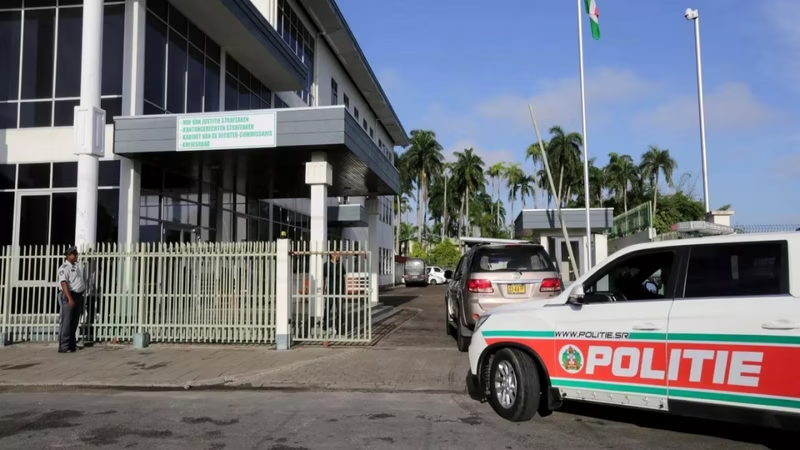
The 43-year-old suspect was apprehended shortly after the attack and taken into police custody. However, before he could face formal charges or questioning, he was found dead in his cell—hanged, in what authorities confirmed as an apparent suicide.
This development has raised serious questions about prison oversight and mental health screening for high-risk detainees. How could someone accused of such a heinous crime be left unmonitored long enough to take their own life? Human rights advocates are calling for an immediate internal investigation into custodial protocols.
With the suspect now dead, key questions about motive, planning, and potential warning signs may remain forever unanswered—leaving victims’ families without legal closure.
Victims of the Suriname Stabbing: Remembering the Lives Lost
Among the nine victims were five children, whose names and ages have not all been publicly released out of respect for their families. The remaining four victims were adults, believed to be family members or close relatives of the suspect.
Preliminary reports suggest the attack unfolded within a single household, indicating an intensely personal, though devastatingly violent, family tragedy. Community members have described the neighborhood as quiet and tightly knit—making the sudden eruption of violence all the more jarring.
Local vigils are being planned, and religious leaders have called for prayers across denominations. The human cost of the Suriname stabbing is immeasurable, with entire families wiped out in a matter of minutes.
Domestic Dispute Turned Deadly: What We Know So Far
While the investigation is still ongoing, authorities have indicated that the attack stemmed from a domestic dispute. Early evidence points to escalating tensions within the suspect’s immediate or extended family, possibly related to custody, financial stress, or interpersonal conflict.
Domestic violence is a global crisis, but its potential to escalate into mass casualty events is often underestimated. According to the World Health Organization (WHO), nearly 1 in 3 women worldwide experience physical or sexual violence—mostly by an intimate partner . Yet, systems for early intervention, especially in smaller nations like Suriname, are often underfunded or inaccessible.
Could earlier intervention—through social services, mental health outreach, or community policing—have prevented this massacre? Experts say yes, but only if warning signs are taken seriously before it’s too late.
National Outcry and Presidential Response
Suriname’s President, Chan Santokhi, issued a public message of condolence and solidarity, calling the attack “a dark day for our nation” and vowing to strengthen community safety measures.
“Our hearts break for the families who have lost loved ones—especially the children, whose futures were stolen in an act of unimaginable cruelty,” the President stated. His administration has announced a national day of mourning and pledged to review domestic violence response protocols across law enforcement and social services.
Citizen-led petitions are also circulating, demanding better mental health infrastructure and mandatory training for police on handling high-risk domestic cases.
Could This Tragedy Have Been Prevented? Mental Health and Systemic Gaps
This horrific event underscores a critical gap in many countries: the link between untreated mental illness, domestic conflict, and lethal violence. While not all individuals with mental health challenges are violent, access to care can be a crucial buffer during crises.
In Suriname, mental health resources are limited. According to Pan American Health Organization (PAHO) data, the country has fewer than 2 psychiatrists per 100,000 people—far below WHO recommendations .
Prevention strategies that could help include:
- Community-based early warning systems for domestic conflict
- Mandatory mental health screenings during family court proceedings
- 24/7 crisis hotlines with trained counselors
- Police de-escalation training focused on domestic incidents
For more on global efforts to combat gender-based violence, see our in-depth report on [INTERNAL_LINK:global-domestic-violence-prevention-strategies].
Conclusion: A Nation in Mourning Seeks Answers
The Suriname stabbing is more than a crime story—it’s a devastating reminder of how quickly private pain can erupt into public tragedy. With the suspect dead by suicide, the legal process ends abruptly, but the emotional and societal wounds will take years to heal.
As Suriname mourns its dead, the world watches. And hopefully, other nations will take this as a stark lesson: invest in mental health, empower communities to report warning signs, and never treat domestic disputes as “private matters.” Because as this tragedy shows, silence can be deadly.
Sources
- Times of India: Suriname stabbing: Suspect dies by suicide in custody; had killed 9 people including children
- World Health Organization (WHO): Violence Against Women Fact Sheet
- Pan American Health Organization (PAHO): Mental Health in the Americas