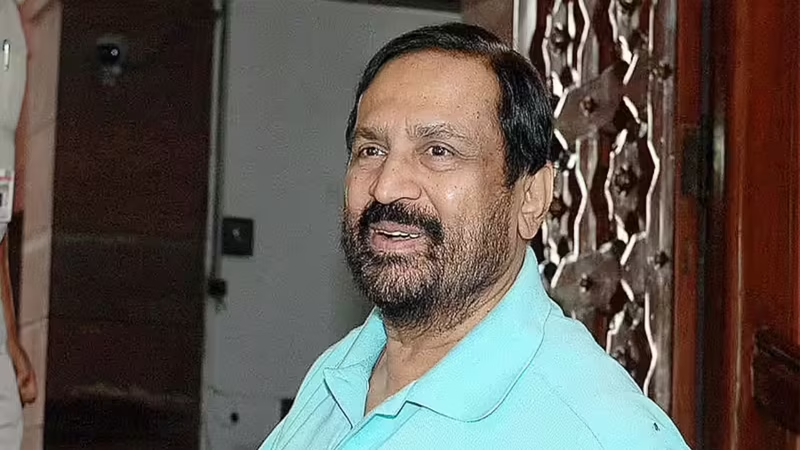
India has lost one of its most polarizing yet influential political-sports figures. Suresh Kalmadi, former Union Minister and long-time president of the Indian Olympic Association (IOA), passed away at the age of 81 in Pune on Tuesday, January 6, 2026, following a prolonged illness. While mourners gather for his final rites, the nation reflects on a legacy defined by both trailblazing contributions to Indian sports and the shadow of the 2010 Commonwealth Games corruption scandal.
Table of Contents
- Who Was Suresh Kalmadi? A Brief Biography
- Suresh Kalmadi and the Rise of Indian Sports Administration
- The 2010 Commonwealth Games Scandal: A Turning Point
- Political Career Beyond Sports
- Tributes Pour In from Across the Aisle
- Final Journey: Funeral Arrangements in Pune
- Legacy: A Mixed but Undeniable Impact
- Conclusion: Remembering a Complex Figure
- Sources
Who Was Suresh Kalmadi? A Brief Biography
Born on November 15, 1944, in Pune, Maharashtra, Suresh Kalmadi entered public life as a member of the Indian National Congress. He was elected to the Lok Sabha multiple times from Pune and served as Union Minister of State for Defence, Civil Aviation, and Parliamentary Affairs in the 1990s.
However, it was his role in sports administration that brought him national—and later international—attention. He became president of the IOA in 1996, a position he held for nearly two decades, making him one of the longest-serving sports administrators in Asia.
Suresh Kalmadi and the Rise of Indian Sports Administration
Kalmadi’s early tenure was marked by significant progress:
- He played a key role in bringing the 2010 Commonwealth Games to India—the first time the event was hosted in the country.
- Under his leadership, the IOA gained greater autonomy and international recognition.
- He advocated for increased government funding for Olympic disciplines beyond cricket.
For many years, he was seen as a visionary who put Indian sports on the global map. His efforts laid the groundwork for future multi-sport event bids, including the Asian Games and Youth Olympics.
The 2010 Commonwealth Games Scandal: A Turning Point
Despite the successful hosting of the Games in Delhi, the aftermath was marred by allegations of massive corruption, financial mismanagement, and inflated contracts. A 2011 CAG report estimated irregularities worth over ₹14,000 crore.
Suresh Kalmadi, as chairman of the Organising Committee, became the face of the controversy. He was arrested in April 2011 by the Central Bureau of Investigation (CBI) and spent nearly 10 months in Tihar Jail before being granted bail. Though never convicted in a final court judgment, the scandal irreparably damaged his reputation and led to his ouster from the IOA.
The episode sparked nationwide debates about transparency in sports governance—a conversation that continues today with reforms like the National Sports Code .
Political Career Beyond Sports
Beyond the stadiums, Kalmadi remained a powerful political figure in Maharashtra. He was instrumental in building the Congress party’s base in Pune and mentored several younger leaders. Even after his fall from grace in sports, he retained influence in local politics, often acting as a mediator in party disputes.
Notably, he never held ministerial office after the 1990s but remained an MP until 2014. His political acumen earned respect even from rivals, with BJP leaders acknowledging his role in Pune’s civic development.
Tributes Pour In from Across the Aisle
Following news of his death, condolences flooded in:
- Prime Minister Narendra Modi: “Suresh Kalmadi ji contributed significantly to Indian sports. My condolences to his family.”
- President Droupadi Murmu: “He played a vital role in promoting Olympic values in India.”
- Former Sports Minister Ajay Maken: “Despite the controversies, his passion for sports was unmatched.”
Even critics acknowledged his early contributions, reflecting the nuanced view many hold of his career.
Final Journey: Funeral Arrangements in Pune
Kalmadi’s mortal remains are being kept at his Kalyani Nagar residence in Pune for public viewing on Tuesday evening. His funeral is scheduled for Wednesday, January 7, 2026, with full state honours expected given his stature as a former Union Minister.
Security has been heightened in the area, and senior political leaders from across parties are expected to attend the last rites.
Legacy: A Mixed but Undeniable Impact
Assessing Suresh Kalmadi’s legacy requires holding two truths at once:
- He was instrumental in modernizing Indian sports administration and securing global events for the country.
- His leadership during the 2010 Commonwealth Games became a cautionary tale about oversight, accountability, and ethical governance.
His story is a reminder that legacy is rarely black or white. For more on this evolution, see our feature on [INTERNAL_LINK:history-of-indian-sports-governance].
Conclusion: Remembering a Complex Figure
Suresh Kalmadi’s passing closes a significant chapter in India’s political and sporting history. Love him or critique him, his influence is woven into the fabric of modern Indian sports. As the nation bids farewell, it’s worth reflecting not just on what went wrong—but on the ambitions he dared to pursue for a country often reluctant to dream big in global sports.