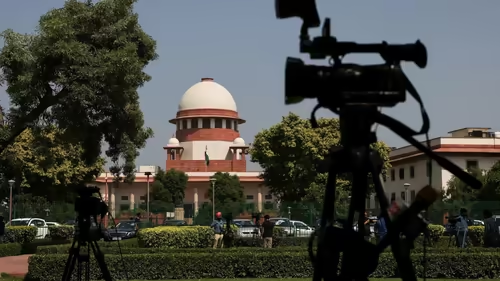
Imagine being locked away for seven long years—watching seasons change, families grow, and the world move on—without ever having your day in court. This is not a dystopian fiction; it’s the stark reality for lawyer-activist Surendra Gadling. In a powerful intervention that underscores a deep crisis within India’s judicial system, the Supreme Court has finally ordered an expedited hearing in his case, acknowledging the grave injustice of his prolonged incarceration without trial .
Gadling, who is also a co-accused in the high-profile Bhima Koregaon case, has been in custody since 2018. However, his current predicament stems from a separate 2016 case—the Surajgarh arson incident in Rajasthan. For nearly a decade, this case has been mired in procedural delays, judicial vacancies, and bureaucratic inertia, leaving Gadling trapped in a legal limbo that violates the very essence of justice .
Table of Contents
- Who is Surendra Gadling and the Surajgarh Arson Case?
- Seven Years in Jail: A Breach of Fundamental Rights
- The Supreme Court’s Intervention to Expedite Hearing
- The Systemic Crisis of Undertrial Prisoners in India
- Conclusion: A Test for India’s Promise of Justice
- Sources
Who is Surendra Gadling and the Surajgarh Arson Case?
Surendra Gadling is a Nagpur-based human rights lawyer known for his work with marginalized communities, particularly Dalits and Adivasis. His legal practice often brought him into conflict with state authorities, making him a frequent target of legal scrutiny .
The specific case that has led to his current seven-year detention is the 2016 Surajgarh arson case. The incident involved the burning of a police station in Surajgarh, Rajasthan. Gadling was named as an accused, though he has consistently denied any involvement. The case was initially handled by a local court but was later transferred to a Special NIA (National Investigation Agency) court, adding another layer of complexity to the proceedings .
Since his arrest, the case has been stuck in a procedural quagmire. Key issues include the non-appointment of a permanent judge to the special court designated for the case and the unresolved transfer of crucial evidence from the NIA court back to the original jurisdiction. These administrative failures have effectively halted the trial before it could even begin in earnest .
Seven Years in Jail: A Breach of Fundamental Rights
The Indian Constitution guarantees every citizen the right to a speedy trial under Article 21, which protects the right to life and personal liberty. The Supreme Court itself has repeatedly held that a delay in trial is not just an inconvenience but a form of punishment in itself, especially for those who are presumed innocent until proven guilty .
Gadling’s seven-year wait is a flagrant violation of this principle. It raises serious questions about the state’s power to detain individuals indefinitely on mere suspicion. His case is not an isolated incident but a symptom of a much larger problem. According to National Crime Records Bureau (NCRB) data, over two-thirds of India’s prison population are undertrials, many of whom spend years behind bars for crimes they may not have committed, simply because they cannot afford bail or their cases are deprioritized .
The Supreme Court’s Intervention to Expedite Hearing
Faced with this untenable situation, the Supreme Court has taken direct and decisive action. During a recent hearing, the bench expressed deep concern over the “inordinate delay” and the fact that Gadling has been in custody for seven years without a single substantive hearing on the merits of the case .
The Court has issued two critical directives to break the deadlock:
- Appointment of a Judge: The Court has ordered the concerned High Court to immediately appoint a permanent judge to the special court handling the Surajgarh case. A vacant judgeship has been a primary reason for the trial’s stagnation.
- Transfer of Evidence: The Court has mandated the swift and proper transfer of all case-related evidence and records from the NIA court back to the special court, clearing the final administrative hurdle.
With these roadblocks removed, the Supreme Court has now ordered that the trial against Surendra Gadling must proceed on an expedited basis, ensuring that he finally gets the fair and timely hearing he is constitutionally entitled to .
The Systemic Crisis of Undertrial Prisoners in India
Gadling’s case is a microcosm of a national emergency. India’s prisons are overflowing with undertrials, a situation exacerbated by a severe shortage of judges, a massive backlog of cases, and a complex legal aid system that often fails the most vulnerable.
- Judicial Vacancies: As of 2025, India’s subordinate courts operate with a vacancy rate of nearly 20%, meaning thousands of cases are simply waiting for a judge to be assigned .
- Poverty and Bail: Many undertrials remain in jail not because they are guilty, but because they are too poor to secure bail, which can be set at unaffordable amounts for minor offenses .
- Case Backlog: The total number of pending cases in Indian courts has crossed 50 million, creating a system where justice is often delayed for decades .
Organizations like the Commonwealth Human Rights Initiative (CHRI) have long advocated for systemic reforms, including the establishment of more fast-track courts and a re-evaluation of bail policies, to address this crisis .
Conclusion: A Test for India’s Promise of Justice
The Supreme Court’s intervention in Surendra Gadling’s case is a welcome and necessary step. However, it should not be seen as a solution but as a spotlight on a deeply broken system. While one man may finally get his day in court, thousands of others remain in the shadows of our prisons, their lives on hold. Gadling’s ordeal is a stark reminder that the promise of “justice for all” is hollow unless it is delivered swiftly, fairly, and without prejudice. The true test of our democracy lies not just in the verdict of this case, but in our collective will to fix the system that allowed it to happen in the first place.
Sources
- Times of India: Activist in jail for 7 years sans trial, SC steps in to hasten proceedings [[1], [3], [4]]
- SC Observer: Supreme Court Expedites Hearing in Surendra Gadling’s Surajgarh Case
- Supreme Court of India Judgement: Writ Petition (Criminal) No. of 2026
- The Hindu: Right to Speedy Trial is a Fundamental Right
- National Crime Records Bureau (NCRB): Prison Statistics India
- Commonwealth Human Rights Initiative (CHRI): Undertrial Prisoners in India