Table of Contents
- A Judicial Intervention in Campus Equity
- What Were the UGC Equity Regulations?
- Why the Supreme Court Intervened
- Key Concerns Raised by Petitioners
- Supporters Defend the Guidelines
- Impact on Universities and Students
- What Happens Next?
- Conclusion
- Sources
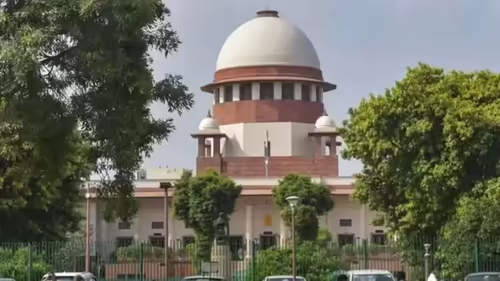
In a dramatic turn for India’s higher education landscape, the Supreme Court has issued an interim stay on the University Grants Commission’s (UGC) newly introduced UGC equity regulations. The bench, headed by Chief Justice of India, expressed serious reservations about the policy, stating it had the potential to “divide society” rather than foster unity [[1]]. This decision—coming amid intense national debate—has paused the implementation of guidelines that sought to institutionalize social equity measures across all central and state-funded universities.
A Judicial Intervention in Campus Equity
The stay order, issued on January 30, 2026, responds to multiple petitions challenging the constitutional validity of the UGC’s ‘Guidelines for Promotion of Equity and Inclusion in Higher Educational Institutions,’ notified earlier this month. While framed as a progressive step toward inclusive education, critics argued the rules overstepped administrative boundaries and risked deepening social fault lines under the guise of affirmative action.
The Supreme Court’s sharp observation—that such well-intentioned policies could backfire by creating “separate identities” on campuses—has reignited a long-standing national conversation about the balance between social justice and meritocracy in education.
What Were the UGC Equity Regulations?
Released on January 15, 2026, the UGC’s 28-page document mandated several sweeping changes for universities, including:
- Establishment of mandatory ‘Equity and Inclusion Cells’ in every institution.
- Reservation of up to 25% of seats in faculty recruitment and student admissions for ‘marginalized groups’ beyond existing constitutional quotas.
- Requirement for syllabi to include content on caste, gender, and religious discrimination.
- Annual audits to assess institutional compliance with equity benchmarks.
While the UGC stated these measures were aligned with Article 15(4) and Article 46 of the Constitution—which empower the state to promote educational interests of weaker sections—the guidelines lacked clarity on definitions, enforcement mechanisms, and legal backing for non-constitutional categories.
Why the Supreme Court Intervened
The Court’s primary concern centered on the principle of federalism and legislative overreach. Several petitioners, including private university associations and academic bodies, argued that the UGC—a statutory body—cannot unilaterally impose binding social engineering policies without parliamentary legislation or consultation with state governments.
More critically, the bench questioned whether creating identity-based monitoring cells and expanding reservation beyond SC/ST/OBC categories would foster genuine inclusion or inadvertently stigmatize students and faculty. “When you label someone as ‘marginalized’ in official records, are you empowering them—or isolating them?” asked one judge during hearings [[1]].
Key Concerns Raised by Petitioners
Opponents of the regulations highlighted several red flags:
- Lack of Legal Basis: The guidelines attempt to create new categories of beneficiaries not recognized under the Constitution.
- Administrative Burden: Smaller colleges lack resources to implement complex equity audits and reporting systems.
- Academic Freedom: Mandating specific content in curricula infringes on institutional autonomy.
- Social Polarization: Formal categorization could fuel campus tensions rather than dialogue.
One petitioner noted, “Equity cannot be achieved by bureaucratic checkboxes. It requires cultural change, not surveillance.”
Supporters Defend the Guidelines
Conversely, student unions and social justice advocates defended the UGC’s move as a necessary corrective to systemic exclusion. They pointed to data from the All India Survey on Higher Education (AISHE) showing persistent underrepresentation of Dalit, Adivasi, and Muslim students in elite institutions [[2]].
“These guidelines are not about division—they’re about visibility,” said Dr. Priya Menon, a sociologist at JNU. “For decades, marginalized voices have been erased from syllabi and hiring panels. This is a small step toward repair.”
They argue that the Supreme Court’s stay may delay much-needed reforms, especially in private universities where equity mechanisms are often absent.
Impact on Universities and Students
With the stay in place, universities are now in a state of limbo:
- Institutions that had begun forming Equity Cells must halt operations.
- Faculty recruitment processes involving new equity criteria are frozen.
- Students awaiting admissions under expanded quotas face uncertainty.
However, existing constitutional reservations (SC/ST/OBC/EWS) remain unaffected. The stay applies only to the *new* provisions introduced by the UGC guidelines.
For a deeper look at how reservation policies shape campus life, see our analysis on [INTERNAL_LINK:reservation-in-indian-higher-education].
What Happens Next?
The case will now proceed to a full hearing, likely over the next few months. The Supreme Court has asked the Union Ministry of Education and the UGC to file detailed responses justifying the legal and constitutional basis of the regulations.
Legal experts suggest the final judgment could set a precedent on the limits of executive policymaking in social justice matters. As one constitutional scholar noted, “The Court isn’t against equity—it’s against unaccountable power.”
Conclusion
The Supreme Court’s stay on the UGC equity regulations is more than a legal pause—it’s a national moment of reflection. While the goal of inclusive education is universally shared, the path to achieving it remains deeply contested. The Court’s warning about societal division underscores a crucial truth: policies designed to heal must not inadvertently deepen wounds. As India navigates this complex terrain, the balance between justice, unity, and institutional autonomy will define the future of its higher education system.