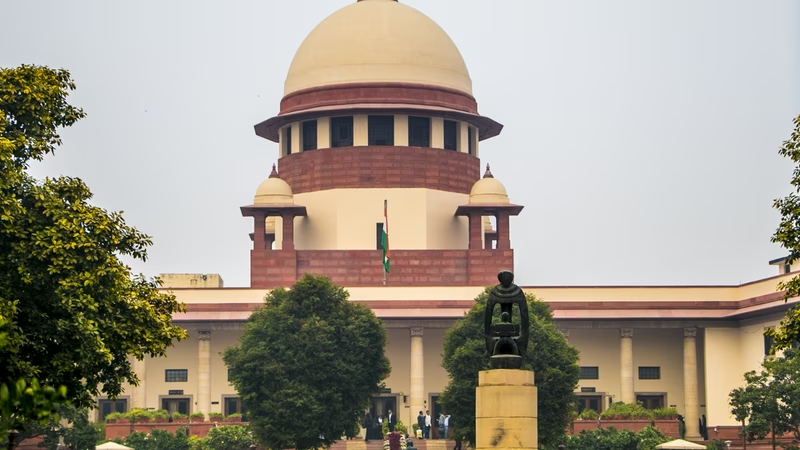
Supreme Court Draws the Line: No VIP Lanes in Justice
In a landmark rebuke to judicial entitlement, the Supreme Court has firmly declared: “The rich and influential cannot bypass tiers of court and come directly to us.” Led by Chief Justice of India Surya Kant, the bench made this unequivocal statement while dismissing a high-profile plea challenging a provision of the Prevention of Money Laundering Act (PMLA).
The message was clear and resonant: in India’s legal system, there are no shortcuts for the powerful. Justice, the Court insisted, must be blind—not just in theory, but in practice. This ruling isn’t just procedural; it’s a moral reset for a judiciary often accused of favoring the elite.
Table of Contents
- The Context of the Ruling
- Supreme Court on Judicial Hierarchy
- PMLA Challenges and Consolidated Hearing
- Why This Matters for Ordinary Citizens
- Historical Precedents and Judicial Integrity
- Public and Legal Community Reaction
- Conclusion: Justice Without Exception
- Sources
The Context of the Ruling
The sharp remarks came during the hearing of a petition filed by a well-connected individual challenging Section 45 of the PMLA—a provision that mandates stringent bail conditions for money laundering offenses. The petitioner sought direct intervention from the Supreme Court, skipping the High Court and trial court entirely.
CJI Surya Kant, alongside Justice Ujjal Bhuyan, refused to entertain the plea. “You cannot come here just because you are influential,” the bench stated. “Everyone must go through the judicial process. The law applies equally—to a pauper and to a billionaire.”
This wasn’t an isolated comment but a deliberate pushback against a growing trend: affluent litigants using their resources to leapfrog lower courts, often prolonging cases or seeking favorable forums.
Supreme Court on Judicial Hierarchy
India’s judicial system is built on a clear hierarchy: District Courts → High Courts → Supreme Court. The apex court’s primary role is to interpret the Constitution and settle substantial questions of law—not to function as a first resort for those who can afford top lawyers.
The bench emphasized three key principles:
- Exhaustion of remedies: Litigants must first approach lower courts before knocking on the Supreme Court’s door.
- Prevention of forum shopping: Wealthy parties shouldn’t cherry-pick courts based on perceived leniency.
- Preservation of judicial discipline: Bypassing tiers undermines the authority and workload management of entire court systems.
“If we allow this, the entire structure collapses,” the Court warned .
PMLA Challenges and Consolidated Hearing
Beyond the procedural rebuke, the Court also addressed the growing number of petitions challenging the PMLA’s constitutional validity. Acknowledging that over two dozen similar cases are pending, the bench announced they will be heard together in a consolidated proceeding.
This move aims to:
- Ensure uniform interpretation of the law
- Prevent contradictory judgments across benches
- Expedite resolution of a critical anti-corruption statute
Legal experts see this as a strategic consolidation to uphold the PMLA—a key tool used by the Enforcement Directorate (ED) against financial crimes—while also reviewing its fairness .
Why This Matters for Ordinary Citizens
At first glance, this might seem like an internal legal matter. But it has profound implications for everyday Indians:
- Access to justice: When the rich flood the Supreme Court with premature petitions, it delays cases involving fundamental rights or public interest.
- Trust in institutions: Equal treatment reinforces public faith that the law isn’t a “two-tier” system.
- Accountability: High-profile accused can no longer hide behind procedural delays to avoid trial.
For more on how judicial reforms impact daily life, explore our guide on [INTERNAL_LINK:how-indian-courts-handle-money-laundering-cases].
Historical Precedents and Judicial Integrity
While this ruling is timely, it’s not unprecedented. In State of U.P. v. Singhara Singh (1964), the Court held that direct appeals to the apex court without exhausting remedies are “inappropriate and impermissible.”
More recently, in 2022, the Supreme Court criticized “headline-seeking litigation” by celebrities and politicians—a trend that clogs dockets and distorts legal priorities .
What makes CJI Surya Kant’s statement stand out is its blunt, almost moral tone. It’s not just about procedure; it’s about principle.
Public and Legal Community Reaction
The legal fraternity has largely welcomed the stance. Senior advocate Indira Jaising called it “a necessary correction to judicial elitism.” Meanwhile, civil society groups praised the Court for “reclaiming its role as the guardian of equality.”
However, some critics caution that while the message is strong, enforcement remains key. “Will the Court consistently reject such petitions?” asks legal scholar Prof. Faizan Mustafa. “That’s the real test.”
Public social media sentiment echoed relief. “Finally, someone’s telling the truth,” read a top comment on X (formerly Twitter) under a news clip of the hearing .
Conclusion: Justice Without Exception
The Supreme Court’s recent ruling is more than a procedural note—it’s a cultural reset. By refusing to let wealth dictate judicial access, CJI Surya Kant’s bench has reaffirmed a foundational truth of democracy: no one is above the law. As PMLA challenges move toward a consolidated hearing, this moment could mark the beginning of a more disciplined, equitable, and credible justice system—one where your bank balance doesn’t buy you a faster lane to the courtroom.
Sources
- Times of India. “Rich can’t bypass tiers of court & come directly to us: Supreme Court.” https://timesofindia.indiatimes.com/…
- Supreme Court of India. Official website – Cause Lists and Orders. https://main.sci.gov.in
- PRS Legislative Research. “The Prevention of Money Laundering Act (PMLA): Key Issues.” https://prsindia.org
- Bar and Bench. Legal Commentary on Judicial Discipline. https://www.barandbench.com