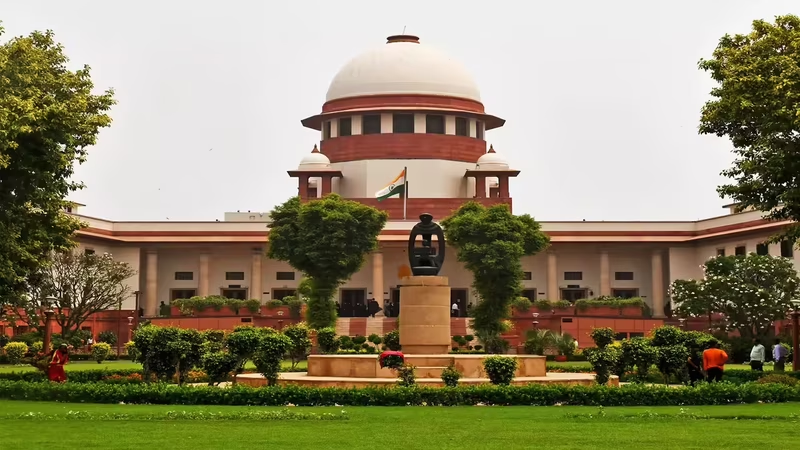
In a landmark ruling that reaffirms the sanctity of personal liberty, the Supreme Court of India has delivered a sharp rebuke to authorities misusing preventive detention laws. The Court’s clear message? These extraordinary powers are not a convenient loophole to keep someone behind bars after they’ve been granted bail in a regular criminal case.
This recent judgment, stemming from a case involving the Telangana ‘Goonda Act’, has sent shockwaves through legal and administrative circles, setting a crucial precedent for protecting citizens from arbitrary state power .
Table of Contents
- What is Preventive Detention?
- The Supreme Court’s Latest Stand
- Preventive vs. Punitive Detention: What’s the Difference?
- Constitutional Safeguards Under Article 22
- Why This Judgment Matters for You
- Conclusion: A Win for Personal Liberty
- Sources
What is Preventive Detention?
At its core, preventive detention is a legal mechanism that allows the state to detain an individual without a trial or formal conviction. The stated purpose isn’t to punish for a past crime, but to prevent a future one. It’s based on the government’s “satisfaction” that a person’s actions could threaten public order, national security, or essential services .
However, this power is a double-edged sword. While it exists for legitimate state interests, its potential for abuse is immense. This is why the Indian Constitution places it under strict scrutiny, a fact the Supreme Court has just powerfully reiterated.
The Supreme Court’s Latest Stand on Preventive Detention
The January 2026 judgment is unequivocal. The Court quashed a preventive detention order, finding it was a “colourable exercise of power”—a legal term for a disguised, improper use of authority . The authorities had detained an individual who had already been granted bail in a criminal case, simply because they feared he might commit another offence .
The Court slammed this logic, stating that a mere “apprehension of repetition of offences” is not enough grounds for such a severe measure . To justify preventive detention, the state must provide concrete, compelling material that demonstrates a real and present threat to public order, not just a vague suspicion.
This ruling directly challenges a disturbing trend where state governments use local “Goonda Acts” or similar laws to circumvent the regular judicial process and keep individuals in custody indefinitely, effectively nullifying their hard-won bail.
Preventive vs. Punitive Detention: What’s the Difference?
Understanding the distinction between these two types of detention is crucial to grasping the significance of the Court’s decision.
- Punitive Detention: This is the standard form of imprisonment. It occurs after a person has been tried in a court of law, found guilty of a crime, and sentenced as punishment . It’s a consequence of a proven past action.
- Preventive Detention: This happens before any crime is committed, based on a suspicion that the person might commit one in the future . Its aim is not to punish, but to prevent .
Using preventive detention to achieve the outcome of punitive detention—keeping someone locked up—is a fundamental perversion of the law. The Supreme Court’s judgment draws a bright, clear line between these two concepts, ensuring they are not used interchangeably.
Constitutional Safeguards Under Article 22
The framers of the Indian Constitution were well aware of the dangers of unchecked state power. That’s why they included specific safeguards for detainees in Article 22 of the Indian Constitution.
While Article 22(1) and (2) protect individuals arrested under ordinary law (like the right to be informed of charges and to consult a lawyer), clauses (4) through (7) lay out the rules for preventive detention . These include:
- A person cannot be held in preventive detention for more than three months without the case being reviewed by an Advisory Board.
- The detainee must be informed of the grounds for their detention, though the state can withhold information it deems against public interest.
- The detainee has the right to make a representation against the detention order.
These provisions are meant to be a check on arbitrary power. The Supreme Court’s latest judgment reinforces that these aren’t just procedural formalities; they are substantive rights that must be respected in both letter and spirit .
Why This Judgment Matters for You
This isn’t just a legal technicality—it’s a vital shield for every citizen. Here’s why:
- Protects Against Arbitrary Arrest: It prevents the state from using draconian laws as a first resort to silence dissent or harass individuals.
- Upholds the Right to Bail: It ensures that a court’s decision to grant bail, a cornerstone of our justice system, cannot be easily overturned by executive fiat.
- Reinforces Judicial Oversight: It reminds the executive branch that its powers are subject to judicial review and must be exercised with the utmost caution and evidence.
This judgment is a powerful reminder that personal liberty, enshrined in Article 21, is paramount. For more on how the judiciary protects fundamental rights, see our analysis on [INTERNAL_LINK:fundamental_rights_in_india].
Conclusion: A Win for Personal Liberty
The Supreme Court’s firm stance against the misuse of preventive detention is a significant victory for civil liberties in India. By clearly stating that these laws cannot be a tool to prolong custody or bypass the regular criminal justice system, the Court has reinforced the delicate balance between state security and individual freedom. This judgment serves as a critical directive to all state authorities: extraordinary powers demand extraordinary justification, not mere suspicion.
Sources
- Times of India: Preventive detention can’t be to prolong custody: Supreme Court
- LiveLaw: Preventive Detention Can’t Be Used To Override Bail, Must Prove ‘Public Order’ Threat : Supreme Court
- Indian Kanoon: Article 22 in The Constitution Of India 1950
- Supreme Court Observer: Analysis of Sanilkumar S vs State Of Kerala