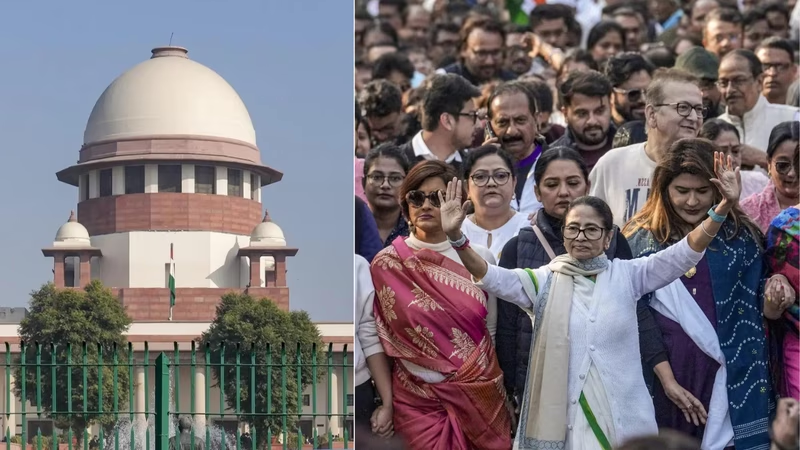
In a courtroom drama that has sent shockwaves through India’s political and judicial corridors, the Supreme Court mobocracy remarks have become the center of a fierce national debate. The apex court, visibly disturbed by the unfolding events in Kolkata, didn’t mince words, asking if the Calcutta High Court had been turned into a political protest site akin to Delhi’s infamous Jantar Mantar.
The controversy stems from the Enforcement Directorate’s (ED) investigation into the I-PAC coal scam, which has put West Bengal Chief Minister Mamata Banerjee and her Trinamool Congress (TMC) party directly in the crosshairs. The ED alleges not just financial irregularities but a systematic attempt by the state machinery to obstruct justice—a claim the Supreme Court appears to be taking very seriously.
Table of Contents
- The Supreme Court ‘Mobocracy’ Outburst
- ED Allegations: Obstructing the I-PAC Probe
- TMC Defense: Political Vendetta or Legal Fight?
- What is the I-PAC Coal Scam?
- Broader Implications for Federalism and Institutions
- Conclusion: A Nation Watching Closely
- Sources
The Supreme Court ‘Mobocracy’ Outburst
On January 15, 2026, the Supreme Court’s bench delivered a stinging critique of the atmosphere that prevailed in the Calcutta High Court during a recent hearing related to the ED’s case. The justices were reportedly appalled by the presence of a large number of lawyers and supporters who were not even part of the official proceedings, creating what one judge described as a scene of utter chaos .
The court’s now-famous rhetorical question—“As if it’s Jantar Mantar!”—has become a viral soundbite, symbolizing its deep unease with the perceived erosion of judicial decorum. The term “mobocracy,” used by the ED’s counsel and seemingly endorsed by the court, suggests a rule by the mob rather than by law, a direct challenge to the foundational principles of a democratic republic .
ED Allegations: Obstructing the I-PAC Probe
The Enforcement Directorate approached the Supreme Court after facing significant roadblocks in West Bengal. The agency claims that on January 9, 2026, its officials were prevented from conducting a scheduled raid, allegedly on the orders of the state government. The ED further contends that the Calcutta High Court hearing was deliberately packed with TMC-affiliated lawyers to create an intimidating environment and influence the judicial process .
In its filings, the ED painted a stark picture of the situation in the state, bluntly stating, “There is no democracy in West Bengal, only mob rule,” directly accusing Chief Minister Mamata Banerjee of masterminding the obstruction . This is not an isolated incident; it is part of a long-standing tug-of-war between central investigative agencies and several state governments, raising critical questions about the balance of power in India’s federal structure.
TMC Defense: Political Vendetta or Legal Fight?
Unsurprisingly, the Trinamool Congress has hit back hard. The party dismisses the ED’s allegations as nothing more than a politically motivated witch-hunt orchestrated by the central government to destabilize a key opposition stronghold. Chief Minister Mamata Banerjee has filed a caveat in the Supreme Court, a legal maneuver to ensure she is heard before any order is passed against her or her party .
The TMC argues that the ED is overstepping its mandate and using its powers to harass political opponents. They maintain that the chaotic scenes in the High Court were a spontaneous show of solidarity from the local legal community against what they perceive as an assault on the state’s autonomy. For them, this is less about a specific corruption case and more about defending their right to govern without constant interference from New Delhi.
What is the I-PAC Coal Scam?
At the heart of this legal and political storm is the I-PAC (Indian Power and Allied Components) coal scam. While full details are still emerging through the investigative process, the case is believed to involve alleged irregularities in the allocation and mining of coal blocks in West Bengal. The ED is investigating potential money laundering activities linked to these alleged scams, with its probes leading to high-ranking TMC leaders.
Understanding the specifics of the I-PAC case is crucial to grasping the intensity of the current standoff. It represents a classic clash where a financial investigation by a central agency collides with the political authority of a powerful regional party. You can learn more about the legal framework governing such investigations on the official website of the Enforcement Directorate.
Broader Implications for Federalism and Institutions
This episode transcends the immediate players involved. It strikes at the core of two vital pillars of Indian democracy:
- Judicial Independence: Can courts function effectively when their premises are turned into arenas for political grandstanding? The Supreme Court’s intervention is a clear signal that it will not tolerate any actions that undermine the sanctity and impartiality of the judiciary.
- Centre-State Relations: The recurring conflict between agencies like the ED/CBI and non-BJP ruled states has become a major point of contention. This case will likely set a precedent for how such disputes are handled in the future, potentially redefining the boundaries of federal cooperation.
The outcome of this case will be watched closely not just by politicians in West Bengal, but by every state government in the country. It’s a litmus test for institutional integrity in an increasingly polarized political climate.
Conclusion: A Nation Watching Closely
The Supreme Court’s sharp remarks on ‘mobocracy’ have elevated a regional legal dispute into a national conversation about the health of India’s democratic institutions. The comparison to Jantar Mantar was not just a casual remark; it was a powerful metaphor for the court’s fear that political protests and mob pressure are seeping into the hallowed halls of justice. As the legal battle between the ED and the TMC continues, the entire nation will be watching to see whether the rule of law can prevail over the politics of power. For more on the evolving political landscape in West Bengal, see our in-depth analysis on [INTERNAL_LINK:west-bengal-politics].