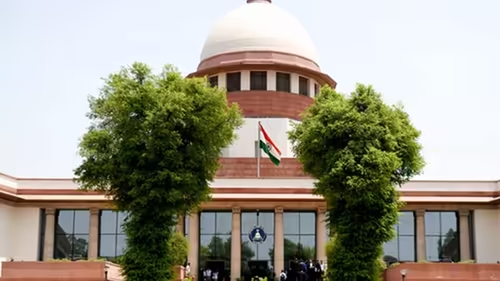
“A magistrate cannot be a judge in his own cause.”
With these seven words, the Supreme Court of India has delivered a sharp reminder that even those entrusted with delivering justice must themselves remain bound by its core principles. In a recent landmark ruling, the apex court quashed legal proceedings initiated by a Special Railway Magistrate who had taken on the railway administration over staffing issues—only to then preside over the very case he had triggered.
This decision isn’t just about one official’s overreach. It’s a resounding defense of one of the oldest and most sacred tenets of fair adjudication: **no one should be allowed to judge a matter in which they have a personal stake**. Let’s unpack what happened, why it matters, and what this means for judicial integrity across India.
Table of Contents
- The Railway Dispute That Sparked the Controversy
- What Does ‘Judge in His Own Cause’ Really Mean?
- Why the Supreme Court Stepped In
- Broader Implications for India’s Judiciary
- Historical Precedents Reinforcing Impartiality
- Conclusion: Justice Must Not Only Be Done—It Must Be Seen to Be Done
- Sources
The Railway Dispute That Sparked the Controversy
The case originated when a Special Railway Magistrate—appointed under the Railways Act to handle offenses related to railway operations—alleged that the railway administration was deliberately understaffing his court. He claimed this was a form of “interference” meant to obstruct justice.
In response, the magistrate didn’t just file a complaint. He initiated formal legal proceedings against the railway authorities… and then proceeded to hear and adjudicate those very proceedings himself.
Essentially, he became both the complainant and the judge—a clear conflict of interest that the railway administration challenged all the way to the Supreme Court.
What Does ‘Judge in His Own Cause’ Really Mean?
The phrase “judge in his own cause” traces back to the Latin maxim *nemo iudex in causa sua*—“no one should be a judge in their own case.” It’s a cornerstone of the **principle of natural justice**, which underpins fair legal systems worldwide.
In practical terms, this principle ensures two things:
- Impartiality: The decision-maker must have no personal, financial, or emotional interest in the outcome.
- Perceived Fairness: Even the appearance of bias can undermine public trust in the judicial process.
As the Supreme Court has repeatedly held, justice must not only be done—it must manifestly and undoubtedly be seen to be done .
Why the Supreme Court Stepped In
In its ruling, the Supreme Court didn’t mince words. The bench observed that the magistrate’s actions created an “unacceptable conflict of interest” and violated the foundational norms of judicial conduct.
Key points from the judgment include:
- The magistrate was not merely a neutral arbiter; he was the aggrieved party initiating the action.
- By presiding over his own complaint, he compromised the integrity of the judicial process.
- The proceedings were therefore “inherently flawed” and had to be quashed in their entirety.
The Court emphasized that magistrates, like all judicial officers, are not above the law—they are its guardians, and must embody its highest ethical standards .
Broader Implications for India’s Judiciary
This ruling sends a strong message across India’s vast judicial ecosystem—from district courts to specialized tribunals. It reinforces that:
- Role Clarity Matters: Judicial officers must distinguish between their administrative grievances and their adjudicative duties.
- Recusal Is Not Weakness: If a judge has any connection to a case, stepping aside is a sign of strength, not failure.
- Public Trust Is Fragile: One instance of perceived bias can erode confidence in the entire system.
For institutions like railway tribunals, consumer courts, or environmental benches—where officials often wear multiple hats—this judgment is a timely cautionary tale.
To understand more about judicial ethics in India, see our explainer on [INTERNAL_LINK:principles-of-natural-justice-in-india].
Historical Precedents Reinforcing Impartiality
The Supreme Court’s stance isn’t new. It builds on decades of jurisprudence:
- In A.K. Kraipak v. Union of India (1969), the Court held that even a remote possibility of bias is enough to invalidate a decision.
- In State of Punjab v. V.K. Khanna (2001), it ruled that a judge with a personal grudge against a party must recuse themselves.
- More recently, in Ram Pratap Singh v. State of UP (2023), the Court reiterated that “impartiality is non-negotiable.”
These cases collectively affirm that the “judge in his own cause” doctrine isn’t theoretical—it’s a living, breathing safeguard against arbitrariness.
Conclusion: Justice Must Not Only Be Done—It Must Be Seen to Be Done
The Supreme Court’s decision to quash the railway magistrate’s self-adjudicated case is more than a procedural correction. It’s a reaffirmation of democracy’s bedrock: that power, even judicial power, must be exercised with humility, transparency, and absolute neutrality. By shutting the door on magistrates acting as both prosecutor and judge, the Court has protected not just a legal principle—but the very soul of Indian justice.
Sources
- Times of India: Magistrate cannot be a judge in his own cause: Supreme Court
- Supreme Court of India Judgments Portal: Official Judgments Database
- Ministry of Law and Justice, India: Principles of Natural Justice
- The Hindu: When Judges Must Step Aside: A Legal Primer