Table of Contents
- The Supreme Court’s Controversial Ruling
- Who is I-PAC and Why Are They in the Spotlight?
- The Legal Battle: Privacy vs. Investigation
- Understanding the ED’s Sweeping Powers
- A Conflicting Precedent? The Santiago Martin Case
- What This Means for You and Digital Privacy
- Conclusion: A Delicate Balance
- Sources
The Supreme Court’s Controversial Ruling on ED Access Phone
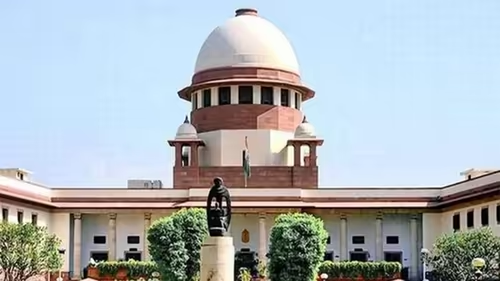
In a decision that has sent ripples through India’s political and legal landscape, the Supreme Court has firmly rejected a plea to protect the digital privacy of a key political consultant. The court has given the green light to the Enforcement Directorate (ED) to access information from the seized mobile phone of Jitendra Mehta, a functionary of the Indian Political Action Committee (I-PAC). This move comes despite strong arguments centered on the fundamental right to privacy, which was enshrined by the apex court itself in the landmark Puttaswamy judgment .
The court’s reasoning was stark and direct: it asserted its own capability to safeguard the interests of innocent citizens, implying that the judicial system would act as a check against any potential misuse of the accessed data. This ruling is not just about one phone; it’s a powerful statement about the hierarchy of rights when national investigations are at stake.
Who is I-PAC and Why Are They in the Spotlight?
To understand the gravity of this situation, we must first know who I-PAC is. The Indian Political Action Committee (I-PAC) is not your average political party. It’s India’s leading cross-party political consultancy, widely credited with revolutionizing election campaigning across the country [[9], [16]]. From Delhi to West Bengal, I-PAC has been the strategic brain behind some of the most significant electoral victories in recent years .
Their involvement in high-stakes politics naturally places them under intense scrutiny. The current case stems from an ED investigation where their offices were raided. Notably, the Calcutta High Court had previously dismissed a similar privacy plea from the Trinamool Congress (TMC), with the ED submitting that no data was initially seized during the raids [[5], [7]]. However, the focus has now shifted squarely to the data on Mehta’s personal device, a treasure trove of potentially sensitive communications and strategic information.
The Legal Battle: Privacy vs. National Investigation
At the heart of this conflict is a fundamental tension in modern jurisprudence: the individual’s right to privacy versus the state’s duty to investigate financial crimes and potential threats to national integrity. The right to privacy was declared a fundamental right under Articles 14, 19, and 21 of the Indian Constitution in the historic 2017 Puttaswamy case [[28], [34]]. This judgment was a watershed moment for civil liberties in India.
However, the Supreme Court has consistently held that this right is not absolute. It can be lawfully restricted for reasons of national security, public order, and the prevention of crime. The ED’s argument hinges on this very principle, claiming that accessing the phone is essential for a thorough investigation into alleged financial irregularities. The court’s latest decision signals a clear prioritization of the investigative process in this specific instance, trusting its own oversight mechanisms to prevent abuse.
Understanding the ED’s Sweeping Powers
The Enforcement Directorate operates under the stringent Prevention of Money Laundering Act (PMLA). Its powers are notably broad, especially when compared to regular police forces. Under Section 50 of the PMLA, the ED can conduct searches and seizures without even summoning the person for prior questioning . This gives them a significant advantage in securing evidence before it can be tampered with or destroyed.
This legal framework is what empowers the ED to seize electronic devices like mobile phones. The critical question then becomes: what can they do with the data once they have it? While general police procedure often requires a warrant to search the contents of a seized phone , the PMLA’s special provisions create a more complex and less restrictive environment for the ED, as evidenced by the Supreme Court’s recent stance.
A Conflicting Precedent? The Santiago Martin Case
Adding a layer of complexity to this issue is a seemingly contradictory ruling from just last year. In December 2024, the Supreme Court had actually restrained the ED from accessing and copying data from electronic devices seized from lottery king Santiago Martin and his relatives [[19], [23], [24]].
This raises a critical question: why the different treatment? Legal experts suggest the distinction may lie in the specifics of each case—the nature of the allegations, the stage of the investigation, and the perceived risk of evidence tampering. The Santiago Martin case might have presented a scenario where the court felt the ED’s request was overly broad or not sufficiently justified, whereas in the I-PAC case, the court appears to have found a more compelling need for immediate access. This inconsistency highlights the highly contextual and discretionary nature of these judicial decisions.
What This Means for You and Digital Privacy
While this case involves a high-profile political consultancy, its implications stretch far beyond. In our hyper-connected world, our mobile phones are extensions of our minds—containing our private messages, financial details, location history, and personal photos. This ruling underscores a sobering reality:
- Your digital privacy is not an impenetrable fortress. State agencies, particularly those with special powers like the ED, can gain access to your personal data under the guise of a legitimate investigation.
- Judicial oversight is the primary safeguard. The court’s assurance that it “knows how to protect innocent citizens” places immense trust in the judiciary to act as a fair and effective check on executive power. This is a system that relies heavily on the integrity and vigilance of the courts.
- Context is everything. As seen in the contrasting Santiago Martin case, there is no one-size-fits-all rule. The outcome of such privacy battles will depend heavily on the unique facts and legal arguments presented in each instance.
For anyone concerned about digital rights, this case is a stark reminder to stay informed about your legal protections and the evolving landscape of state surveillance. It also points to the importance of robust data protection laws, like the long-awaited Digital Personal Data Protection Act, to provide clearer guidelines for both citizens and investigating agencies.
Conclusion: A Delicate Balance
The Supreme Court’s decision to allow the ED access phone data from an I-PAC functionary is a pivotal moment in India’s ongoing negotiation between security and liberty. It reaffirms that while the right to privacy is fundamental, it can yield to the state’s compelling interest in conducting serious financial investigations. This ruling, however, exists in a delicate balance with other recent judgments, creating a nuanced and sometimes confusing legal terrain. Ultimately, the true test will be in how this power is exercised and whether the promised judicial safeguards prove effective in protecting the innocent from unwarranted intrusion. For now, the message is clear: in the eyes of the law, a mobile phone is not just a personal device, but a potential piece of evidence that can be unlocked in the name of justice.
Sources
- Times of India: Supreme Court rejects privacy plea, allows ED to access I-PAC man’s phone
- Live Law: Calcutta High Court disposes of Trinamool Congress’ plea in I-PAC case
- I-PAC Official Website: India’s Biggest Political Consultancy
- Supreme Court Observer: Right to Privacy: Puttaswamy v. Union of India
- The Hindu: SC restrains ED from accessing seized electronic devices in Santiago Martin case