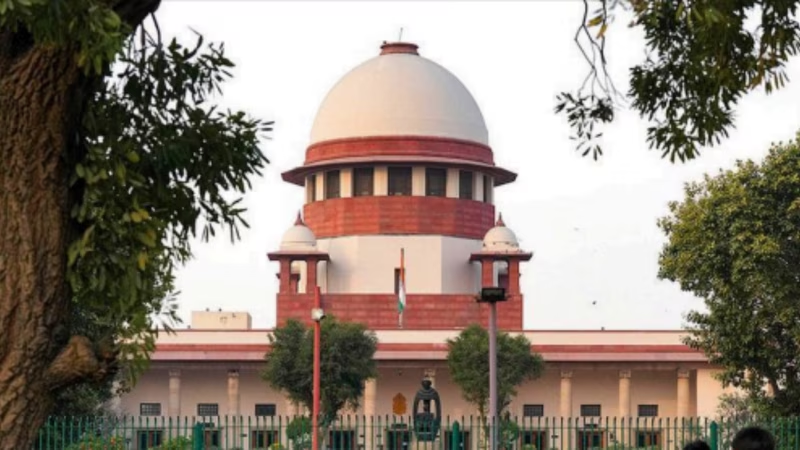
In a move that could redefine the balance of power in India’s democratic framework, the Supreme Court has decided to scrutinize a contentious provision that shields the Chief Election Commissioner (CEC) and Election Commissioners (ECs) from any legal action. This decision comes after a Public Interest Litigation (PIL) boldly accused the apex election body of becoming a ‘law unto itself’—a claim that has sent shockwaves through the political and legal corridors of the nation .
At the heart of this legal storm is a 2023 amendment that granted unprecedented, lifelong immunity to the CEC and ECs for actions performed in their official capacity. The plea before the court contends that this blanket protection is not only unconstitutional but also a direct threat to the very principles of accountability and transparency that underpin a healthy democracy .
Table of Contents
- The Plea That Shook the System
- What is CEC EC Immunity and Why Does it Matter?
- Constitutional Conundrum: Article 324 Under Siege
- Historical Context: How Did We Get Here?
- Potential Implications for Indian Democracy
- Conclusion: A Pivotal Moment for Accountability
- Sources
The Plea That Shook the System
The Supreme Court, led by a bench comprising Chief Justice of India Surya Kant and Justice Joymalya Bagchi, has issued notices to both the Central Government and the Election Commission of India (ECI), seeking their responses to the PIL . The petitioners argue that the legal shield provided to the CEC and ECs is “unprecedented” and “unbridled,” effectively placing them beyond the reach of the judiciary .
This isn’t just a legal technicality; it’s a fundamental challenge to the system of checks and balances. If an institution as powerful as the ECI, which oversees the world’s largest democracy, operates without any fear of legal recourse, what mechanisms exist to ensure its decisions are fair and impartial? The PIL forces us to confront this uncomfortable question head-on.
What is CEC EC Immunity and Why Does it Matter?
The CEC EC immunity in question stems from a 2023 amendment to the election law. This amendment states that the CEC and ECs cannot be prosecuted or sued for any action taken in their official capacity, even after they retire from office . The only way to remove them from their post is through a complex impeachment process in Parliament, similar to that of a Supreme Court judge .
On the surface, this might seem like a measure to protect the independence of the election body from political vendettas. However, critics argue that it creates a dangerous precedent. Absolute power, as history has repeatedly shown, can lead to absolute corruption—or at the very least, a perception of bias that can erode public trust.
Consider these key concerns raised by the immunity provision:
- Lack of Accountability: Without the possibility of legal action, there’s no direct mechanism for citizens or stakeholders to challenge potentially erroneous or biased decisions.
- Erosion of Public Trust: An institution perceived as unaccountable can quickly lose its moral authority, regardless of its actual conduct.
- <Constitutional Conflict: The provision may conflict with the basic structure of the Constitution, which relies on a separation of powers and judicial review.
Constitutional Conundrum: Article 324 Under Siege
The Election Commission derives its authority from Article 324 of the Indian Constitution, which empowers it to superintend, direct, and control elections . While this article establishes the ECI as a permanent and independent body, it was never intended to create an entity that is completely insulated from all forms of scrutiny .
The current legal challenge is essentially asking the Supreme Court to interpret whether the 2023 amendment, which grants this sweeping immunity, is in harmony with the spirit and letter of Article 324. The court’s decision will set a crucial precedent for how independent constitutional bodies are held accountable in the future.
Historical Context: How Did We Get Here?
The push for greater autonomy for the ECI is not new. For decades, there have been debates about insulating the commission from executive interference. However, the 2023 amendment appears to have swung the pendulum too far in the opposite direction. By granting lifelong immunity, the law has arguably created a scenario where the ECI is not just independent from the government, but also from the people it serves and the judiciary that upholds the rule of law .
This development has sparked intense debate among legal scholars and political analysts. Some see it as a necessary evil to protect the integrity of the electoral process, while others view it as a significant overreach that undermines democratic principles. The Supreme Court’s intervention is a critical step in resolving this tension.
Potential Implications for Indian Democracy
The outcome of this case will have far-reaching consequences:
| Possible Outcome | Implication for Indian Democracy |
|---|---|
| Supreme Court upholds the immunity | Strengthens ECI’s independence but risks creating an unaccountable ‘super-body’. |
| Supreme Court strikes down the immunity | Reinforces the principle of checks and balances, ensuring the ECI remains answerable to the law. |
| Supreme Court modifies the immunity | Creates a balanced framework where the ECI is protected from frivolous litigation but remains accountable for gross misconduct. |
Regardless of the verdict, this case is a stark reminder that the health of a democracy depends not just on strong institutions, but on institutions that are transparent and answerable to the citizens they serve. For more on the evolving role of India’s constitutional bodies, see our deep dive on [INTERNAL_LINK:indian-constitutional-bodies].
Conclusion: A Pivotal Moment for Accountability
The Supreme Court’s decision to examine the CEC EC immunity is more than just a legal proceeding; it’s a defining moment for Indian democracy. The core issue is simple yet profound: can any institution, no matter how vital its role, be placed entirely above the law? The PIL’s warning of the ECI becoming a ‘law unto itself’ is a clarion call for a return to the foundational principles of accountability and the rule of law. The nation will be watching closely as the highest court navigates this constitutional minefield.
Sources
- PTI. “SC to examine plea challenging legal immunity to CEC, ECs.” Times of India, 12 Jan. 2026.
- “Supreme Court to examine immunity for CEC & ECs after PIL flags ‘law unto itself’ risk.” Times of India.
- “SC issues notice on plea against law to provide immunity to CEC, ECs.” The Hindu.
- “Election Commission of India (Article 324).” Election Commission of India.
- “In 2023, the BJP quietly amended the law to grant complete immunity to Election Commissioners…” Legal Daily.