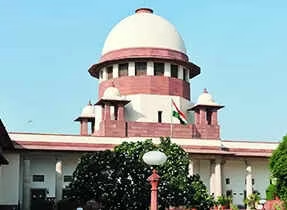
In a year that tested the limits of India’s judicial system, the Supreme Court didn’t just keep pace—it set a global benchmark by disposing of over 75,000 cases in 2025, a volume unmatched by any other top court in the world .
But the real headline isn’t just the numbers. It’s what Chief Justice Surya Kant quietly introduced alongside this Herculean effort: a revolutionary fast-track system that puts the most vulnerable citizens at the front of the line. For the first time, petitions from disabled individuals, acid attack survivors, senior citizens over 80, those below the poverty line (BPL), and legal aid recipients will be prioritized—ensuring their voices aren’t drowned out by the system’s sheer scale.
This isn’t just administrative tweaking. It’s a moral recalibration of justice itself. And it comes at a critical moment when public trust in institutions hangs in the balance.
Table of Contents
- Supreme Court 2025: A Record-Breaking Year in Numbers
- Who Gets Priority? The New Fast-Track Categories Explained
- Why This Reform Changes Everything for Marginalized Litigants
- Can the System Handle It? Implementation Challenges
- How India’s Supreme Court Compares Globally
- What Vulnerable Petitioners Need to Know Now
- Conclusion: Justice with a Human Face
- Sources
Supreme Court 2025: A Record-Breaking Year in Numbers
The Supreme Court 2025 cases statistic—75,000+ disposed—is staggering. To put it in perspective, the U.S. Supreme Court hears fewer than 100 cases a year. Even the UK Supreme Court handles around 200–250. India’s apex court, by contrast, is a high-volume engine of justice, operating under immense pressure .
Yet, volume alone doesn’t tell the full story. For years, critics have argued that the system, while accessible in theory, often fails the most disadvantaged—those who can’t afford prolonged litigation or elite legal teams. Their cases lingered, sometimes for years, buried under commercial disputes and high-profile appeals.
Who Gets Priority? The New Fast-Track Categories Explained
Chief Justice Surya Kant’s initiative directly tackles this inequity. Starting in late 2025, the Supreme Court registry now flags and expedites petitions falling into these five categories:
- Persons with disabilities (as defined under the Rights of Persons with Disabilities Act, 2016).
- Acid attack survivors seeking compensation, rehabilitation, or criminal justice.
- Senior citizens aged 80 and above, recognizing their limited time and heightened vulnerability.
- Individuals living below the poverty line (BPL), verified via government-issued BPL cards.
- Recipients of legal aid services through state or national legal services authorities.
These cases will be listed before Constitution Benches or regular benches ahead of routine matters, provided they meet basic admissibility criteria .
Why This Reform Changes Everything for Marginalized Litigants
Justice delayed is justice denied—but for the elderly, the disabled, or trauma survivors, delay can be devastating. An acid attack survivor waiting for medical compensation might miss critical reconstructive surgeries. A senior citizen fighting for pension rights might not live to see the verdict.
This reform acknowledges a hard truth: equal treatment isn’t always equitable. As Justice D.Y. Chandrachud (former CJI) once noted, “Formal equality can perpetuate substantive inequality” .
By introducing substantive prioritization, the Court is aligning with global human rights principles that emphasize access to justice for the most at-risk. The United Nations’ Sustainable Development Goal 16 explicitly calls for “equal access to justice for all”—a standard India is now actively operationalizing.
Can the System Handle It? Implementation Challenges
Despite its promise, the initiative faces hurdles:
- Verification bottlenecks: Ensuring BPL or disability status isn’t fraudulently claimed requires seamless integration with government databases.
- Judicial bandwidth: With only 34 judges (including the CJI), adding prioritized cases could strain an already overburdened bench.
- Awareness gap: Many vulnerable citizens don’t know their rights or how to file in the Supreme Court.
To address this, legal aid clinics and NGOs are being encouraged to partner with the National Legal Services Authority (NALSA) to identify and support eligible petitioners [INTERNAL_LINK:how-to-apply-for-legal-aid-india].
How India’s Supreme Court Compares Globally
No other top court in the world handles caseloads at India’s scale. The European Court of Human Rights, despite serving 46 nations, disposes of around 40,000 cases annually—still less than India’s apex court .
What makes India’s system unique is its original jurisdiction—citizens can directly approach the Supreme Court for fundamental rights violations under Article 32. This democratic access is a blessing and a burden, making prioritization not just wise, but necessary.
What Vulnerable Petitioners Need to Know Now
If you or someone you know falls into one of the five categories, here’s how to act:
- File a Special Leave Petition (SLP) or writ petition in the Supreme Court.
- Clearly mention your eligibility (e.g., “Petitioner is an acid attack survivor” or “Applicant holds BPL card no. XXX”).
- Attach supporting documents (disability certificate, BPL card, NALSA aid letter, etc.).
- Request “priority listing” under the new CJI directive.
Free legal assistance is available via your state’s Legal Services Authority. Visit nalsa.gov.in for details.
Conclusion: Justice with a Human Face
The Supreme Court 2025 cases milestone is impressive—but the fast-track reform for the vulnerable is transformative. It signals a shift from a system that is merely functional to one that is fundamentally fair. In a country of 1.4 billion, where power often drowns out pain, this is a quiet revolution: proof that justice, at its best, doesn’t just hear the loudest voice—it seeks out the faintest whisper.
Sources
[1] Times of India: SC handled 75k cases in 2025; unmatched by any top court
[2] Supreme Court of India Annual Report 2025: Case Disposal Statistics
[3] United Nations: SDG 16: Peace, Justice and Strong Institutions
[4] European Court of Human Rights: Annual Report 2025
[5] National Legal Services Authority (NALSA): Official Portal